How Forensic Facial Reconstruction Works—Skull to Face
Forensic facial reconstruction turns bare skulls into lifelike faces using tissue-depth data, anatomy, and increasingly AI. From Richard III to Pompeii victims, the technique bridges science and art to identify the unknown and bring history to life.
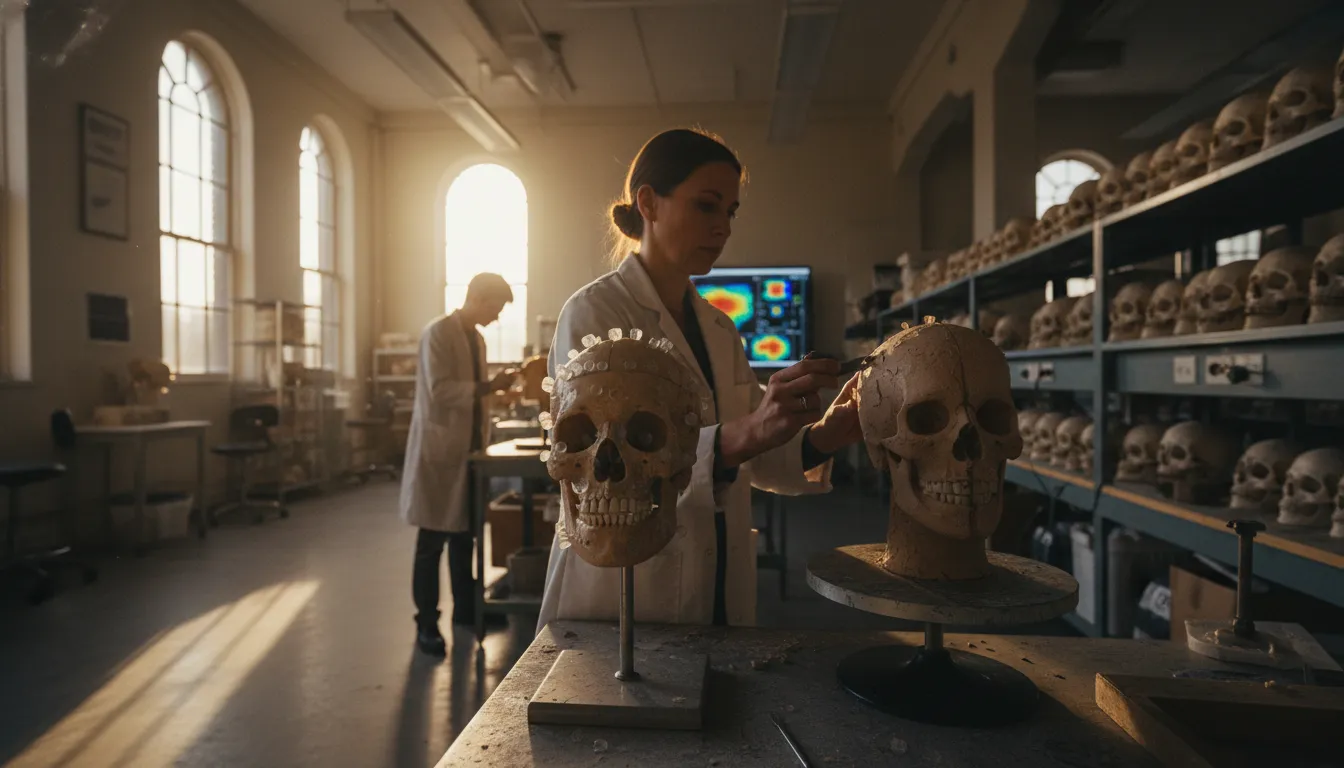
From Bone to Portrait
A skull holds more secrets than most people realize. Beneath every brow ridge, cheekbone, and jaw angle lies a blueprint of the face that once covered it. Forensic facial reconstruction is the discipline that reads that blueprint—translating skeletal remains into a recognizable human likeness through a blend of anatomy, anthropology, and artistry.
The technique serves two worlds. In criminal forensics, it helps police identify unknown victims when fingerprints, dental records, and DNA databases come up empty. In archaeology, it puts faces on history—from Egyptian pharaohs to medieval kings buried under parking lots.
The Science Behind the Face
Every reconstruction starts with a forensic anthropologist examining the skull. Key features—the width of the nasal opening, the size and shape of the cheekbones, the prominence of the teeth, the points where muscles once attached—reveal the subject's likely sex, age, and ancestry. These biological clues form the scaffold on which the face is built.
The critical ingredient is tissue-depth data: average measurements of soft-tissue thickness at specific landmarks on the face. Since the German physiologist Welcker first documented these depths by inserting blades into cadaver faces in the 1880s, researchers have compiled more than 220,000 measurements from over 19,500 adults across 140 studies, according to a 2023 review in the International Journal of Legal Medicine. Small pegs representing these average depths are placed at 18 to 32 landmarks on the skull, giving the sculptor—or the software—precise constraints for how thick the face should be at each point.
Three Classical Methods
The field recognizes three main approaches, each developed in a different tradition:
- American method (Krogman, 1946) — relies primarily on tissue-depth markers, building the face outward from measured points.
- Russian method (Gerasimov, 1971) — focuses on reconstructing individual facial muscles directly on the skull before adding skin.
- Manchester method (Neave, 1977) — combines both, layering muscles and tissue-depth data together. It is the most widely adopted technique today.
Traditional reconstructions use clay, wax, or plastic applied to a cast of the skull. The process can take weeks of painstaking sculpting.
How AI Is Changing the Game
Computerized 3D methods have accelerated the workflow dramatically. CT scans of the skull are loaded into rendering software that maps tissue depths digitally, producing a virtual face in hours rather than weeks. More recently, deep learning and generative AI have pushed the field further. Convolutional neural networks trained on hundreds of head CT scans can now predict soft-tissue contours from bone structure with high accuracy, particularly around the jaw and muscle attachment sites where anatomy is most tightly linked to the skeleton.
Generative models can even produce photorealistic portraits directly from skeletal data, conditioning results on metadata such as sex, estimated age, and body mass. Researchers caution, however, that soft-tissue features like lip shape, ear form, hairstyle, and body fat vary enormously among individuals and cannot be reliably predicted from bone alone. These remain educated guesses informed by archaeological context.
Famous Faces Brought Back
Some of the technique's most celebrated results include:
- Johann Sebastian Bach (1895) — the very first forensic facial reconstruction, created by German anatomist Wilhelm His.
- King Tutankhamun (2005) — two independent teams, one French and one American, built busts from CT data under the direction of Zahi Hawass, producing strikingly similar results.
- Richard III (2013) — after the king's skeleton was unearthed beneath a Leicester car park, forensic artists created a face that revealed a surprisingly gentle expression, challenging centuries of villainous portraiture.
How Accurate Is It?
No reconstruction is a photograph. Hair color, skin tone, scars, and fat distribution leave no trace on bone. Yet studies suggest the results can be remarkably close. In one controlled experiment, researchers approximated the faces of living individuals from skull dimensions alone, then asked 52 volunteers to match each approximation to the correct photograph from a lineup of five. Most volunteers identified the right person, according to Live Science.
The field sits at the intersection of science and art—rigorous in its anatomical foundations, yet necessarily interpretive in its final details. As AI models train on ever-larger datasets and imaging technology improves, the gap between skull and face continues to narrow, giving names back to the nameless and faces back to history.