Which Animals Use Tools—and What It Reveals
Tool use was once considered uniquely human. Scientists now document it across mammals, birds, fish, and even invertebrates—reshaping our understanding of animal cognition.
Beyond Human Hands
For most of the twentieth century, tool use served as a bright line separating humans from the rest of the animal kingdom. That boundary began to crumble in 1960 when Jane Goodall watched a chimpanzee strip leaves from a twig and slide it into a termite mound—a deliberate act of manufacture that forced science to rethink what it means to be clever. Since then, researchers have logged tool use in at least nine animal classes spanning four phyla, from sea urchins to elephants, yet the behavior remains documented in fewer than one percent of known animal genera.
What Counts as a Tool?
Defining tool use is harder than it sounds. The most widely cited framework, introduced by researcher Benjamin Beck, requires three conditions: the object must not be part of the animal's own body, must not be attached to the environment, and must be manipulated to achieve a beneficial outcome. More recent proposals expand the definition to include behaviors that mediate the flow of information between the user and its surroundings—a shift that has brought at least 18 competing definitions into the literature.
This debate matters because where scientists draw the line determines which species qualify. A hermit crab slipping into an empty shell might look like tool use, but most researchers exclude it because the crab does not actively manipulate the shell to alter something else.
The Star Performers
Primates
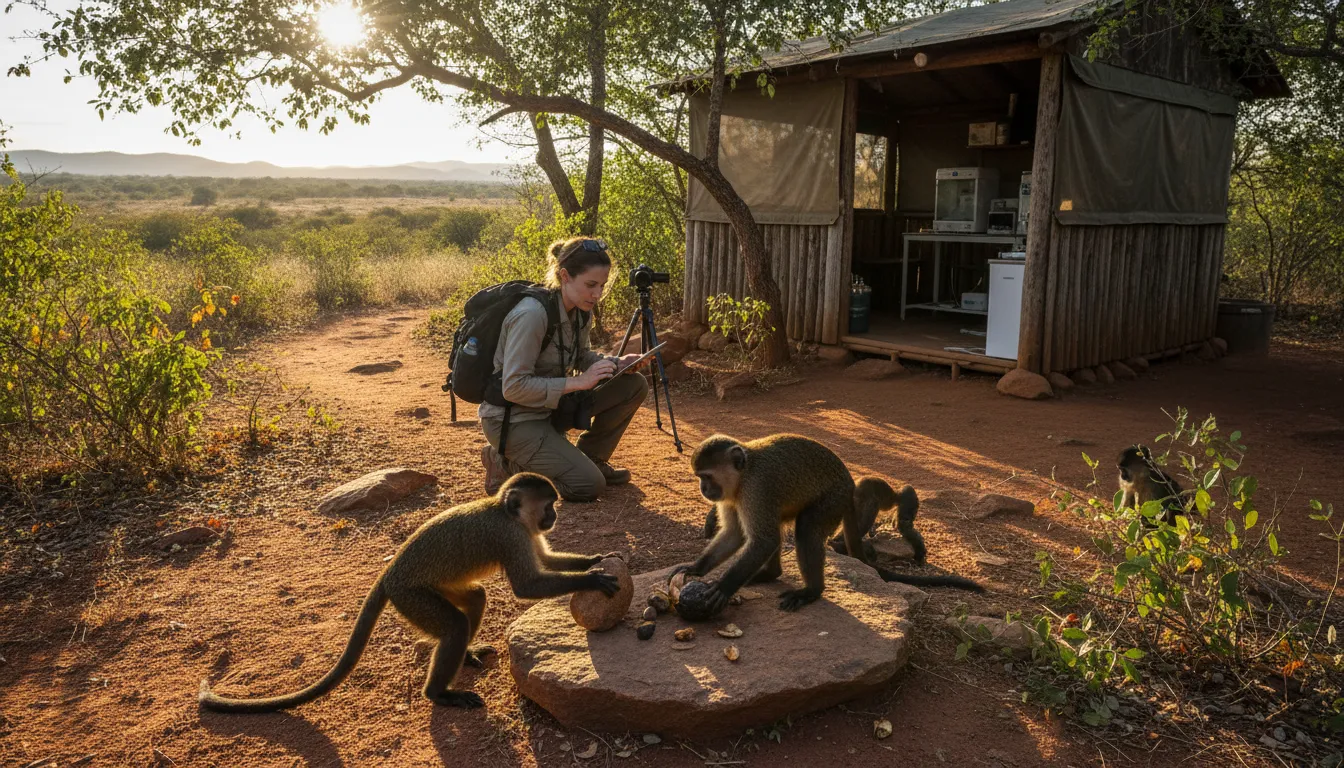
Chimpanzees remain the gold standard. Wild populations use stone hammers to crack nuts, leaf sponges to soak up water, and sharpened sticks to hunt bush babies. Capuchin monkeys in Brazil select rocks of the right weight and durability to smash open hard fruit—displaying a form of quality assessment before they even begin.
Birds
New Caledonian crows are among the only non-human animals that manufacture tools, trimming pandanus leaves into hooked probes to extract insect larvae from bark. Laboratory experiments show they can plan ahead, choosing the correct tool for a task they have not yet encountered. Woodpecker finches on the Galápagos use cactus spines in a similar fashion, probing crevices that their beaks alone cannot reach.
Marine Mammals
Bottlenose dolphins in Shark Bay, Australia, tear marine sponges from the seafloor and wear them over their snouts while foraging—a technique called "sponging" that protects their sensitive rostrums from sharp rocks and stinging organisms. Mothers pass the behavior to daughters, making it one of the clearest examples of cultural transmission of tool use outside primates. Sea otters, meanwhile, float on their backs and smash shellfish against flat stones balanced on their chests.
Invertebrates and Fish
Veined octopuses in Indonesia collect discarded coconut shells, carry them across the seafloor, and reassemble them into portable shelters—behavior that qualifies as tool use because the animal transports the object for future benefit. Certain wrasse species smash sea urchins against rocks to break them open, and some archer fish have been observed using water jets in ways that researchers debate as borderline tool use.
A Cow Named Veronika
The latest surprise comes from an Austrian farm. A study published in Current Biology documented a Swiss Brown cow named Veronika picking up a deck brush with her mouth and using it to scratch herself. Across randomized trials she preferred the bristled end for most body parts but switched to the stick end for softer lower-body areas—evidence of flexible, multi-purpose tool use previously reported only in great apes.
Because cows lack hands, Veronika must grip and reposition the brush entirely with her mouth, yet she adjusts her movements with apparent foresight. The finding suggests that livestock cognition has been drastically underestimated.
Why It Matters
Tool use rivals language as a window into the nature of cognition. Each new species added to the list weakens the old assumption that complex problem-solving requires a large brain or dexterous hands. Instead, the evidence points to convergent evolution: unrelated lineages arriving at similar solutions under similar ecological pressures—scarce food, hard-shelled prey, parasites that need scratching.
Understanding which animals use tools, and how, also carries practical implications. Conservation programs can better protect species whose survival depends on learned, culturally transmitted skills. And for researchers studying the origins of human technology, every new toolmaker in the animal kingdom offers another data point in the long story of intelligence itself.