Why Gangs Now Control 90% of Haiti's Capital
For decades, Haitian politicians armed street gangs to consolidate power. When the state collapsed, those gangs turned on their patrons — and now effectively run the country, controlling an estimated 90 percent of Port-au-Prince.
A Country Held Hostage
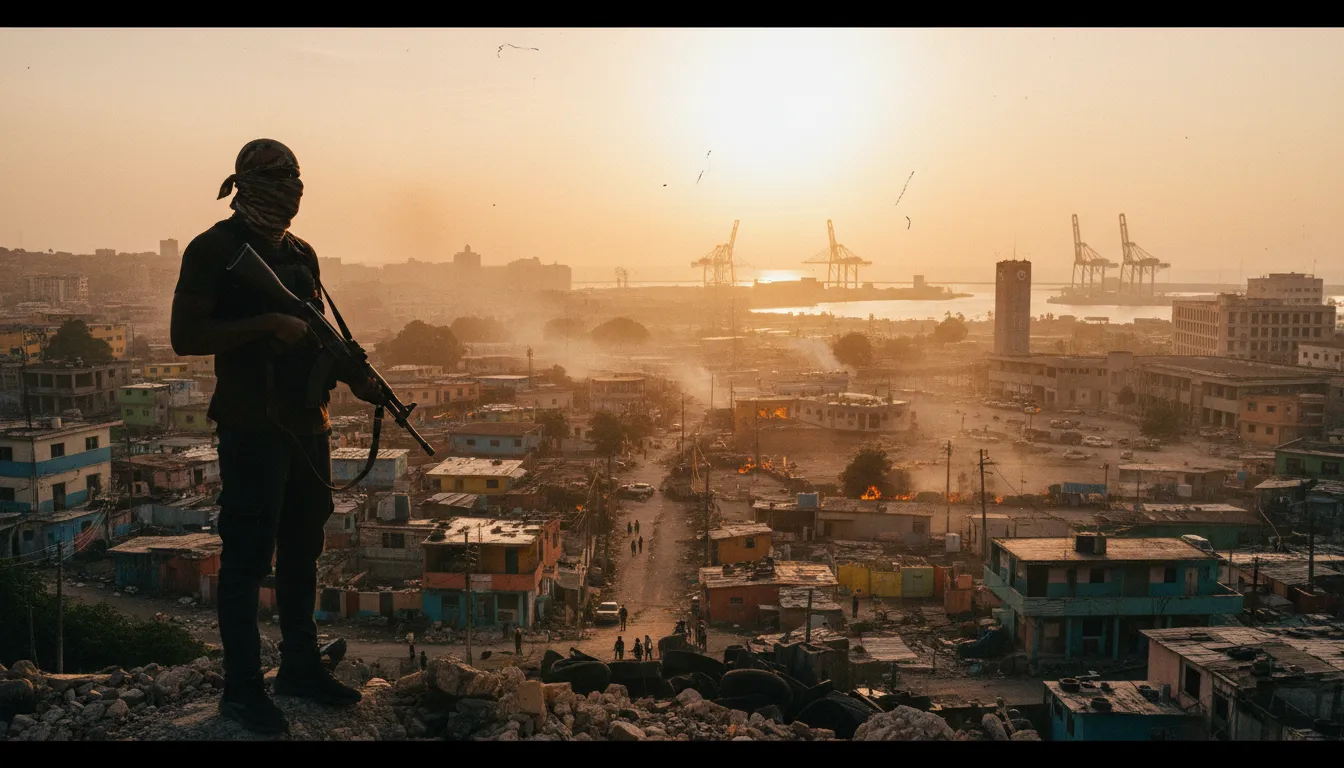
Haiti is one of the most extreme examples of state failure in the Western Hemisphere. Armed gangs now control an estimated 90 percent of Port-au-Prince, a capital of nearly three million people, according to United Nations estimates. Hundreds of thousands of residents have been displaced. Hospitals have shuttered, schools have emptied, and supply routes in and out of the city are routinely blockaded by armed checkpoints. Understanding how this happened requires tracing several decades of political dysfunction — and the deliberate choice by Haitian leaders to arm the men who now terrorize their own country.
How Politicians Built the Gangs
Armed groups are not a new phenomenon in Haiti. For much of the 20th century, political leaders used street enforcers — known as chimères — to intimidate opponents, suppress protests, and consolidate power in Port-au-Prince's poorest neighborhoods. Politicians provided cash, weapons, and legal cover; the gangs provided votes, intimidation, and muscle. According to PBS NewsHour, this symbiotic relationship stretched across multiple administrations and political factions.
The arrangement eventually backfired. Flush with weapons — many trafficked illegally from the United States — and emboldened by years of impunity, the gangs outgrew their patrons. They carved out independent fiefdoms across the capital, fighting rival groups for control of neighborhoods, commercial ports, and drug trafficking corridors.
The 2010 Earthquake and Deepening Collapse
The catastrophic earthquake of January 2010, which killed an estimated 220,000 people and displaced 1.5 million more, accelerated Haiti's institutional collapse. Courts, prisons, police stations — already fragile — were physically destroyed overnight. A subsequent cholera outbreak killed roughly 10,000 more. The resulting vacuum left vast areas of the country without functioning governance for years, creating ideal conditions for armed groups to entrench themselves further.
The Turning Point: 2021
The assassination of President Jovenel Moïse in July 2021 was the decisive rupture. With no elected president, a parliament that had ceased to function since 2020, and a judiciary in disarray, Haiti had no legitimate authority capable of commanding its security forces. Armed gangs stepped directly into the vacuum.
The most prominent figure to emerge was Jimmy Chérizier, a former Haitian National Police officer who goes by the alias "Barbecue." Dismissed from the force in 2018 following his alleged involvement in the La Saline massacre — in which at least 71 people were killed and over 400 homes burned — Chérizier formed the G9 Family and Allies federation in 2020, uniting nine gangs under a single command. In 2023, G9 merged with its former rival coalition to create Viv Ansamn ("Living Together"), the most powerful gang alliance in Haitian history, according to Al Jazeera.
A Humanitarian Catastrophe in Numbers
The scale of the crisis is staggering. In a single year, more than 5,900 people were killed in gang-related violence, with over 1.4 million Haitians — roughly 11 percent of the entire population — displaced from their homes, according to UN News. The United Nations estimates that half of all gang members in Haiti are now children, with recruitment of minors rising 700 percent in early 2025 compared to the same period a year earlier. More than half the population faces crisis-level food insecurity.
Why International Efforts Have Failed
International attempts to restore order have yielded limited results. A Kenya-led Multinational Security Support (MSS) mission, authorized by the UN Security Council in 2023 and deployed in mid-2024, arrived with roughly 1,000 personnel — far too few to stabilize a capital where gangs command entire districts. Experts at the United States Institute of Peace described the mission as chronically underfunded, understaffed, and unable to quell gang violence.
In late 2025, the UN replaced the MSS with a new Gang Suppression Force (GSF), eventually intended to reach 5,500 officers. For now, it operates with the same 1,000-person contingent. Critics note that no external force can substitute for Haiti's own state institutions — institutions that, for now, barely exist. As the International Crisis Group has argued, dismantling the gang alliances requires breaking the political and financial networks that created and sustained them in the first place.
A Fragile Road Ahead
Despite the ongoing crisis, Haiti is preparing for its first general elections in a decade, with a record 280 political parties registering to compete. Whether the vote can be held safely — and whether it can produce a government with enough legitimacy to begin rebuilding the state — remains deeply uncertain. What is clear is that lasting recovery will require far more than a ballot: it demands dismantling the decades-old arrangement by which Haitian elites armed their own worst enemies and called it governance.