AI Fears and Inflation Drive Wall Street's Worst Month
US stocks closed out February 2026 with their steepest monthly losses in nearly a year, battered by AI disruption anxiety, hotter-than-expected inflation data, and renewed tariff turbulence.
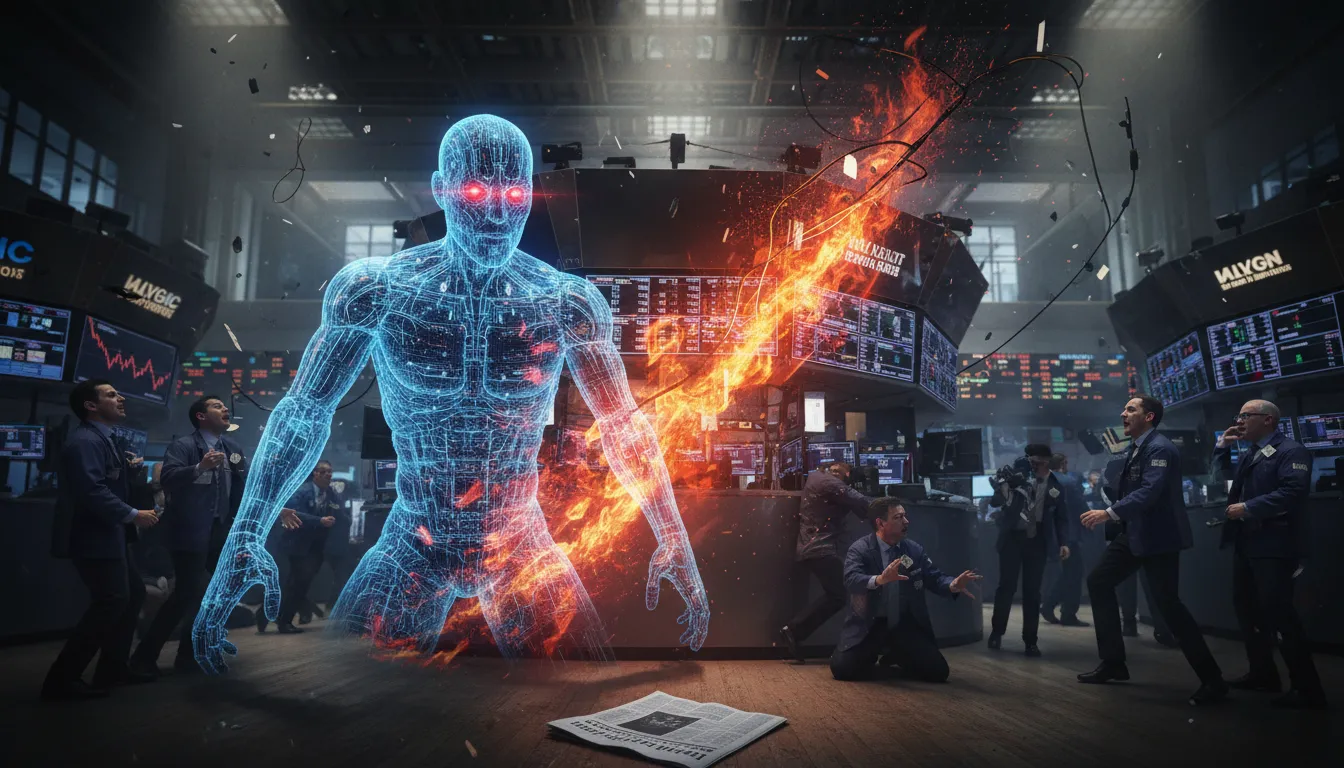
A Brutal Month on Wall Street
February 2026 proved punishing for American investors. The Nasdaq Composite posted its worst monthly decline since March 2025, falling more than 3%, while the S&P 500 slid roughly 1.6% for the month. The technology-heavy iShares Expanded Tech-Software ETF lost nearly 10% in February alone, pushing its year-to-date losses to almost 23%. What began as a correction quickly deepened into something more structural, as three converging forces rattled confidence simultaneously: fears over artificial intelligence disruption, a shock inflation reading, and the return of tariff uncertainty.
AI Anxiety Goes Mainstream
For more than a year, the AI narrative lifted markets. In February, it started doing the opposite. Investors began aggressively selling shares in companies most exposed to AI-driven disruption — insurance firms, software vendors, and financial services providers whose core functions increasingly look automatable. Nvidia slid 4.2% on the final trading session of the month, extending a 5.5% drop from the day before, despite posting solid earnings — a sign that even AI's biggest beneficiaries are not immune to broader sentiment shifts.
The flashpoint came when Jack Dorsey's fintech company Block announced it was laying off approximately 4,000 employees — nearly 40% of its total workforce — explicitly attributing the cuts to artificial intelligence. In a candid post, Dorsey said something shifted in December 2025 when AI models made an "order of magnitude" leap in capability, making deep structural cuts not just possible but necessary. He predicted that "the majority of companies will reach the same conclusion" within a year. Investors applauded the efficiency play, sending Block's stock up 24% after hours — but the broader market read the news as a warning shot about white-collar job losses at scale.
Block was not alone. Amazon and eBay also announced layoffs in the same week, deepening concerns that AI-driven workforce restructuring is accelerating faster than Wall Street's models had anticipated.
The Inflation Shock
Compounding the AI anxiety was a jarring inflation report. The Producer Price Index for January climbed 0.5% month-on-month — well above the 0.3% consensus forecast — while core PPI, which strips out food and energy, surged 0.8%, more than double expectations. The Dow Jones Industrial Average shed over 500 points on the news. Bond markets moved swiftly, repricing expectations for Federal Reserve policy and effectively burying hopes for any rate cut in the first half of 2026. Some analysts now warn the Fed may need to consider further hikes if services-sector inflation remains sticky.
Tariffs Add to the Pressure
A third layer of uncertainty came from trade policy. After the Supreme Court struck down tariffs imposed under emergency powers law, President Trump announced a new flat 15% tariff on imports, reigniting fears of supply-chain disruption and higher consumer prices. Reuters noted that the combination of AI worries, renewed tariff angst, and geopolitical strife — particularly the escalating Middle East conflict — created one of the most difficult multi-front environments for equity investors in recent years.
What Comes Next
As February closed, market strategists urged caution rather than panic. The S&P 500 remains elevated by historical standards, and corporate earnings outside the tech sector have largely held up. But the mood has shifted. The era of AI-as-pure-tailwind appears to be giving way to a more complex reckoning — one where the same technology disrupting incumbents also pressures the broader market's loftier valuations. With inflation stubbornly high and rate cuts off the table, investors face a spring defined less by optimism than by risk management.