How a Cosmic Crash Built Titan and Saturn's Rings
New research from the SETI Institute proposes that Saturn's largest moon, Titan, was forged in a violent collision between two ancient moons hundreds of millions of years ago — and that the same event created Saturn's iconic rings.
A Moon Born from Catastrophe
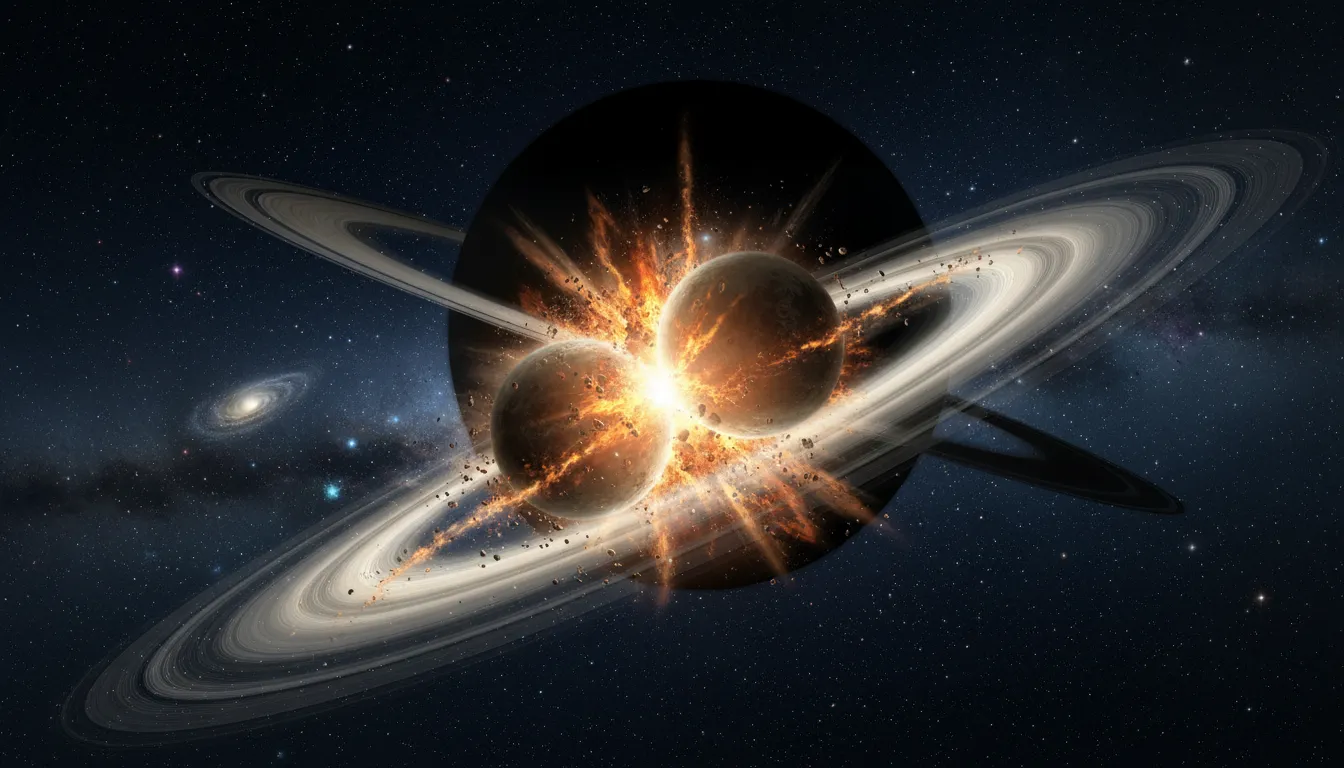
Saturn's largest moon, Titan, may owe its very existence to one of the solar system's most violent ancient accidents. A new study led by SETI Institute scientist Matija Ćuk, accepted for publication in the Planetary Science Journal, proposes that Titan formed when two earlier moons slammed together hundreds of millions of years ago — and that the aftershocks of that collision ultimately created Saturn's spectacular rings.
Two Moons Become One
Using sophisticated computer simulations, Ćuk's team modeled the orbital dynamics of Saturn's ancient moon system and found that an extra moon — referred to as Proto-Titan — existed alongside a smaller companion dubbed Proto-Hyperion. As gravitational forces slowly destabilized their orbits, the two bodies were drawn into an inevitable, catastrophic merger.
The collision, the researchers argue, explains several long-standing puzzles about Titan. Most striking is Titan's remarkably smooth surface: the moon has far fewer impact craters than expected for a body its age. A moon-forming merger would have catastrophically resurfaced Titan, erasing billions of years of crater history in geological terms nearly instantly.
The Hyperion Clue
A key breakthrough came from examining Hyperion, Saturn's small, chaotically tumbling moon. Ćuk explained that Hyperion "provided us the most important clue about the history of the system." The moon shares a gravitational resonance with Titan — but that resonance appears to be only a few hundred million years old, far younger than Saturn itself.
The team's simulations show that debris ejected during the Proto-Titan/Proto-Hyperion merger would have naturally coalesced into a new body at precisely Hyperion's current orbital position, explaining both its origin and its unusually young gravitational relationship with Titan. The timing fits the collision hypothesis almost perfectly.
From Moon Crash to Iconic Rings
The story does not end with Titan. According to the research, the massive merger triggered a cascade of further destruction throughout Saturn's inner moon system. Titan's reshaped orbit destabilized several medium-sized inner moons through resonance effects, setting off secondary collisions. Most of the resulting debris eventually reassembled into new moons, but smaller icy fragments were left scattered in orbit — eventually spreading out to form Saturn's rings, roughly 100 million years ago.
This timeline aligns with data from NASA's Cassini spacecraft, which revealed that Saturn's rings are surprisingly young by cosmic standards — far too pristine and thin to have survived for billions of years. Cassini also measured subtle anomalies in Saturn's mass distribution and gravitational wobble that pointed toward a now-vanished moon, lending additional weight to the collision hypothesis.
Testing the Theory in 2034
The hypothesis remains to be confirmed, but scientists will not have to wait forever. NASA's Dragonfly mission — a nuclear-powered rotorcraft lander scheduled to arrive at Titan in 2034 — will analyze the moon's surface geology and chemistry in unprecedented detail. If Dragonfly finds signs of massive ancient resurfacing or chemical signatures consistent with a violent merger, it would provide compelling evidence that Titan truly is the child of catastrophe.
The study also resolves a secondary mystery: the peculiar orbital tilt of Saturn's distant moon Iapetus, which can be explained by gravitational disturbances caused by Titan's post-merger orbit shift.
Rewriting Planetary History
If confirmed, the research fundamentally reshapes our understanding of how planetary systems evolve. It suggests that even in our own solar system, dramatic and violent moon-moon collisions occurred far more recently than previously assumed — and that the serene rings we see today around Saturn are, in geological terms, a surprisingly fresh scar from an ancient cosmic catastrophe.