Three Hottest Years in History Stump Climate Scientists
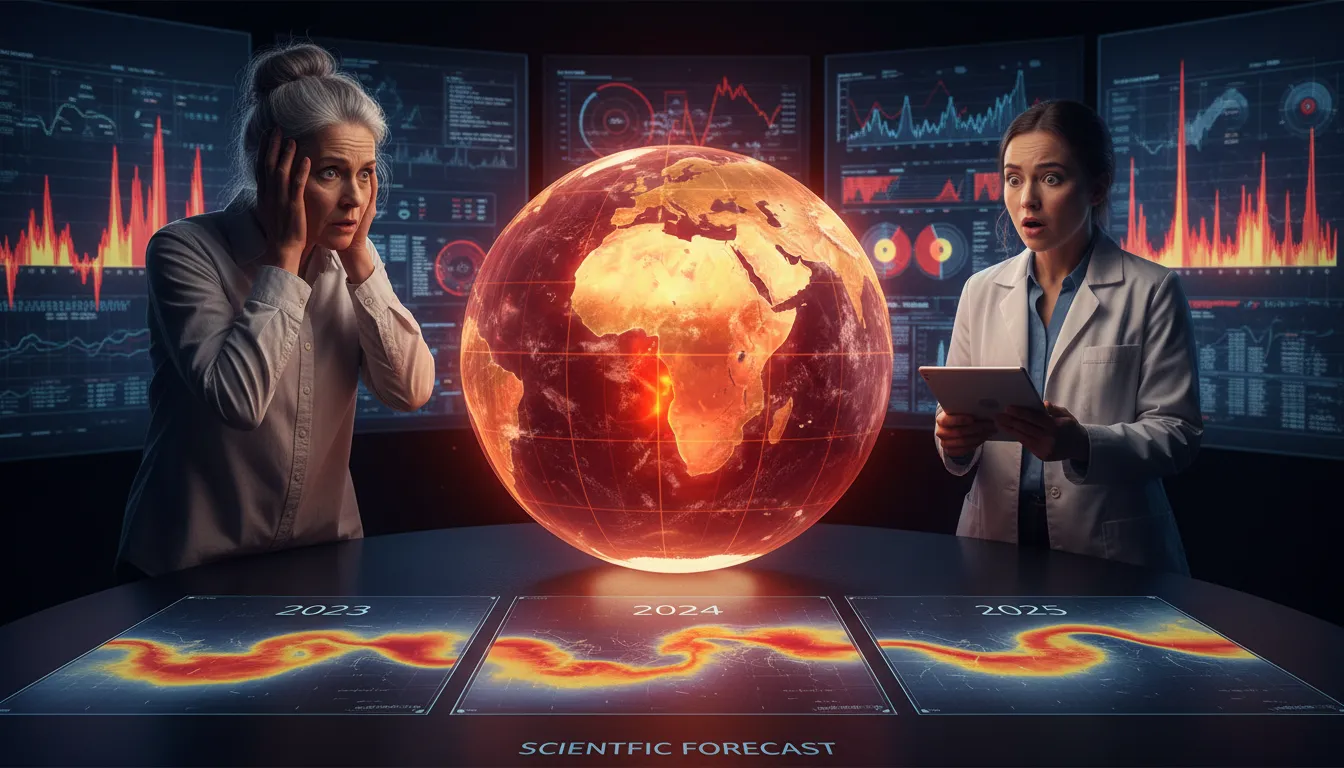
The years 2023, 2024 and 2025 were the three hottest on record — and they exceeded scientific forecasts by a margin that has left leading climate researchers both alarmed and baffled.
A Warming Spike Unlike Any Before
The past three years have shattered temperature records — and, in the process, shattered the expectations of some of the world's most experienced climate scientists. The years 2023, 2024 and 2025 were the three hottest on record since measurements began in 1850, but what alarms researchers is not just the records themselves; it is how dramatically they exceeded every forecast.
Gavin Schmidt, director of NASA's Goddard Institute for Space Studies, called the heat of 2023 "humbling" and "confounding." His statistical model, which had reliably predicted temperatures since 2016, significantly underestimated what actually occurred. In September 2023 alone, global temperatures broke records by an "absolutely astonishing" 0.5°C — unprecedented in NASA's entire measurement history.
The Numbers Behind the Alarm
According to Berkeley Earth's 2025 Global Temperature Report, last year ranked as the third warmest on record, with a global mean temperature of 1.44°C above pre-industrial levels. That followed 2024, which became the first year in history to clearly exceed the 1.5°C threshold set by the Paris Agreement. Land temperatures in 2025 hit 2.03°C above baseline — the second highest ever measured.
The human scale of this heat is staggering. Approximately 770 million people — roughly one in every 12 people on Earth — experienced locally record annual temperatures in 2025. Around 450 million of them lived in China alone.
The rate of warming is also accelerating. Global surface temperatures are now rising at roughly 0.27°C per decade, nearly 50% faster than the rate recorded during the 1990s and 2000s. Robert Rohde, Berkeley Earth's chief scientist, stated plainly: "The last three years are indicative of an acceleration in the warming. They're not consistent with the linear trend that we've been observing for the 50 years before that."
The Unexplained Gap
A landmark report from more than 60 international scientists identified several factors amplifying warming beyond greenhouse gas emissions: reduced reflective aerosols from cleaner shipping fuels, peak solar activity, and the atmospheric moisture injected by the 2022 Hunga Tonga volcanic eruption. A separate analysis by Future Earth and the World Climate Research Program flagged an accelerating planetary energy imbalance and the weakening capacity of land ecosystems to absorb carbon — both potential amplifiers of the warming signal.
Even combining all identified factors, scientists account for only a fraction of the anomalous heat. Schmidt estimates a residual gap of roughly 0.2°C that remains unexplained. "I wish I knew why, but I don't," he told NASA's Earth Observatory. "We're still in the process of assessing what happened and if we are seeing a shift in how the climate system operates."
What Comes Next
Breaching the 1.5°C threshold — now considered likely by many models before 2030 — does not mean irreversible catastrophe, scientists stress. The harder 2°C ceiling remains achievable if global emissions fall sharply within the coming decade. But ocean trends offer a bleaker picture: sea levels are now rising at 4.5 mm per year, more than double the 20th-century average of 1.85 mm per year, driven by accelerating ice melt and thermal expansion of warming seas.
Berkeley Earth projects 2026 will likely rank as the fourth warmest year on record — a modest cooling from the three-year spike. Scientists are watching closely to determine whether Earth's temperature trajectory settles back toward its former trend, or whether the climate system has, as some fear, shifted to a new and more volatile baseline from which there is no easy return.