Antarctic Hektoria Glacier Retreats 8 km in Two Months
Antarctica's Hektoria Glacier lost eight kilometres of ice in just 60 days — the fastest glacier retreat ever recorded in modern history — forcing scientists to fundamentally rethink their models of ice loss and sea level rise.
A Collapse That Shocked the Science Community
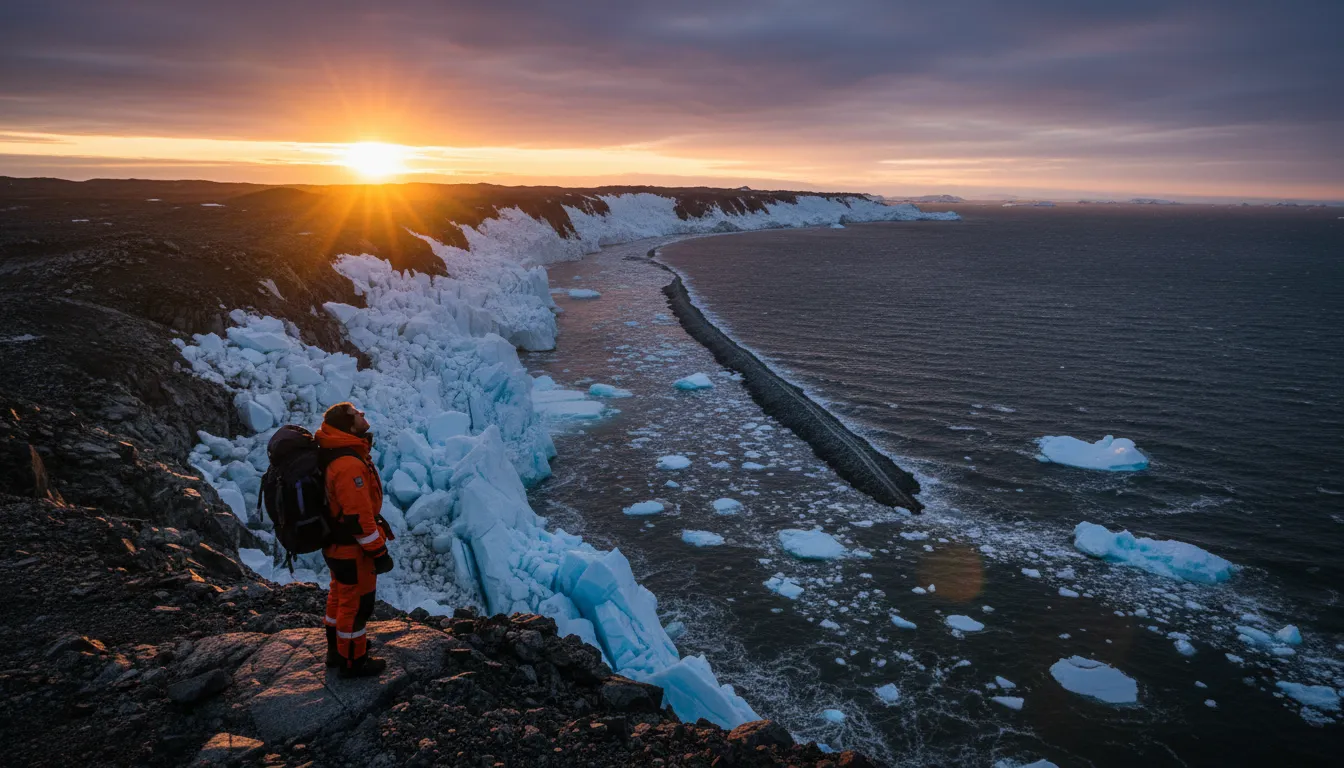
In the span of two months in late 2022, Antarctica's Hektoria Glacier shed 8.2 kilometres of its length — nearly half its mass — in what researchers have confirmed as the fastest glacier retreat ever documented in modern history. The rate was roughly ten times greater than any previously recorded value, and it left glaciologists scrambling to explain what they had witnessed.
The findings, published in Nature Geoscience and led by researchers at the University of Colorado Boulder, do not merely describe an extraordinary event — they expose a fundamental gap in how scientists model the behaviour of Antarctic ice.
The Mechanism: A Flat Floor and a Fatal Float
The key to Hektoria's dramatic collapse lies beneath it. The glacier rests on an ice plain — a broad, exceptionally flat stretch of bedrock sitting below sea level. As the glacier thinned over recent years, this geometry proved catastrophic.
Once the ice became thin enough, large sections began to lift off the bedrock and float. Ocean water pushed up through crevasses from below, while surface crevasses opened from above. The two sets of fractures met, and enormous slabs broke free. As each iceberg calved away, the glacier face behind it was immediately exposed to the same forces — triggering a cascade of successive collapses.
"The ice plain caused a large part of the glacier to go afloat suddenly," the CU Boulder team explained. Seismic instruments recorded glacier earthquakes during the retreat — small tremors confirming that grounded ice was being lost, meaning every tonne that broke away contributed directly to global sea level rise.
The Broader Warning: Other Glaciers Are at Risk
What makes this discovery alarming is that ice plains have been detected beneath numerous other Antarctic glaciers. Scientists now worry that Hektoria may be a preview of what could happen elsewhere — including at Thwaites Glacier, the so-called "Doomsday Glacier," whose total collapse is estimated to raise global sea levels by more than three metres.
"If a much larger glacier were to retreat this quickly, the consequences for global sea level rise could be severe," the researchers warned, according to CNN. Current climate projections were built on retreat rates that Hektoria rendered obsolete overnight.
A Second Blow to Existing Models: Iron in the Southern Ocean
Simultaneously, a separate line of research has upended another long-held assumption about Antarctica's role in the global climate system. For decades, scientists believed that melting glaciers were the primary source of iron — a critical nutrient limiting phytoplankton growth — in the waters around Antarctica.
New research published via the Royal Netherlands Institute for Sea Research (NIOZ) and Phys.org found the opposite: glacial meltwater accounts for only about 10% of dissolved iron in ice shelf cavities, while deep ocean upwelling contributes 62% and continental shelf sediments provide 28%.
This matters because iron drives phytoplankton blooms that absorb vast quantities of atmospheric CO₂. Models that overestimated glacial iron input have likely miscalculated the Southern Ocean's carbon-sequestration potential — and therefore its role in moderating climate change.
Rethinking the Worst-Case Scenarios
Together, these two discoveries deliver the same uncomfortable message: the worst-case projections of previous decades may no longer be worst-case enough. The pace at which Antarctica is changing — and the mechanisms driving that change — are outstripping the models built to track them.
Scientists at CIRES and CU Boulder are now urging that ice plain topographies be systematically mapped across the continent, so that glaciers with similar vulnerability profiles can be identified before the next Hektoria-scale event occurs without warning.