Artemis II: Humans Head to the Moon for First Time Since 1972
NASA has set April 1, 2026 as the launch date for Artemis II, sending four astronauts on a 10-day free-return journey around the Moon — the first crewed deep-space mission in over 50 years.
A Half-Century in the Making
For the first time since Apollo 17 touched the lunar surface in December 1972, human beings are about to venture to the Moon. NASA has officially targeted April 1, 2026 for the launch of Artemis II — a 10-day mission that will send four astronauts on a sweeping free-return trajectory around the Moon and back to Earth, closing a 54-year gap in crewed deep-space exploration.
The launch window opens at 6:24 p.m. ET from Kennedy Space Center in Florida. If weather or technical conditions prevent a liftoff on April 1, six additional windows are available through April 6, with a final backup on April 30.
The Crew: A Roster of Historic Firsts
The mission's four-person crew carries outsized symbolic weight. Commander Reid Wiseman, pilot Victor Glover, and mission specialist Christina Koch represent NASA, while mission specialist Jeremy Hansen flies for the Canadian Space Agency.
Glover will become the first person of color to travel to the Moon's vicinity; Koch the first woman to reach deep space; and Hansen the first non-American ever to venture to the Moon. Hansen is also making his spaceflight debut. Koch, who spent 328 days aboard the International Space Station in 2019 — a record for the longest single spaceflight by a woman — brings unparalleled endurance experience to the mission.
What the Mission Will Actually Do
Artemis II will not land on the Moon. Instead, Orion will follow a free-return trajectory, swinging roughly 8,000 kilometers beyond the lunar far side before gravity slings the spacecraft back toward Earth. The crew will travel farther from Earth than any humans in history, reentering the atmosphere at approximately 40,000 km/h — a critical test of the Orion heat shield — before splashing down in the Pacific Ocean off San Diego.
The mission's objectives closely mirror those of Apollo 8 in 1968: verify that the spacecraft's life support, navigation, and propulsion systems work reliably with humans aboard, paving the way for a future landing attempt.
Technical Hurdles Before Liftoff
The road to April 1 has not been smooth. During wet dress rehearsals in February, engineers detected a persistent hydrogen leak at a service mast interface, attributed to moisture in a Teflon seal. Controllers were forced to halt countdown twice and drain the rocket. Though the leak was stabilized within acceptable limits, it was never fully eliminated.
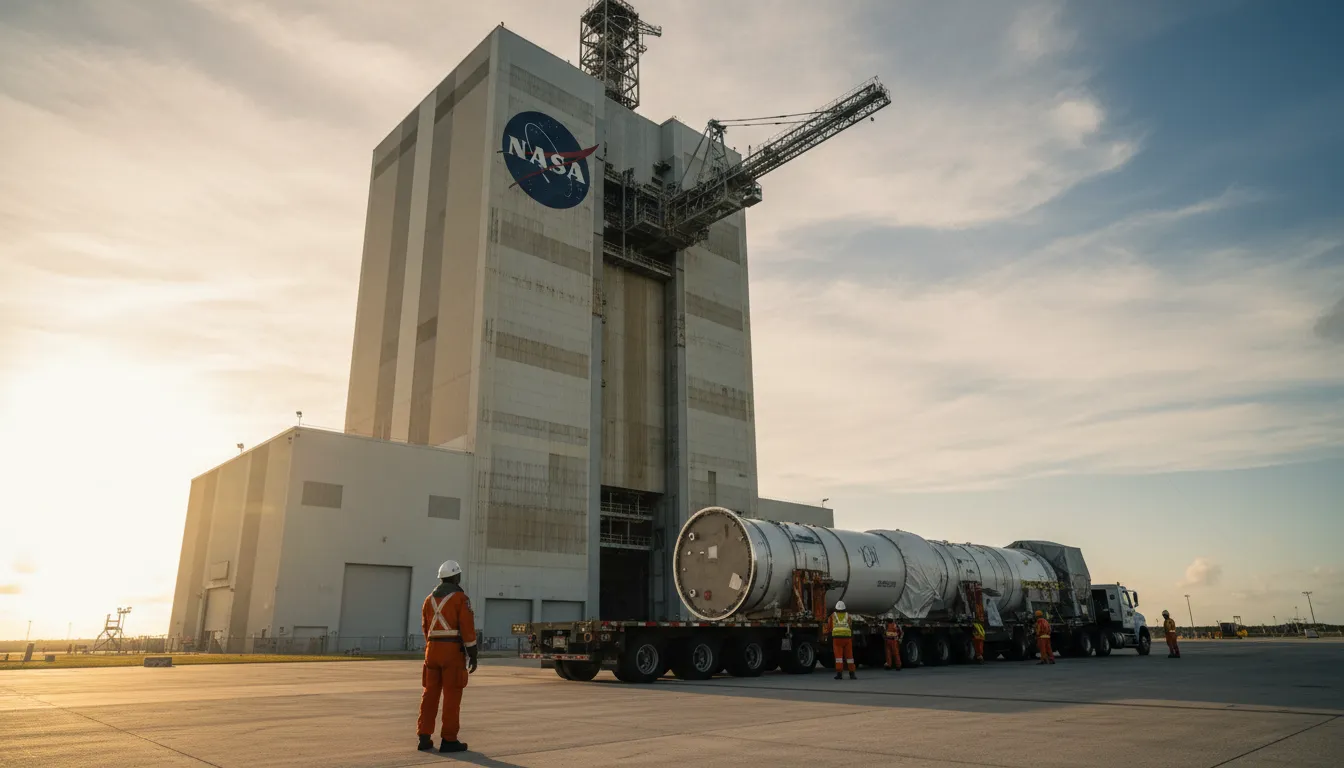
A more serious blow came after the February 19 rehearsal: teams discovered a faulty helium seal in the quick-disconnect section where ground lines feed the interim cryogenic propulsion stage. NASA rolled the entire SLS stack back into the Vehicle Assembly Building for repairs. Technicians replaced the defective seal, and a subsequent unanimous vote at a formal risk-assessment review cleared the crew to fly.
The rocket is expected to roll back out to Launch Pad 39B in late March.
The Bigger Picture: Road to a Lunar Landing
A successful Artemis II clears the path for eventual boots on the Moon, though the timeline has shifted. NASA has restructured the Artemis III mission, now planned for 2027, to focus on rendezvous and docking tests in low Earth orbit with SpaceX's Starship HLS and Blue Origin's Blue Moon landers — rather than a lunar landing. The first American crewed touchdown on the Moon since 1972 is now expected with Artemis IV in early 2028.
For now, April 1 represents something simpler and profound: humanity returning, however briefly, to the neighborhood of the Moon.