China's Solar Capacity Set to Overtake Coal in 2026
For the first time in history, China's installed solar power capacity is projected to surpass coal in 2026, marking a watershed moment in the global energy transition even as the country paradoxically continues building new coal plants.
A Historic Crossover
China is on the verge of a landmark energy milestone. According to the China Electricity Council (CEC), the country's installed solar power capacity will exceed coal for the first time in 2026 — a moment analysts are calling a turning point in the world's largest energy system.
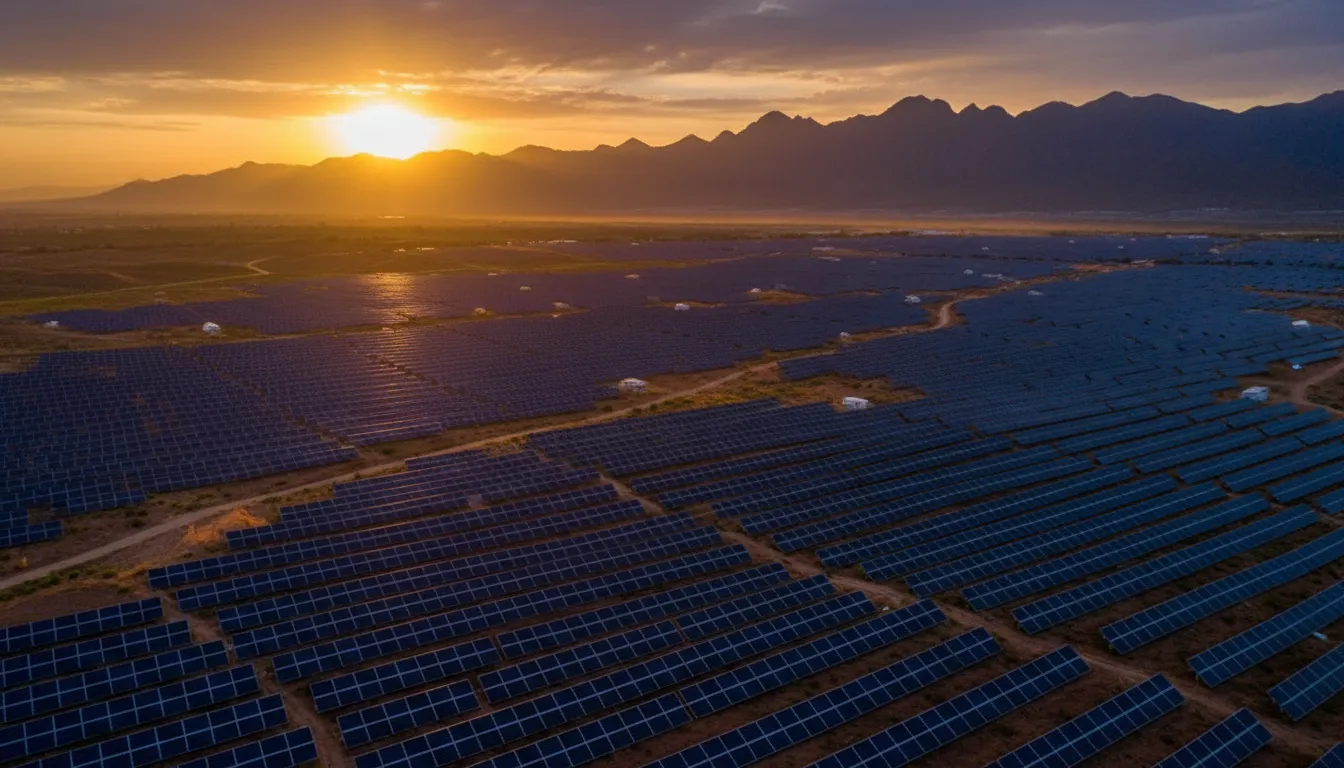
Solar capacity reached roughly 1,200 gigawatts (GW) by the end of 2025 after a record year that added 315 GW of new panels. Coal capacity, meanwhile, stands at approximately 1,333 GW. With China expected to install another 235 GW of solar this year, the crossover is all but certain.
Renewables Reshape the Power Mix
The shift extends well beyond solar alone. By the end of 2026, non-fossil energy sources — solar, wind, hydro, and nuclear — are projected to account for 63 percent of China's total installed power capacity, while coal's share falls to roughly 31 percent, according to CEC projections reported by Carbon Brief.
The combined capacity of wind and solar alone will represent about half of the nation's entire generating fleet. China plans to add more than 400 GW of new generation capacity in 2026, with wind and solar contributing over 300 GW of that total.
The economic weight of this transformation is enormous. China's clean-energy sectors contributed 15.4 trillion yuan ($2.1 trillion) in 2025, representing 11.4 percent of GDP and driving roughly one-third of economic growth. If measured as a standalone economy, the sector would rank as the world's eighth-largest.
Global Dominance
China's renewable buildout dwarfs every other country. It is expected to account for over half of all new solar capacity installed worldwide this year and roughly 60 percent of new wind capacity. As Yale Environment 360 notes, the sheer scale means China's domestic energy decisions carry outsized consequences for global climate targets.
The pace has been staggering: solar capacity averaged 270 GW of annual growth over the past three years, a rate that would have seemed implausible a decade ago when China was still the world's coal plant construction leader.
The Coal Paradox
Yet the milestone comes with a significant caveat. Even as solar eclipses coal in installed capacity, China continues to approve and build new coal-fired power plants at a striking rate. Developers submitted proposals for 161 GW of new coal capacity in 2025 alone, and 291 GW remains in the pipeline — either permitted or under construction, according to Global Energy Monitor data cited by 350.org.
Capacity and generation are also different things. Coal plants run closer to their maximum output than solar panels, which only produce power during daylight. As a result, coal still provides roughly half of China's actual electricity generation despite its shrinking capacity share.
Lauri Myllyvirta, a leading analyst on China's energy policy, has warned that policymakers face a critical choice in the near term: either limit new coal construction or risk slowing the renewable expansion that has driven costs down so dramatically.
What Comes Next
Under new government guidelines, coal plants are being repositioned as backup "peaker" facilities to handle demand spikes and fill gaps when sun and wind fall short. Many existing coal plants already operate at only about 50 percent capacity utilization, and a growing number run at a loss due to competition from cheap renewables.
China's solar-over-coal milestone is real and significant — a signal that the economics of clean energy have fundamentally shifted. But until the country reconciles its simultaneous coal buildout, the full climate promise of this historic crossover remains incomplete.