Czech Economy 2026: Wages Rise, Industry Stagnates
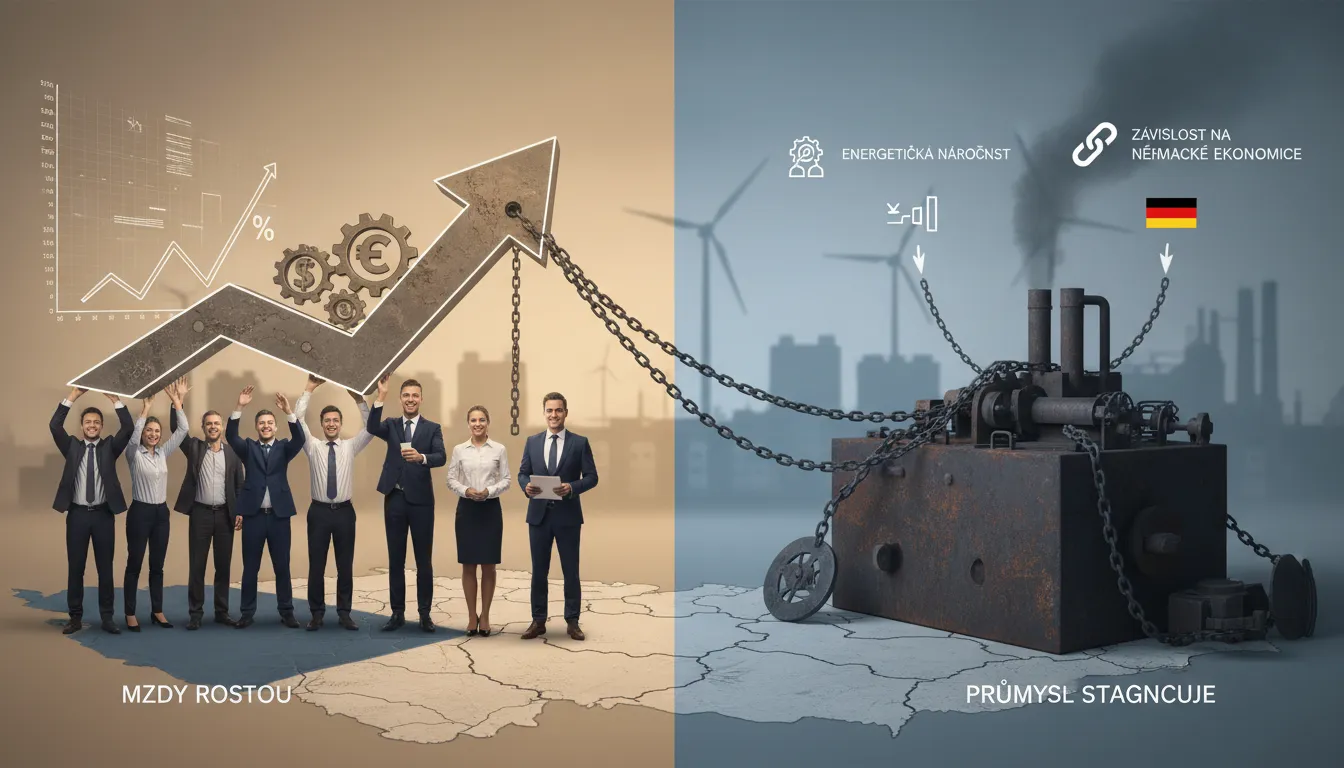
The Czech economy is growing at a rate of around 2.7% per year, and real wages are expected to increase by 2.7% — the second-fastest pace in the entire EU. Behind the favorable figures lie serious threats: industrial stagnation, energy intensity, and dependence on the German economy.
Favorable Macroeconomic Figures
The Czech Republic enters 2026 with relatively strong macroeconomic results. GDP is growing at a rate of around 2.7% per year, which is one of the best performances among the post-communist members of the European Union. Inflation is moving close to the target value of 2% — in January 2026, it even fell to just 1.6%, the lowest level in nine years. The Czech National Bank is holding the key two-week repo rate at 3.50%, where it has kept it since May 2025.
The International Monetary Fund, in its annual report from February 2026, confirmed that the Czech economy continues to grow robustly, driven mainly by domestic demand. Private consumption is driving the economy forward thanks to rising household incomes and a decrease in the propensity to save.
Real Wages: Second Fastest Pace in the EU
The most significant bright spot is the situation in the labor market. Nominal wages are expected to increase by approximately 5% in 2026, with real wage growth reaching an estimated 2.7%. This ranks the Czech Republic second in the entire European Union — wages will increase faster in real terms only in Hungary, where an increase of 3.5% is expected.
After years of high inflation and a decline in purchasing power, workers are slowly getting back into positive territory. Unemployment remains extremely low — around 2.8% — and strong demand for labor in services and construction is keeping wage pressures high. This dynamic is the main source of concern for the CNB, which is therefore refusing to proceed with further monetary policy easing.
Industry Under Pressure
Behind the positive numbers lies a serious structural problem: industry is stagnating, while household consumption is keeping the economy afloat. Czech production is excessively concentrated on the automotive industry and subcontracting chains closely linked to the German economy — which itself is undergoing a significant slowdown. The Union of Small and Medium-Sized Enterprises points out that without a recovery in Germany, Czech industrial growth will remain rather conservative.
In addition, there is high energy intensity. The Czech economy consumes approximately 70% more energy per unit of GDP than the EU average. The IMF, in its assessment, explicitly warned that the combination of high energy intensity, a low share of renewable sources (below 16% of electricity production — the lowest in the entire EU), and dependence on a narrow range of export products increases the economy's vulnerability to external shocks.
Geopolitical risks further amplify this vulnerability. A possible escalation of the energy crisis or fluctuations in oil markets could quickly increase production inputs and bring industrial enterprises into loss, as the European Commission also warns in its outlook for the Czech Republic.
Outlook: Cautious Optimism with Conditions
Despite these challenges, cautious optimism prevails among analysts. The Ministry of Finance of the Czech Republic and the Confederation of Industry of the Czech Republic expect industry to recover slightly during 2026, especially in the second half of the year. The key prerequisite is the stabilization of the situation in Germany and the maintenance of global demand.
The Czech economy is thus at a crossroads. A strong labor market and rising household incomes provide a solid foundation — but the structural transformation of industry, diversification of export markets, and reduction of energy intensity are conditions for long-term prosperity that can no longer be postponed.