Hidden Solar Fingerprints May Transform Space Weather
Scientists have discovered that the Sun's interior leaves measurable structural "fingerprints" between solar cycles — a breakthrough that could dramatically improve our ability to predict dangerous solar storms weeks or even years in advance.
Listening to the Sun From the Inside Out
Deep beneath the Sun's blazing surface, something subtle but consequential is happening. Scientists have found that the solar interior does not simply reset between activity cycles — it leaves behind measurable structural imprints, faint but detectable echoes encoded in sound waves bouncing through 700,000 kilometers of plasma. These "fingerprints," revealed through the discipline of helioseismology, are reshaping how researchers think about predicting space weather.
What the Vibrations Reveal
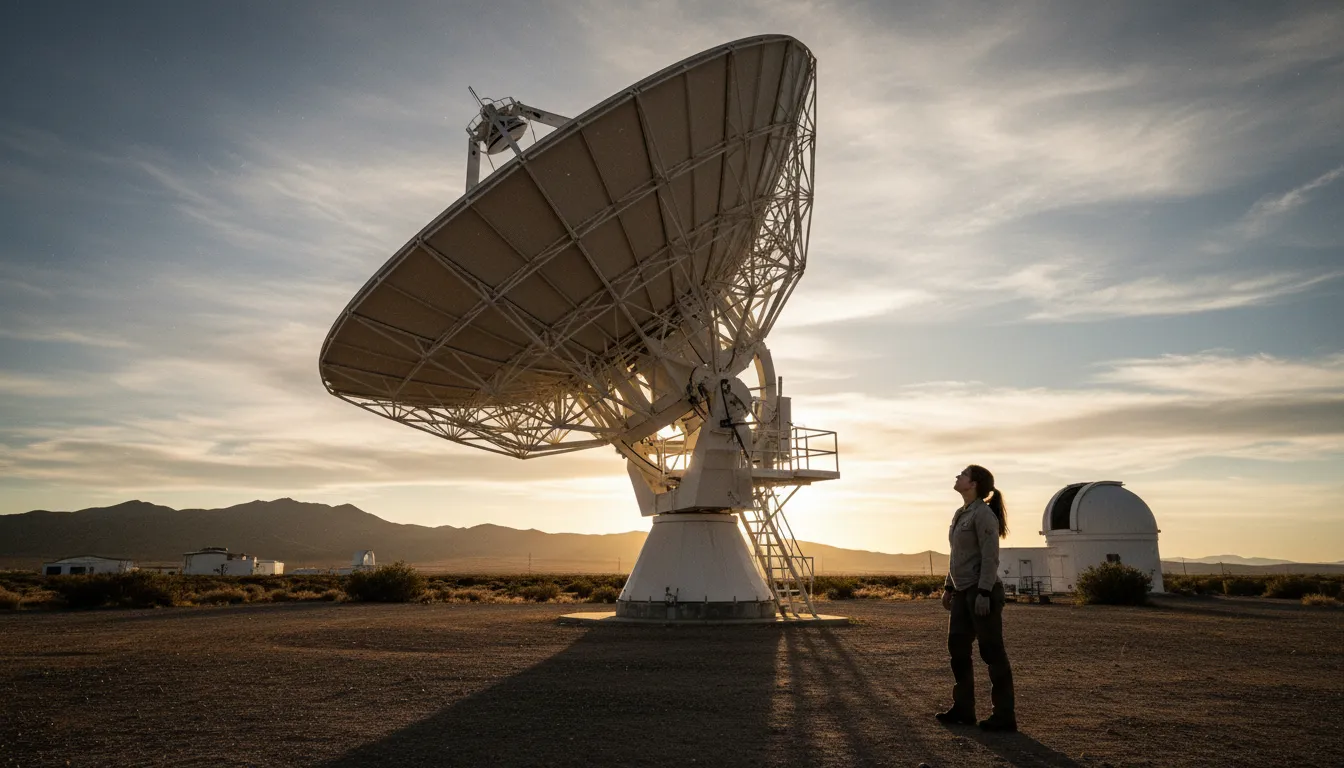
Helioseismology works much like seismology on Earth: just as geologists use earthquakes to probe our planet's interior, solar physicists analyze acoustic oscillations — pressure waves driven by turbulent convection — to map the Sun's hidden layers. For more than 40 years, the Birmingham Solar-Oscillations Network (BiSON), a global array of six ground-based telescopes, has continuously recorded these vibrations.
A recent analysis of BiSON data spanning four successive solar minima has produced a landmark result. Professor Bill Chaplin of the University of Birmingham stated: "For the first time, we've been able to clearly quantify how the Sun's internal structure shifts from one cycle minimum to the next." The findings were published in the Monthly Notices of the Royal Astronomical Society.
The most striking signal involves what physicists call the helium glitch — a distinctive perturbation in sound wave frequencies produced when helium roughly 20,000 to 40,000 kilometers below the Sun's visible surface becomes doubly ionized. This layer changes the compressibility of the surrounding plasma, leaving a detectable imprint on oscillation data. During the unusually deep solar minimum of 2008–2009, the glitch was measurably stronger and sound speeds slightly higher, indicating elevated gas pressure and temperature — structural shifts invisible to conventional sunspot observation.
Why Quiet Periods Matter
The conventional view treated solar minima — the quiet troughs between 11-year activity peaks — as essentially interchangeable. This study dismantles that assumption. Professor Sarbani Basu of Yale University, a co-author of the research, underscored the significance: the Sun's internal behavior during quiet periods "has a strong bearing on how the activity levels build up in the cycles that follow." In other words, the depth and character of each minimum may partly determine the strength and timing of the next solar maximum.
A Broader Picture: HMI and Far-Side Forecasting
Complementary findings from NASA's Helioseismic and Magnetic Imager (HMI) aboard the Solar Dynamics Observatory reinforce the picture. After 14 years of continuous observation, HMI has mapped subsurface plasma flows — differential rotation, meridional circulation, giant convective cells — and tracked how magnetic activity leaves acoustic fingerprints throughout the solar interior. Crucially, HMI now enables detection of active regions on the Sun's far side before they rotate into Earth's view, giving forecasters days of additional warning before potentially dangerous eruptions face our planet.
A separate study published in early 2026 validated a new forecasting system capable of identifying elevated superflare risk windows spanning months to a year in advance. By combining 50 years of X-ray satellite data with machine learning, researchers identified cyclical rhythms — a 1.7-year and a 7-year pattern — whose alignment significantly raises eruption probability. The model's predictions were unexpectedly confirmed by far-side X16.5-class flares in May 2024. Lead researcher Dr. Victor M. Velasco Herrera noted that traditional methods "struggle with these extreme events because they happen so quickly," while the new approach provides "one to two years of advance warning."
The Stakes for Society
The urgency of better forecasting is clear. Severe space weather — solar flares, coronal mass ejections, and streams of energetic particles — threatens satellites, GPS networks, aviation communications, and power grids. The 1989 Quebec blackout, triggered by a geomagnetic storm, left six million people without electricity for nine hours. Modern infrastructure is far more vulnerable. Improved lead times could allow grid operators, satellite operators, and space agencies to take protective action before the storm arrives.
Together, these advances — from BiSON's four-decade acoustic archive to HMI's subsurface flow maps and machine-learning cycle models — suggest that the era of reactive space weather response may be giving way to genuine long-range prediction. The Sun, it turns out, whispers its intentions well in advance. Scientists are finally learning to listen.