How Agricultural Robots Work—and Why They Matter
From laser weeders to AI-powered strawberry pickers, agricultural robots are racing to replace the millions of farm workers the world is running short of—and to help feed nearly 10 billion people by 2050.
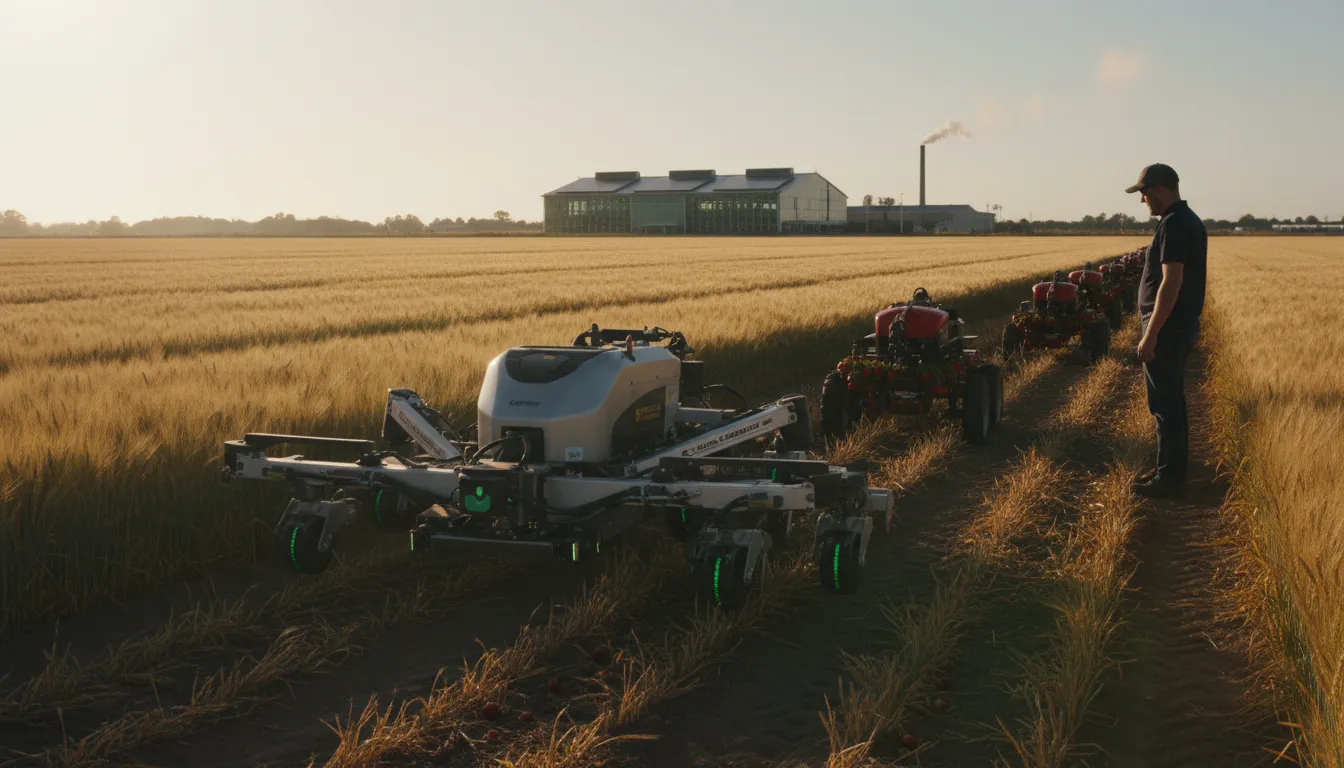
A Farm in Crisis—and a Robotic Fix
Every harvest season, farmers across the United States and Europe scramble to find workers willing to spend weeks bent over strawberry rows, cucumber fields, and apple orchards. The American Farm Bureau estimates that 2.4 million farm jobs go unfilled each year. An aging agricultural workforce, tightening immigration policies, and declining rural populations have pushed the industry toward a breaking point—one that a new wave of robots is being designed to solve.
Agricultural robotics is no longer a futuristic concept. Autonomous machines are already operating on commercial farms across four continents, performing tasks that range from pollinating greenhouse tomatoes to zapping weeds with carbon-dioxide lasers. Understanding how these systems work—and why they exist—reveals much about the future of food itself.
The Main Types of Farm Robots
Agricultural robots generally fall into two broad families: ground rovers and aerial drones. Ground rovers move along crop rows or open fields to perform physical tasks—planting seeds, pulling weeds, picking fruit, or sampling soil. Aerial drones survey crops from above, capturing high-resolution imagery that detects disease, drought stress, or pest pressure long before a human eye would notice anything wrong.
Within each family, robots specialize sharply. A harvesting robot built for strawberries cannot simply be redeployed to pick apples; the geometry of the plant, the delicacy of the fruit, and the mechanics of the pick are entirely different. That narrow specialization is both a strength—robots can be optimized to a single task—and a commercial challenge, since farmers grow many crops on the same land throughout the year.
How They See, Navigate, and Act
Most agricultural robots rely on a layered stack of technologies working in concert:
- Computer vision: Cameras feed images into neural networks trained to identify ripe fruit by color, size, and texture, or to distinguish a weed from a wanted plant within milliseconds.
- LiDAR sensors: Laser pulses build a three-dimensional map of the robot's immediate surroundings, letting it navigate uneven terrain without bumping into plants or irrigation equipment.
- RTK GPS: Real-Time Kinematic satellite positioning provides centimeter-level accuracy for path-following across large open fields—far tighter than the meter-scale accuracy of standard GPS.
- Machine learning: Onboard processors run models that improve with experience, allowing a robot to get better at judging ripeness or avoiding damage over thousands of harvesting cycles.
- Soft robotics: Grippers made of compliant silicone or pneumatically actuated fingers handle fragile produce without bruising—a challenge that stumped engineers for years.
The result is a machine that can, for example, scan a strawberry plant, calculate the probability that each berry is ripe, extend a soft gripper to the most accessible one, sever the stem cleanly, and deposit the fruit in a tray—all in under two seconds per berry.
Weeding, Pollinating, and Monitoring
Harvesting grabs headlines, but robots are transforming other farming tasks too. Carbon Robotics' LaserWeeder deploys 150 CO₂ lasers that vaporize weed seedlings at the root—eliminating up to 200,000 weeds per hour—while leaving surrounding crops untouched. Because it targets individual plants rather than spraying an entire field, it can dramatically cut herbicide use.
In greenhouses, pollination robots like Arugga's Polly deliver precisely calibrated air puffs to tomato flowers, vibrating them enough to release pollen. This replicates the buzz-pollination performed naturally by bumblebees—a service increasingly hard to guarantee as bee populations decline.
Aerial drones equipped with multispectral cameras capture wavelengths of light invisible to the human eye. When a plant is under stress, its near-infrared reflectance changes before any wilting or yellowing occurs. A drone survey processed through AI can flag a fungal outbreak days earlier than a walking inspector would catch it, allowing targeted treatment rather than a blanket chemical application.
The Business Case—and the Barriers
The agricultural robotics market was valued at roughly $16.6 billion in 2024 and is projected to exceed $100 billion by the early 2030s, driven by labor costs, climate pressure, and growing demand for precision farming. Large farms report cost reductions of 20–30% after automation, plus yield improvements of 10–30% through optimized planting density and reduced crop loss.
Yet barriers remain. A commercial harvesting robot can cost anywhere from $30,000 for a compact autonomous tractor to several hundred thousand dollars for a multi-arm picking system—a steep upfront investment for small family farms. Robots also struggle with crops that grow irregularly, in dense canopies, or in muddy field conditions that disable wheels and sensors. And the skills gap is real: operating and maintaining these machines requires training that many rural communities currently lack.
Why It Matters Beyond the Farm Gate
The United Nations projects that the world will need 70% more food by 2050 to feed a population approaching 9.7 billion. Arable land is not expanding meaningfully, water is becoming scarcer, and climate change is making growing seasons less predictable. Agricultural robots offer a path to producing more food with fewer inputs—less water, less fertilizer, fewer pesticides—on the same amount of land.
Whether they can scale fast enough, and become affordable enough for the smallholder farmers who feed much of the developing world, is the defining challenge of the industry. The machines work. Getting them to every field that needs them is the harder problem.