How AI Data Centers Work—and Why They Drain Power
AI data centers consume vast amounts of electricity and water to run and cool thousands of servers. Here's how they work, why demand is surging, and what it means for energy grids and utility bills.
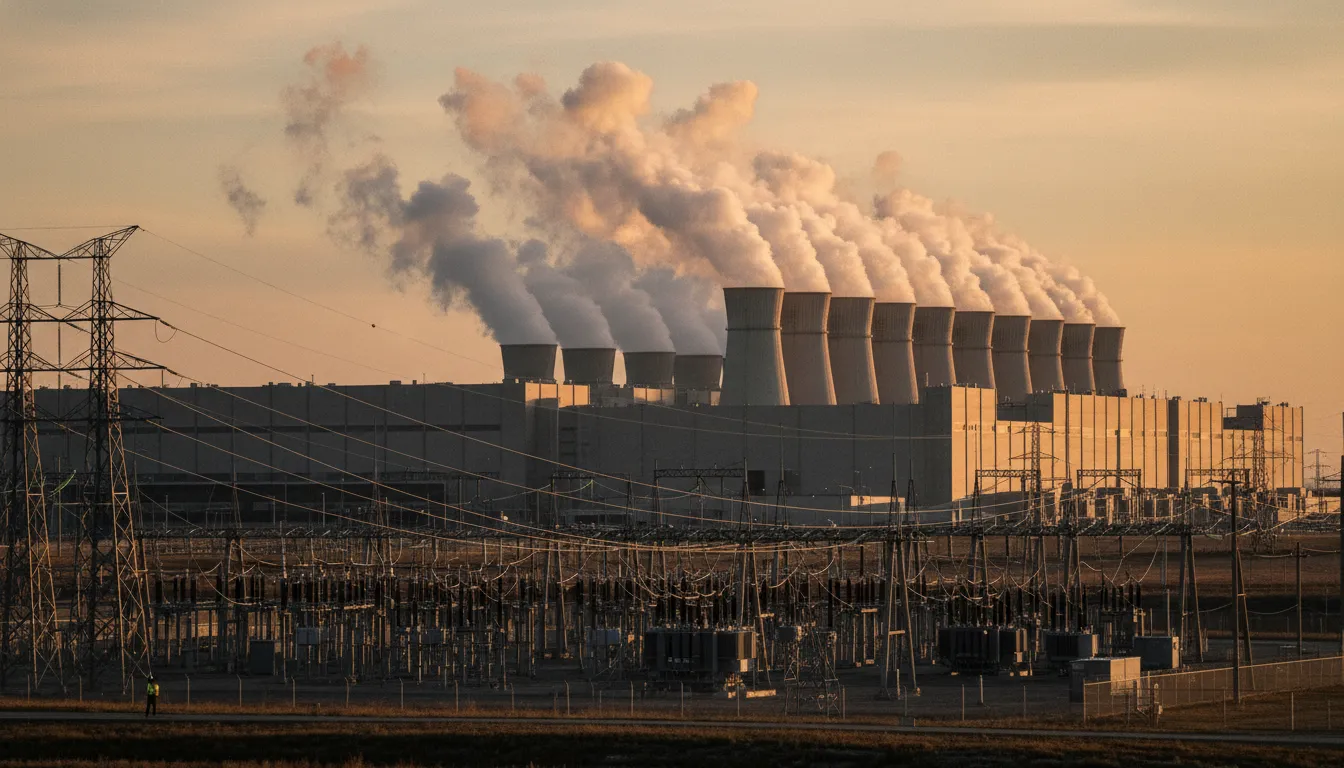
The Engine Room of Artificial Intelligence
Every time you ask an AI chatbot a question, generate an image, or use a cloud-based tool, your request travels to a data center—a warehouse-sized facility packed with thousands of specialized servers. These buildings form the physical backbone of the AI revolution, and their appetite for electricity and water is reshaping energy markets worldwide.
What Happens Inside a Data Center
A modern AI data center houses rows of server racks containing graphics processing units (GPUs) and other accelerators optimized for the massive parallel calculations AI models require. Training a single large language model can demand thousands of GPUs running continuously for weeks or months. Even after training, every user query—called inference—requires real-time computation.
All that processing generates enormous heat. Without constant cooling, chips would overheat and fail within minutes. That's where the second major resource comes in: water.
Why They Need So Much Water
Water conducts heat roughly 30 times more efficiently than air, making it the preferred cooling medium for high-density computing. Most large data centers use some form of evaporative cooling, where warm water absorbs heat from servers and is then cooled in towers by evaporation. The process is energy-efficient but water-intensive—a single hyperscale facility can consume up to 5 million gallons of water per day, equivalent to the daily needs of a city of 50,000 people, according to the Lincoln Institute of Land Policy.
Newer closed-loop systems recirculate water in sealed pipes, reducing freshwater consumption by up to 70%. Some operators are also experimenting with immersion cooling, submerging entire servers in non-conductive liquid to eliminate evaporative losses altogether.
The Electricity Problem
Data centers consumed about 176 terawatt-hours (TWh) of electricity in 2023—roughly 4.4% of total U.S. power, according to the U.S. Department of Energy. The Lawrence Berkeley National Laboratory projects that figure could reach 325 to 580 TWh by 2028, or 6.7–12% of all American electricity.
The geographic concentration is striking. In Virginia's "Data Center Alley," these facilities already consume 26% of the state's total electricity supply. In the Mid-Atlantic region, surging demand triggered an 800% increase in wholesale energy prices during a 2024 capacity auction, with residential rate increases of 20–30% expected by the late 2020s, as reported by Consumer Reports.
Community Pushback and Policy Response
Rising utility costs have fueled a wave of opposition. A nationally representative survey found that 78% of Americans are concerned that new data center construction will increase their energy bills. Activist groups in more than 24 states have organized against proposed facilities, citing noise, water depletion, land use, and strained power grids.
Legislators are responding. By early 2026, lawmakers in over 30 states had introduced more than 300 bills addressing data center impacts, ranging from construction moratoriums to revised tax incentive requirements. Maine became the first state to restrict construction of large data centers outright, according to The National Desk.
What Comes Next
The industry is pursuing several paths to reduce its footprint. More efficient chip architectures promise to deliver the same AI performance with less energy. Tech companies are investing heavily in renewable energy contracts and exploring nuclear power, including small modular reactors, to supply dedicated clean electricity. Researchers have also unveiled algorithms that could cut AI energy use by up to 100 times while improving accuracy.
Still, the fundamental tension remains: as AI capabilities grow and adoption accelerates, so does the physical infrastructure required to support them. How societies balance the benefits of artificial intelligence against its real-world resource costs will be one of the defining policy questions of the coming decade.