How Ancient Texts Survive Inside Egyptian Mummies
For centuries, ancient Egyptians recycled discarded papyrus scrolls into mummy wrappings and casings, accidentally preserving lost works of literature, government records, and personal letters for thousands of years.
Literature in the Linen
When archaeologists at the University of Barcelona recently found a fragment of Homer's Iliad tucked inside the wrappings of a 1,600-year-old mummy at Oxyrhynchus, Egypt, they confirmed something scholars have long known: ancient mummies are time capsules for lost texts. The practice of recycling written papyrus into mummy casings has given us some of the most important literary and historical documents to survive from antiquity.
But how does a Greek epic poem end up inside a corpse — and how do scientists read it thousands of years later?
What Is Cartonnage?
Cartonnage is a lightweight material that ancient Egyptians used to make mummy masks, chest panels, and outer casings. Think of it as ancient papier-mâché: layers of linen, plaster, and — crucially — recycled papyrus, all glued together and painted. The papyrus sheets came from administrative offices, temple archives, and household waste. Tax records, legal contracts, personal letters, and occasionally literary manuscripts were discarded and repurposed by undertakers who needed cheap, flexible material.
This recycling habit means that mummy casings can contain layers of text spanning decades, from mundane grain receipts to fragments of plays by Sophocles or verses of Homer that exist nowhere else on Earth.
Why Egypt Preserves What Other Climates Destroy
Papyrus is organic. In most environments, it rots within decades. Egypt is the exception. The country's extreme aridity — particularly in Upper Egypt — means that buried papyrus can survive for millennia as long as it stays dry and above the water table. The ancient city of Oxyrhynchus (modern al-Bahnasa) has produced more ancient papyri than any other site, with tens of thousands of fragments excavated from its rubbish dumps since the 1890s. The city sits on a branch of the Nile rather than the main riverbank, sparing it from annual flooding that would have destroyed the texts.
Most recovered papyri — roughly 90% — are non-literary: government edicts, census returns, tax assessments, wills, and private correspondence. But the remaining 10% include lost works of Greek drama, early Christian gospels, and philosophical treatises that transformed scholars' understanding of the ancient world.
How Scientists Read Buried Texts
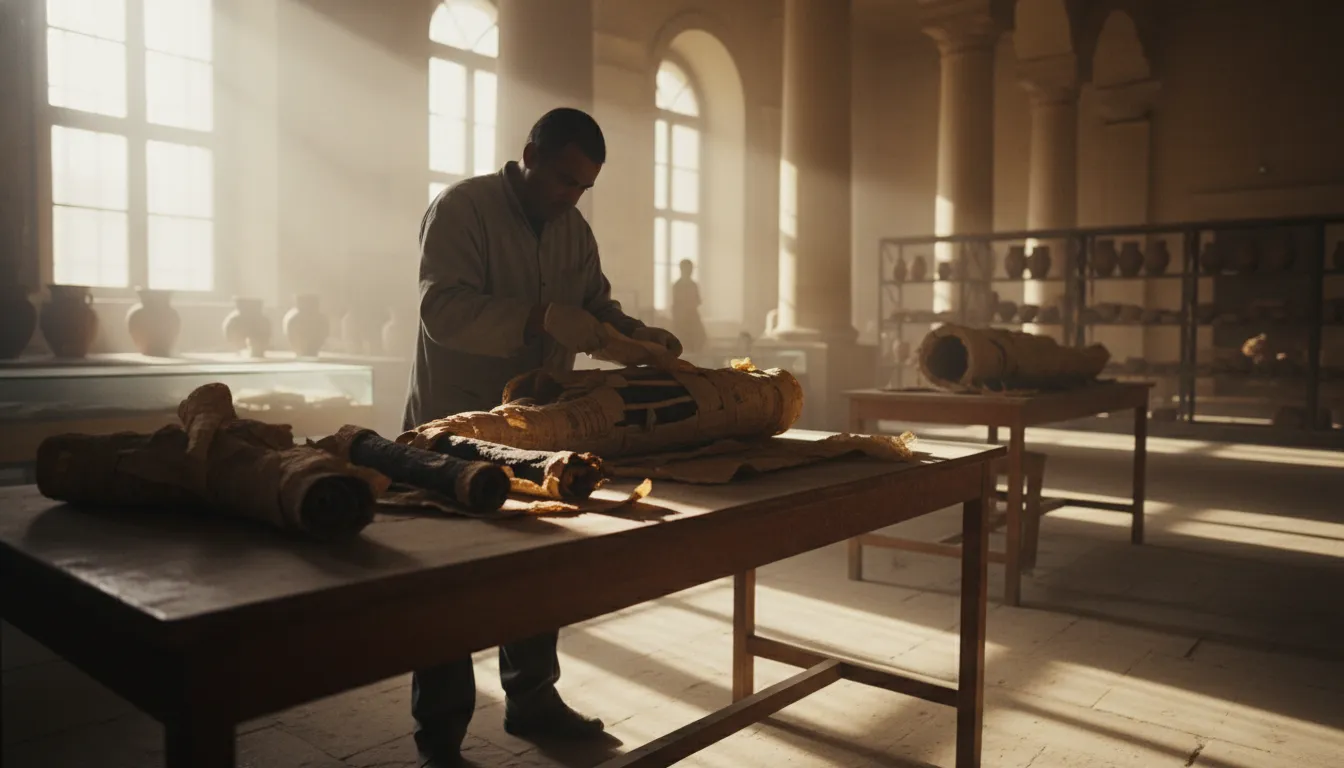
Extracting text from cartonnage has always posed a dilemma. The traditional method involves dissolving the glue that binds the layers, separating the papyrus sheets, and flattening them for reading. This works but destroys the cartonnage — an irreversible trade-off between reading a text and preserving an artifact.
Modern technology is changing the equation. Researchers at University College London have tested non-destructive techniques including:
- Multispectral imaging — using different wavelengths of light to reveal ink invisible to the naked eye
- X-ray fluorescence — effective at detecting iron-based inks through multiple papyrus layers
- Terahertz imaging — capable of reading carbon-based inks with good penetration depth
Each method has trade-offs. X-rays penetrate well but miss carbon ink. Terahertz waves read carbon ink but are less sensitive to iron-based formulas. Combining multiple techniques gives the best results — and leaves the mummy intact.
Not Just Literature
While headlines focus on dramatic finds like the Iliad, the vast majority of mummy papyri reveal everyday life in stunning detail. Scholars have recovered everything from shopping lists and divorce petitions to school exercises where students copied lines from Homer — the ancient equivalent of homework. These mundane documents are arguably more valuable to historians than literary fragments, because they illuminate how ordinary people lived, worked, traded, and governed across centuries of Egyptian, Greek, and Roman rule.
In the Roman period, papyri placed inside mummies typically served a ritual purpose — magical spells or protective texts meant to guide the dead. The Iliad fragment found at Oxyrhynchus broke this pattern, representing the first known Greek literary text deliberately incorporated into the embalming process, according to Smithsonian Magazine.
Why It Still Matters
Thousands of papyrus fragments from Oxyrhynchus alone remain unread, stored in museums and university collections worldwide. With advancing imaging technology, each mummy casing and each box of fragments is a potential library waiting to be opened — without ever being touched. The ancient practice of turning yesterday's paperwork into a mummy's armor may be history's greatest accidental act of preservation.