How Chip Lithography Works—and Why One Company Owns It
Chip lithography uses light to print nanoscale circuits onto silicon wafers. One Dutch company, ASML, holds a total monopoly on the most advanced machines—and the future of computing depends on what comes next.
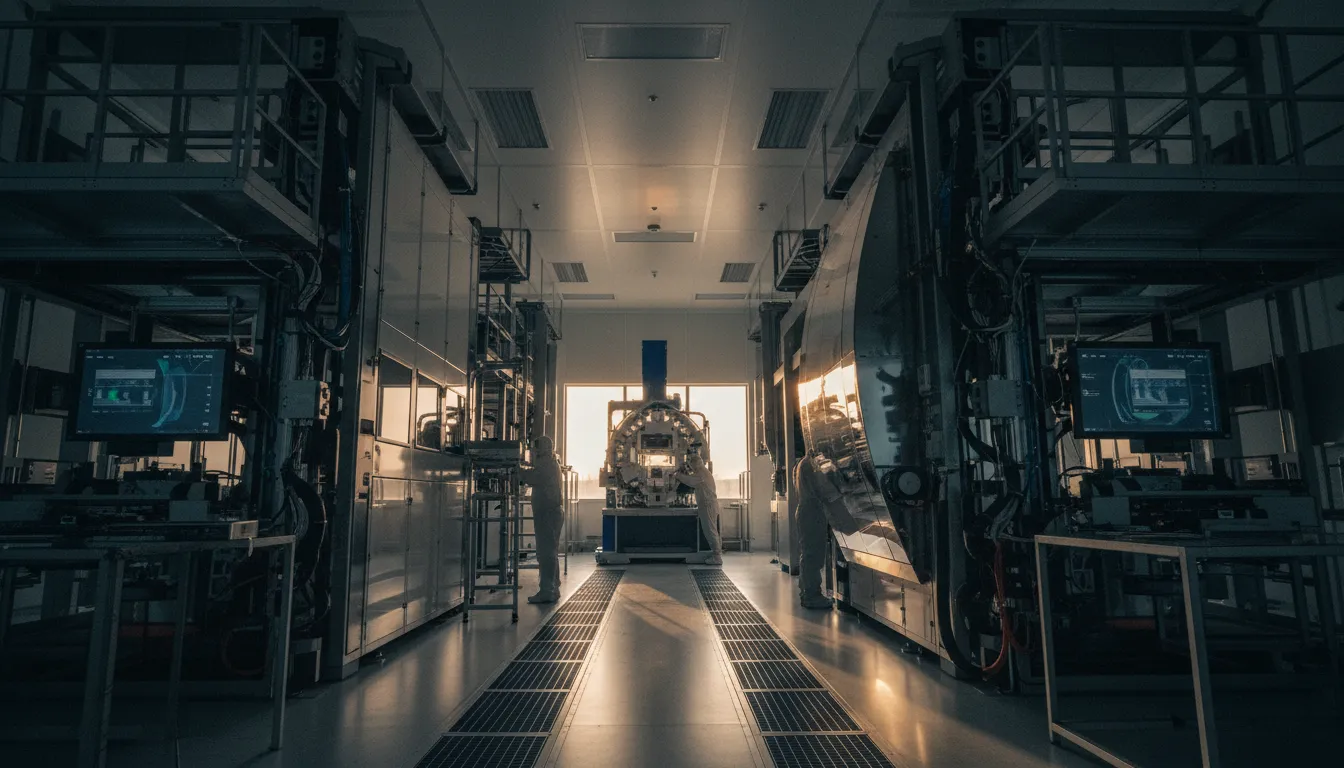
Printing With Light at the Nanoscale
Every smartphone, laptop, and data center on Earth runs on chips built through a process called lithography—the art of printing impossibly small circuit patterns onto silicon wafers using light. It is the single most critical step in semiconductor manufacturing, repeated dozens of times per chip, and it determines how small, fast, and energy-efficient transistors can be.
The basic principle has not changed since the 1960s. A beam of light shines through a photomask—a stencil of the desired circuit pattern—and projects a shrunken image onto a wafer coated with light-sensitive material called photoresist. Where the light hits, it chemically alters the resist. The unexposed areas are washed away, leaving behind the pattern that will become transistors, wires, and other components.
What has changed, dramatically, is the wavelength of that light. Shorter wavelengths can print smaller features. Over six decades the industry moved from visible light (436 nm) to deep ultraviolet (193 nm) to today's cutting edge: extreme ultraviolet (EUV) lithography at just 13.5 nm.
How EUV Lithography Works
EUV machines are among the most complex devices ever built. Inside a vacuum chamber, a high-powered laser fires 100,000 pulses per second at tiny droplets of molten tin. Each droplet is hit twice: the first pulse flattens it, the second superheats it to roughly 220,000 °C—about 40 times hotter than the surface of the Sun. This produces a plasma that emits extreme ultraviolet light.
Because EUV light is absorbed by almost everything, including air and glass, the entire optical path must operate in a vacuum. Traditional glass lenses cannot be used. Instead, the light bounces off a series of six ultra-precise mirrors coated with alternating layers of molybdenum and silicon, each polished to sub-atomic smoothness by Germany's Zeiss. These mirrors direct and focus the light through the photomask and onto the wafer below.
The result: circuit features as small as 3 nanometers—roughly the width of 15 atoms. EUV entered mass production in 2019 and now underpins every leading-edge chip from Apple, Nvidia, and Qualcomm.
ASML's Extraordinary Monopoly
Only one company on Earth builds EUV lithography machines: ASML, based in Veldhoven, the Netherlands. It holds a 100% market share. Each EUV system costs roughly €150–200 million, weighs over 150 tonnes, and requires components from more than 800 suppliers worldwide. The development took over 20 years and billions of dollars in collaborative research with Intel, Samsung, and TSMC.
Today, ASML sells its most advanced machines to only a handful of chipmakers. TSMC, Samsung, and Intel account for the vast majority of orders. This concentration makes ASML one of the most strategically important companies in the global economy—and a focal point of geopolitical tension over who gets access to cutting-edge chip technology.
What Comes After EUV
Even EUV has limits. ASML is already shipping High-NA (numerical aperture) EUV systems that push resolution further, targeting the 2 nm node and beyond. The company has announced plans for hyper-NA tools with even greater precision, potentially costing over $700 million each, expected around 2030.
Meanwhile, startups are exploring radically different approaches. Norway-based Lace Lithography is developing helium atom beam lithography, which replaces light entirely with neutral atoms. Because atoms have no diffraction limit, the beam measures just 0.1 nm—135 times narrower than EUV light. Other candidates include nanoimprint lithography, electron beam lithography, and X-ray approaches.
Whether the next breakthrough comes from refining light or abandoning it altogether, one thing is clear: lithography remains the bottleneck and the enabler of Moore's Law. Whoever masters the next generation will shape the future of computing.