How Dexterous Robot Hands Work—and Why They Matter
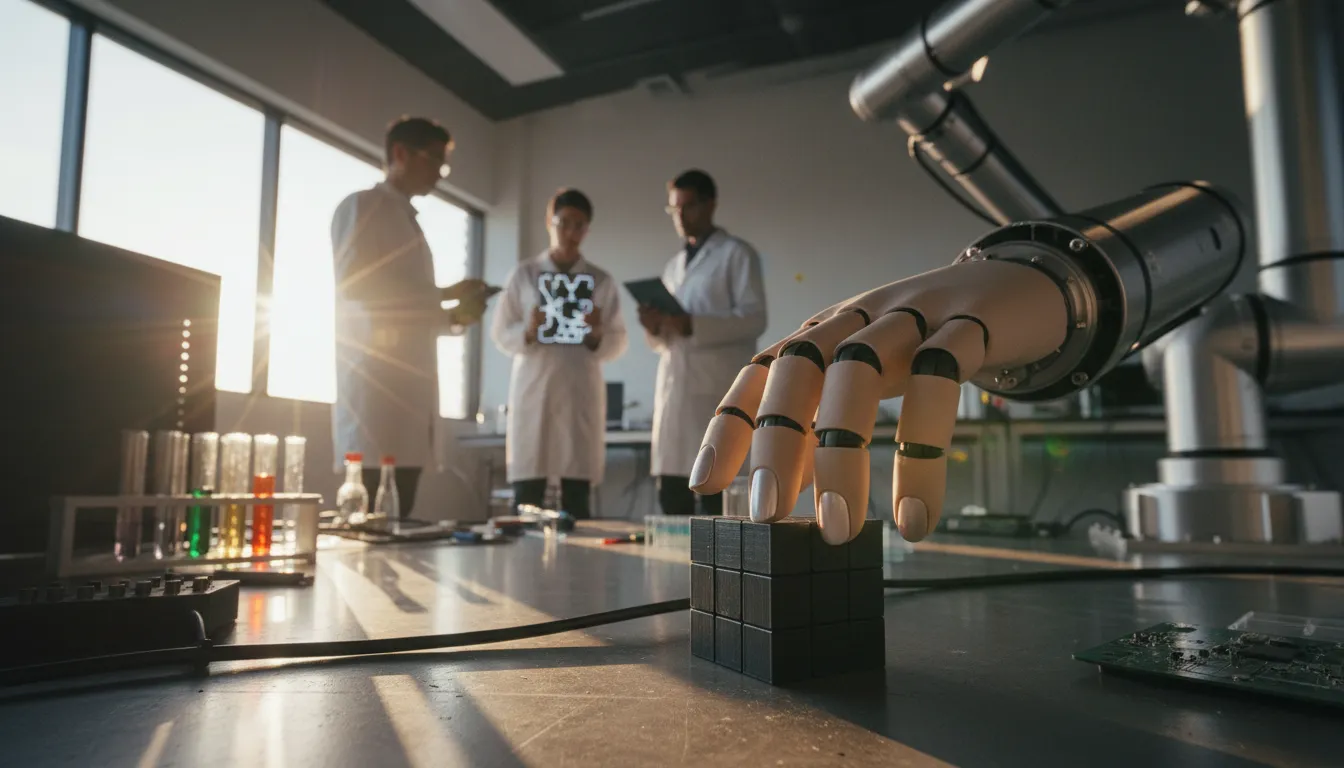
For decades, robots could grip but not truly manipulate. A new generation of biomimetic robotic hands—with soft fingertips, tactile sensors, and even artificial fingernails—is finally giving machines the dexterity to handle the messiness of the real world.
The Gap Between Gripping and Touching
Industrial robots have long excelled at tasks that are repetitive, fast, and predictable—welding car frames, spraying paint, moving pallets. But ask a factory robot to pick a ripe tomato from a bin without bruising it, peel the lid off a sealed container, or pull a single sheet from a stack of paper, and it fails. The reason is simple: it has no hands, only grippers. And a gripper is to a human hand what a rubber band is to a violin string.
That gap is finally closing. A new generation of dexterous robotic hands—engineered to mimic the structure, mechanics, and sensory richness of human fingers—is emerging from research labs and entering factories, warehouses, and even operating theatres. Understanding how they work reveals both the ingenuity required and the enormous stakes involved.
Why Human Hands Are So Hard to Copy
The human hand contains 27 bones, more than 30 joints, and roughly 35 muscles (most of them in the forearm, controlling the fingers via long tendons). It can exert crushing force or thread a needle. It detects texture through pressure receptors spaced less than two millimetres apart. It adjusts grip in milliseconds when an object starts to slip.
Replicating this in hardware is a formidable engineering challenge. Early industrial grippers solved it by avoidance—designing tasks around the gripper's limitations rather than building a gripper equal to any task. That approach works on a production line where every object is identical and identically placed. It fails everywhere else.
The Hybrid Architecture: Rigid Bones, Soft Flesh
The most promising modern designs borrow the hand's own solution: a rigid-soft hybrid. Hard skeletal links—often 3D-printed from metal or stiff polymer—act as bones, transmitting force efficiently. Soft silicone or elastomer materials wrap the joints and fingertips, providing compliance: the ability to deform slightly on contact, distributing pressure and conforming to irregular surfaces.
Actuation typically follows the tendon model. Thin cables routed through the finger structure are pulled by motors housed in the palm or forearm, bending joints the way muscles tug on tendons. This keeps the fingers themselves light and slender. According to a 2025 review in Science Advances, this biomimetic rigid-soft interplay enables "controllable multi-degree-of-freedom dexterity while providing resilience and compliance"—a combination previously considered mutually exclusive in robotics.
The Fingernail Problem—and Its Surprising Solution
One persistent limitation has been precision manipulation of thin or flat objects—picking a coin off a table, peeling fruit, opening a snap-fit lid. Soft fingertips deform too much; rigid ones lack grip. In early 2026, researchers at the University of Texas at Austin published a paper on the PLATO Hand, a three-fingered robotic hand that addresses this directly by embedding rigid artificial fingernails in soft compliant fingertips.
The insight comes from human biology: people with longer fingernails demonstrably outperform those with short ones on fine manipulation tasks, because the nail stiffens the distal fingertip and focuses contact force onto a smaller area. Science News reported that the PLATO Hand's nail-equipped fingers showed significantly stronger grasping force on curved objects and succeeded at tasks—card-flipping, single-sheet selection, lid removal—that defeated purely soft designs.
Feeling the World: Tactile Sensing
Dexterity is not only about mechanics; it depends equally on touch feedback. Human skin contains mechanoreceptors that fire on contact, conveying pressure, vibration, and texture. Robotic tactile sensors replicate this using several physical principles:
- Resistive sensors — conductive material changes resistance under pressure.
- Capacitive sensors — deformation alters the gap between electrode plates.
- Optical sensors — a camera watches how an elastomer surface deforms on contact.
- Piezoelectric sensors — crystals generate voltage when stressed, ideal for detecting slip.
Companies like XELA Robotics have developed multi-axis tactile skins that can be laminated over entire fingers, palms, and phalanges, giving a hand a continuous map of contact forces. This data feeds into control algorithms—increasingly powered by machine learning—that adjust grip in real time, much as the human nervous system does unconsciously.
Why the Industry Needs This Now
The timing matters. Following the mass production debut of humanoid robots in 2025, dexterous hands have become the critical bottleneck. A humanoid robot body is largely solved engineering; a hand capable of matching its environment is not. A 2025 review in Robotics and Computer-Integrated Manufacturing identifies the key applications waiting to be unlocked: assembly in confined spaces, bin-picking of mixed unsorted objects, and in-situ manufacturing where a robot must respond to unpredictable variation.
Beyond manufacturing, dexterous hands matter in surgery (robotic tools that handle delicate tissue), agriculture (harvesting soft fruit without bruising), logistics (sorting irregular packages at speed), and prosthetics (hands that restore natural function after amputation). Each domain has slightly different requirements, but all share the same underlying need: a machine that can touch the world the way humans do.
How Far Away Is Human-Level Dexterity?
Researchers are candid about the gap that remains. Full in-hand manipulation—rotating an object between fingers, retying a shoelace, buttoning a shirt—remains beyond reliable robotic execution. The control problem is immense: coordinating dozens of joints and hundreds of sensors in real time, across objects that were never seen in training data.
But the pace of progress has accelerated sharply. Where gripper design stagnated for decades, the combination of soft robotics, AI-driven control, and additive manufacturing has compressed years of development into months. The hand that can peel an orange today may, within a decade, be the one performing your surgery or assembling your next laptop—one carefully calibrated fingernail at a time.