How Emperor Penguins Survive Antarctica—and Why They're at Risk
Emperor penguins endure the harshest conditions on Earth through an extraordinary breeding cycle that depends entirely on stable sea ice—a foundation now crumbling under climate change.
The Only Animal That Breeds in Antarctic Winter
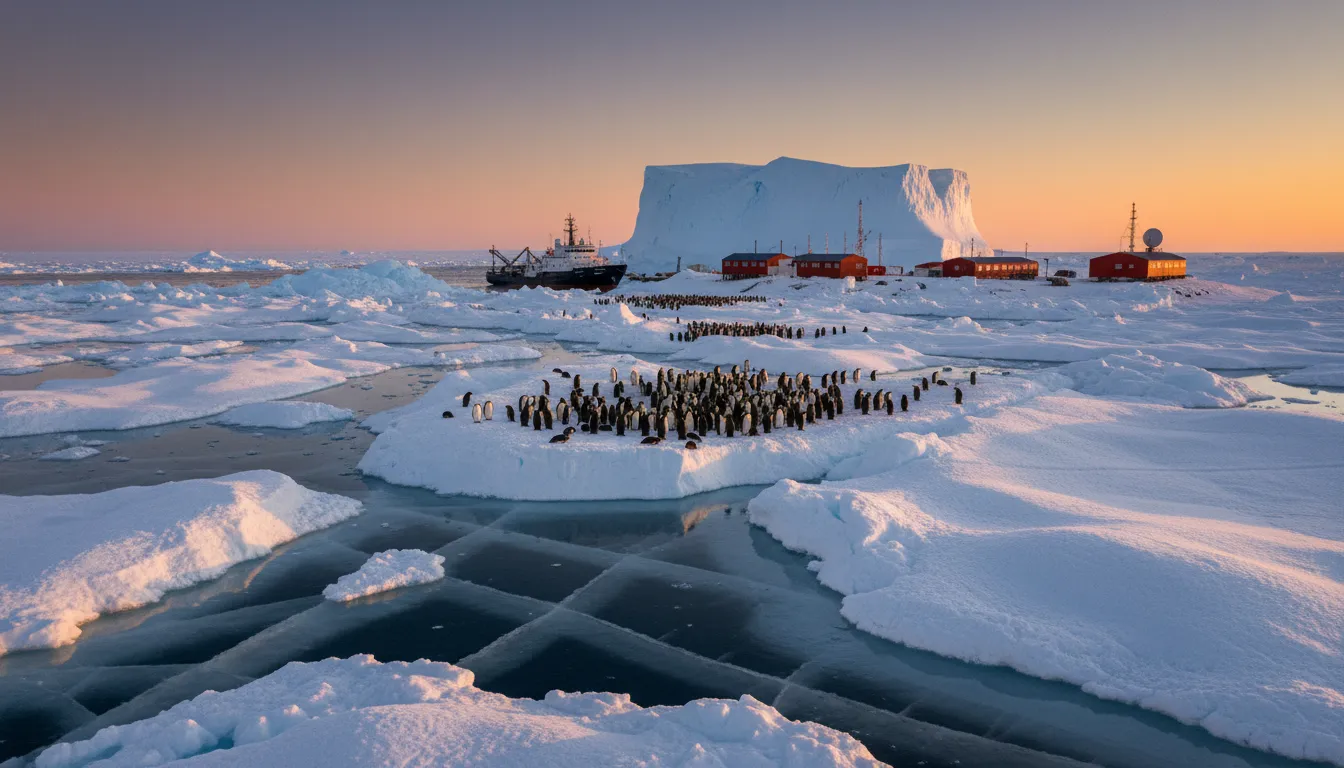
The emperor penguin (Aptenodytes forsteri) is the tallest and heaviest of all penguin species, standing up to 1.2 metres tall and weighing as much as 45 kilograms. It is also the only animal on Earth that breeds during the Antarctic winter, when temperatures plunge below −40°C and winds exceed 200 km/h. This extreme lifestyle is not reckless—it is precisely timed to give chicks the best chance of survival.
A Breeding Cycle Built on Ice
Every March, as autumn descends on Antarctica, emperor penguins trek inland across sea ice to reach their breeding colonies. There are roughly 66 known colonies, all located on or near the Antarctic coastline. After pairing off, the female lays a single egg in May or June, then transfers it to the male and departs for the open ocean to feed.
The male incubates the egg on top of his feet, tucked beneath a warm fold of skin called the brood pouch. For the next 65 to 75 days, he eats nothing. Males huddle together in rotating groups of thousands—those on the windward edge slowly cycle to the sheltered centre—reducing heat loss by up to 50%. By the time the chick hatches, the father has fasted for roughly four months and may have lost nearly half his body weight.
The female returns around hatching time, locating her mate by his unique call. From then on, both parents take turns walking to the sea to catch fish, squid, and krill—the tiny crustacean that underpins the entire Antarctic food web. By January, as summer warmth begins breaking up the sea ice, the chicks have moulted their downy grey feathers for waterproof adult plumage and head to the ocean for the first time.
Why Sea Ice Is Non-Negotiable
This entire cycle depends on one thing: stable fast ice—sea ice that is anchored to the coastline or seabed. The ice must remain intact from roughly April through January for a breeding season to succeed. If it breaks up too early, chicks that have not yet developed waterproof feathers drown or freeze. If ice extends too far, adults must walk longer distances to reach open water for food, and some abandon their eggs rather than starve.
Emperor penguins also need sea ice during their annual moult, a two- to three-week period when they shed and regrow all their feathers at once. During this time they are not waterproof and cannot enter the water, making stable ice platforms essential for survival.
A Crisis Measured From Space
Scientists monitor emperor penguin colonies primarily through satellite imagery—the birds' dark bodies and guano stains are visible against the white ice from orbit. What satellites have revealed in recent years is alarming.
In 2022, record-low Antarctic sea ice caused catastrophic breeding failure at four of five colonies in the Bellingshausen Sea. An estimated 9,000 chicks perished when the ice beneath them disintegrated before they could fledge, according to a study published in Communications Earth & Environment. Between 2018 and 2022, roughly 30% of all known colonies were affected by partial or total sea-ice loss.
More recent data paints an even grimmer picture. Penguin populations in the Bellingshausen and Weddell Sea regions declined by 22% between 2009 and 2023—a rate of 1.6% per year, exceeding earlier model predictions. Globally, the adult population stands at fewer than 600,000 individuals, down at least 10% from 2009 estimates.
From Near Threatened to Endangered
On April 9, 2026, the International Union for Conservation of Nature (IUCN) officially upgraded the emperor penguin's Red List status from Near Threatened to Endangered. Current projections suggest the global population could halve by the 2080s under present warming trends, and over 90% of colonies could become quasi-extinct by the end of the century.
Unlike many endangered species, emperor penguins face no significant threat from hunting, habitat development, or invasive predators. Their fate is tied almost entirely to the trajectory of global greenhouse gas emissions and their effect on Antarctic sea ice. Protecting this species, scientists say, ultimately means addressing climate change itself.