How Humans First Reached Australia by Sea 60,000 Years Ago
Aboriginal Australians are Earth's oldest civilization outside Africa. Reaching their continent required crossing open ocean on simple rafts — the earliest known seafaring in human history.
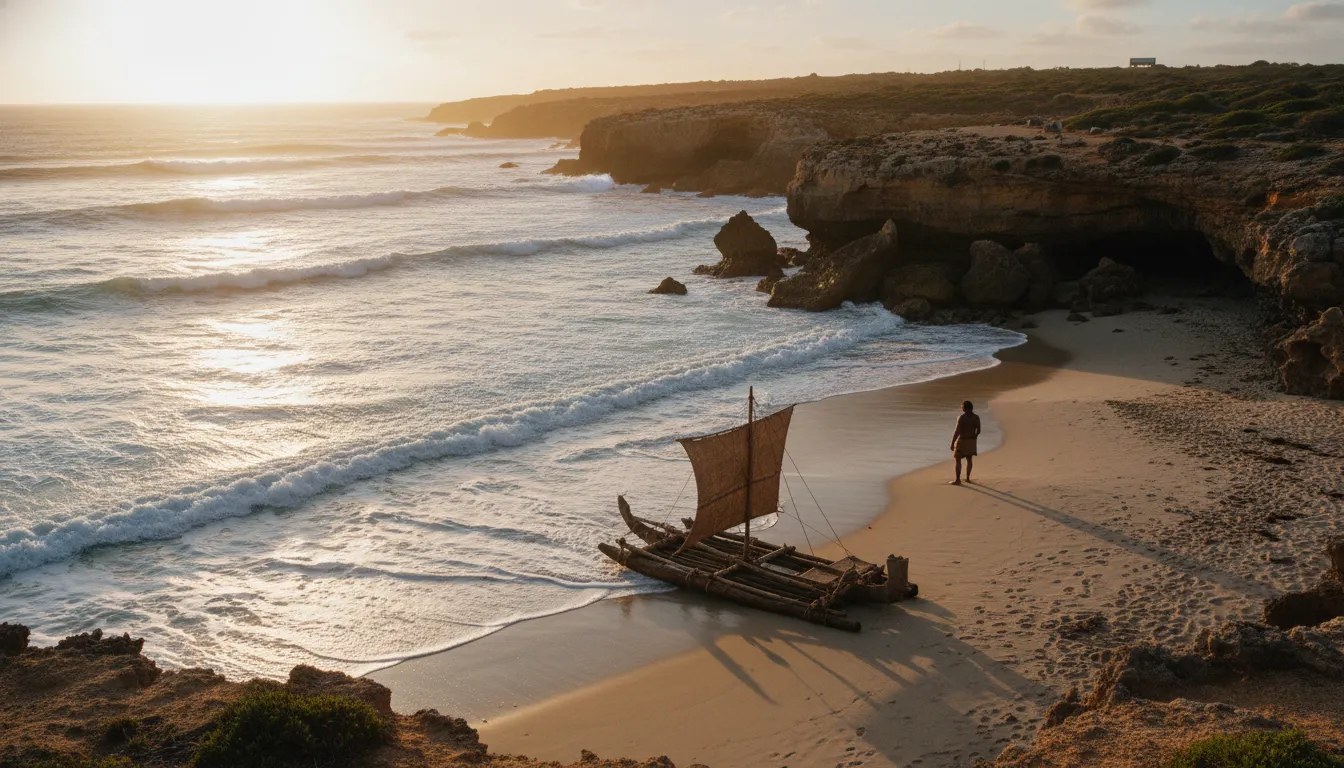
The Longest Voyage in Prehistory
Around 60,000 years ago, small groups of Homo sapiens stood on the shores of Southeast Asia and looked south across open water. No human had ever crossed such a stretch of ocean. Yet they did — on simple bamboo rafts or dugout canoes — and became the ancestors of Aboriginal Australians, the oldest continuous civilization outside Africa.
How they pulled it off remains one of archaeology's most fascinating puzzles. New genetic and archaeological evidence is finally filling in the picture, revealing not one migration route but two, and a level of planning that rewrites assumptions about early human capability.
Sahul: A Lost Continent
During the last Ice Age, sea levels were roughly 60–80 metres lower than today. Australia, New Guinea, and Tasmania were joined into a single massive landmass called Sahul. Southeast Asia's islands, meanwhile, formed a larger peninsula known as Sunda. But even with those lower seas, a chain of deep-water straits — including the famous Wallace Line — separated the two continents. No land bridge ever connected them.
That meant reaching Sahul required crossing at least 60–100 kilometres of open ocean, depending on the route. It was, by a wide margin, the earliest deliberate sea crossing in recorded human prehistory.
Two Routes, One Destination
A landmark genetic study published in Science Advances analysed 2,456 genomes from ancient and living Indigenous communities across Oceania. The results revealed two distinct migration pathways:
- A northern route — from the Philippines and Sulawesi, island-hopping southward into what is now New Guinea.
- A southern route — from mainland Southeast Asia through the Indonesian archipelago, crossing the deepest water gaps to reach northern Australia.
Both groups descended from a single population that left Africa roughly 70,000–80,000 years ago. They split somewhere in South or Southeast Asia, perhaps 10,000–20,000 years before reaching Sahul, and arrived at approximately the same time — around 60,000 years ago.
Evidence on the Ground
The genetic timeline aligns with physical evidence. At Madjedbebe, a sandstone rock shelter in Arnhem Land in Australia's Northern Territory, excavations have uncovered artefacts dated to as early as 65,000 years ago — including the world's oldest known edge-ground hatchets, grinding stones, and ochre pigments. Though some researchers have questioned the earliest dates, citing possible site disturbance by termites, the broader consensus places first human occupation of Australia at no later than 50,000 years ago and quite possibly earlier.
Other sites across northern Australia and New Guinea reinforce the picture of rapid colonisation once people made landfall on Sahul.
What the Crossing Tells Us
The voyage to Sahul was not a lucky accident. Researchers believe it required deliberate planning: building watercraft, reading ocean currents and winds, and carrying enough food and fresh water for a multi-day crossing. Some scholars argue the migrants may have seen smoke from natural bushfires on distant shores, giving them a target to aim for.
The feat also implies social organisation. A viable founding population — enough people to avoid genetic bottleneck — would have numbered in the hundreds, suggesting coordinated, possibly repeated crossings rather than a single boatload of castaways.
As CNN reported, a comprehensive DNA study confirmed Aboriginal Australians as Earth's oldest civilisation, with an unbroken lineage stretching back tens of thousands of years — longer than any other population outside Africa.
Why It Matters
Understanding the settlement of Australia reshapes how we think about early humans. These were not primitive wanderers stumbling onto new land. They were navigators, planners, and innovators who mastered ocean travel millennia before the Polynesians or the Phoenicians. Their achievement stands as the earliest proof that humans could look at a horizon, imagine what lay beyond it, and build the technology to get there.