How Japan's Article 9 Works—and Why It's Eroding
Japan's pacifist constitution, written after World War II, renounces war and forbids military force. But decades of reinterpretation have steadily expanded what the Self-Defense Forces can do, culminating in the recent lifting of lethal weapons export bans.
A Constitution Born From Defeat
In the ruins of World War II, the Allied occupation authorities led by General Douglas MacArthur oversaw the drafting of a new Japanese constitution. Its most radical provision was Article 9, which states: "The Japanese people forever renounce war as a sovereign right of the nation and the threat or use of force as means of settling international disputes." A second paragraph adds that "land, sea, and air forces, as well as other war potential, will never be maintained."
Promulgated in November 1946 and effective from May 1947, the clause was designed to ensure that Japan could never again wage aggressive war. Its precise authorship remains debated — former Prime Minister Kijūrō Shidehara claimed the idea as his own, while others credit MacArthur's staff, particularly aide Charles Kades. Either way, the clause became the constitutional bedrock of postwar Japanese identity.
The Self-Defense Loophole
Article 9's absolute language did not survive contact with Cold War reality for long. As tensions with the Soviet Union and China escalated, Washington reversed course and encouraged Japan to rearm. In 1954, Tokyo established the Japan Self-Defense Forces (JSDF), arguing that the constitution prohibited only offensive "war potential," not the minimum force needed for self-defense.
This reading hinged on a subtle but crucial addition made during drafting. Legislator Hitoshi Ashida inserted the phrase "In order to accomplish the aim of the preceding paragraph" before the ban on military forces — language later interpreted to mean Japan could maintain forces as long as they served defense rather than aggression.
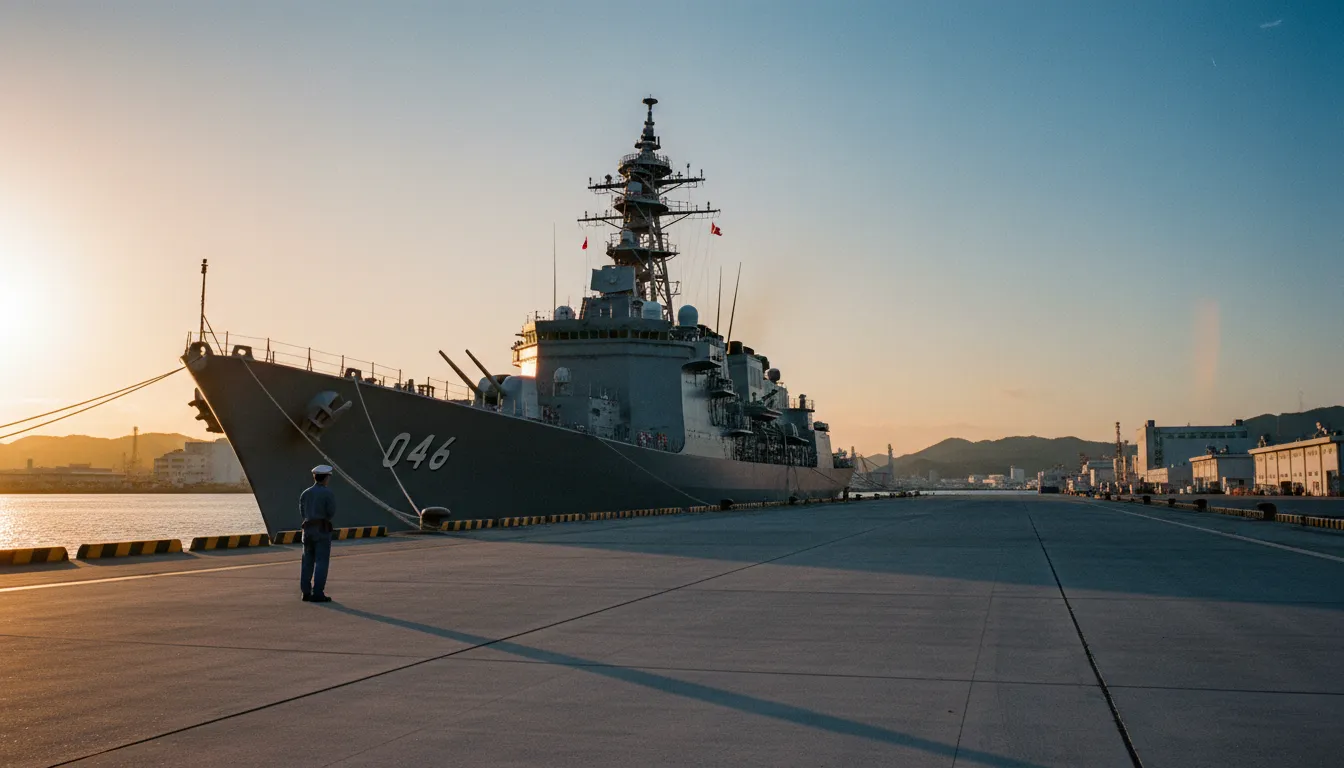
The result is a legal fiction that has persisted for decades. The JSDF today fields approximately 230,000 active personnel, operates advanced destroyers and fighter jets, and ranks among the world's most capable military forces — all while technically not being a "military" under the constitution.
Decades of Stretching the Rules
Each generation has pushed Article 9's boundaries further:
- 1967: Prime Minister Satō Eisaku established the Three Principles on Arms Exports, banning weapons sales to communist nations, UN-embargoed countries, and states in conflict. By 1976, these expanded into a near-total export ban.
- 1992: Japan passed the International Peace Cooperation Act, allowing JSDF personnel to participate in UN peacekeeping operations for the first time.
- 2014: Prime Minister Shinzo Abe's cabinet reinterpreted Article 9 to permit collective self-defense — meaning Japan could use force to defend an ally under attack, not just itself. The Diet formalized this in security legislation passed in September 2015.
- 2014: The blanket arms export ban was replaced with the Three Principles on Defense Equipment Transfers, allowing exports under strict conditions.
From Pacifism to Power Projection
Japan's defense transformation has accelerated sharply. Under a five-year Defense Buildup Program launched in 2022, Tokyo committed 43 trillion yen (roughly $275 billion) through fiscal year 2027, aiming to raise defense spending to 2% of GDP — a level long considered taboo. By fiscal year 2025, Japan reached that target two years early, with spending hitting approximately $70 billion.
The country has acquired long-range cruise missiles capable of striking enemy bases, converted helicopter carriers into platforms for F-35B stealth fighters, and partnered with the UK and Italy to develop a next-generation fighter jet under the Global Combat Air Programme.
Most recently, the government scrapped remaining restrictions on lethal weapons exports. The new framework permits sales of fighter jets, missiles, and warships to the 17 countries with which Japan has defense equipment transfer agreements, subject to National Security Council approval.
Why Article 9 Still Matters
Despite the erosion, Article 9 retains real force. It shapes public debate, constrains political choices, and provides a legal framework that opponents can invoke. Polls consistently show a significant portion of the Japanese public opposes formal constitutional amendment — even as majorities support a stronger defense posture.
China has condemned what it calls Japan's "reckless militarisation." Domestically, constitutional scholars warn that stretching Article 9 through reinterpretation rather than amendment undermines the rule of law. Supporters counter that the security environment — from North Korean missiles to Chinese military expansion — demands adaptation.
The tension at the heart of Article 9 remains unresolved: a clause written to prevent war, governing a nation that increasingly prepares for one.