How Mammals Stopped Laying Eggs—the Long Road
All mammals descend from egg-laying ancestors called synapsids. Here's how the transition from leathery eggs to live birth unfolded over 300 million years—and why a few species never made the switch.
The Egg-Laying Origins of Every Mammal
Every human, whale, and house cat alive today descends from ancestors that laid eggs. More than 300 million years ago, a group of four-limbed vertebrates called synapsids split from the lineage that would eventually produce reptiles and birds. These proto-mammals dominated the land long before dinosaurs appeared—and they reproduced the same way most animals did: by depositing eggs.
Synapsids are often mislabelled "mammal-like reptiles," but that term is outdated. They belong to an entirely separate branch of the amniote family tree. Their defining feature is a single opening low in the skull behind each eye socket—a structural detail that gave the group its name and set it apart from the two-opening skulls of true reptiles.
Lystrosaurus and the Soft-Shelled Secret
One of the best-studied synapsids is Lystrosaurus, a stocky, tusked herbivore roughly the size of a pig. It lived around 250 million years ago and was one of the few land vertebrates to survive the Permian mass extinction—the worst die-off in Earth's history, which wiped out about 90 percent of all species.
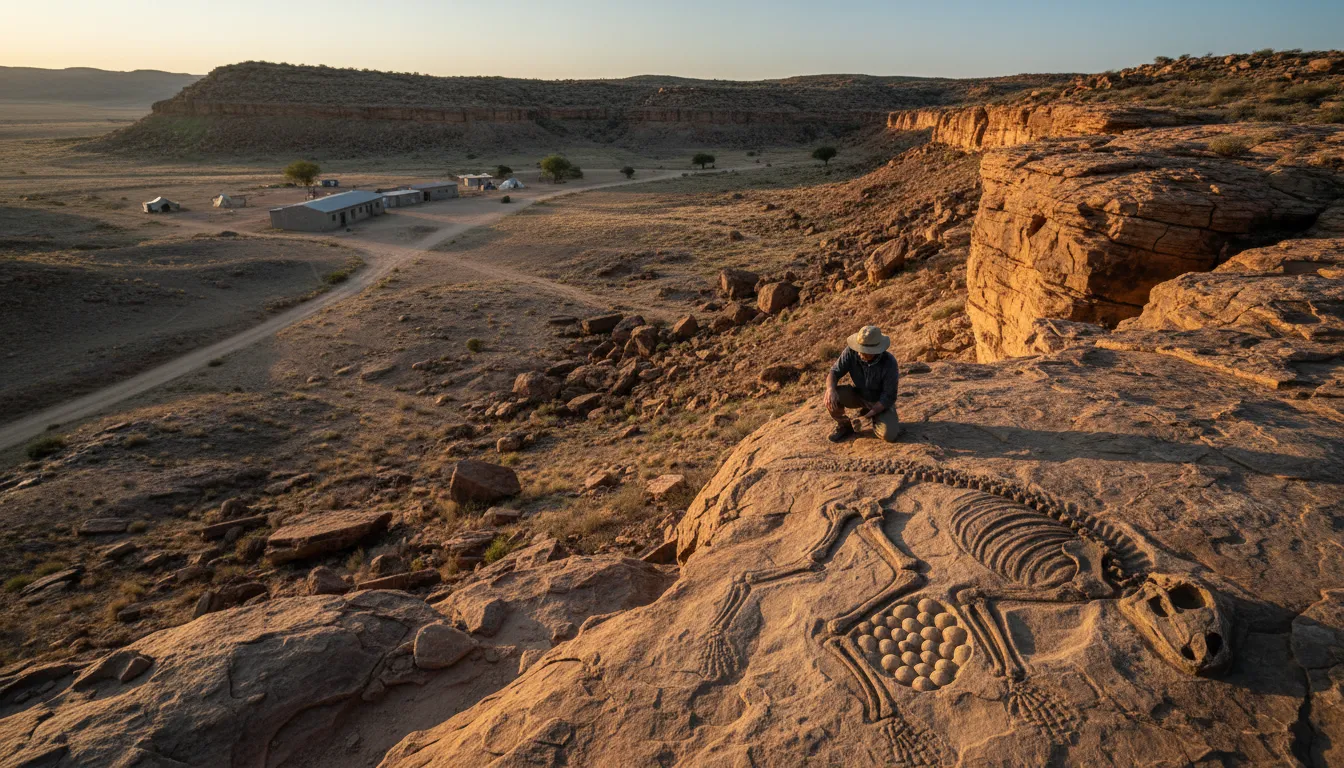
Scientists long suspected that non-mammalian synapsids laid eggs, but direct evidence was scarce. In 2026, researchers led by Professor Julien Benoit at the University of the Witwatersrand announced the discovery of a Lystrosaurus embryo curled inside what appears to have been a large, soft-shelled egg—the first confirmed egg from a mammal ancestor ever found.
Soft, leathery shells explain why synapsid eggs almost never fossilise. Unlike the hard, calcified eggs of dinosaurs and birds, soft shells decompose rapidly. The Lystrosaurus specimen survived only because of exceptional preservation conditions in Early Triassic rocks in South Africa.
Why Eggs Worked—Then Didn't
Egg-laying gave Lystrosaurus a survival edge after the Permian catastrophe. Large, yolk-rich eggs resisted drying out better than small ones, and hatchlings emerged precocial—already capable of feeding and evading predators. In a devastated world of extreme heat and drought, that head start mattered.
But when dinosaurs rose to dominance in the Mesozoic era, mammals were forced into the margins. Most shrank to the size of mice or shrews. At such small body sizes, eggs become a liability: tiny eggs produce extremely undeveloped hatchlings that are easy prey. Retaining embryos inside the body allowed young to develop longer and emerge more capable.
According to paleontologist Christian Sidor of the University of Washington, the simplest interpretation of the fossil record is that live birth evolved once—in the common ancestor of marsupials and placental mammals—probably during the Jurassic period, roughly 160 to 190 million years ago.
The Monotremes: Living Fossils That Never Switched
Not every mammal made the transition. The monotremes—the platypus and four species of echidna—still lay eggs. They diverged from the rest of the mammalian family tree between 163 and 187 million years ago, before live birth fully evolved. Isolated in Australia and New Guinea, with few placental competitors for tens of millions of years, monotremes had no evolutionary pressure to abandon their ancient reproductive strategy.
Monotremes still produce milk, but they lack nipples; instead, milk seeps through patches of skin. This likely mirrors an intermediate stage in mammary gland evolution. Early synapsids may have moistened their eggs with glandular skin secretions—glands that, over millions of years, transformed into the milk-producing mammary glands that define all mammals today.
From Jaw Bones to Ear Bones
Reproduction was not the only thing that changed. One of the most remarkable transitions in vertebrate history happened inside the synapsid skull. Over time, bones that formed part of the jaw joint in early synapsids shrank, migrated, and became the tiny middle ear bones—the hammer, anvil, and stirrup—that give mammals their acute hearing. This gradual transformation, documented across dozens of fossil species, remains one of the clearest examples of large-scale evolutionary change preserved in the fossil record.
Why It Matters
The synapsid-to-mammal story is more than a curiosity. It reveals how reproductive strategies, body size, and ecological pressure interact to shape evolutionary outcomes. Every mammal on Earth—from a blue whale nursing its calf to a platypus incubating a leathery egg—carries the legacy of those ancient, egg-laying ancestors that first walked the supercontinent Pangaea over 300 million years ago.