How Mu2e Hunts for Physics Beyond the Standard Model
Fermilab's Mu2e experiment aims to catch a muon converting into an electron without emitting neutrinos—a process forbidden by the Standard Model that could reveal entirely new forces and particles.
A Forbidden Transformation
Deep beneath the prairies of Batavia, Illinois, a 28-meter-long apparatus at Fermilab is preparing to watch for something that should never happen. The Mu2e experiment—short for Muon-to-Electron Conversion Experiment—will scrutinize quadrillions of muons, waiting for just one to break the rules of physics as we know them.
The rule in question is charged lepton flavor conservation, a principle baked into the Standard Model of particle physics. According to this framework, muons—heavier cousins of electrons—can decay into lighter particles, but they must always produce neutrinos in the process. A muon converting directly into an electron near an atomic nucleus, with no neutrinos at all, would be an unmistakable signal that unknown forces or particles are at work.
Why Muons Matter
Physicists already know that neutrinos violate flavor conservation: they oscillate between types as they travel. But the same behavior has never been observed in charged leptons—electrons, muons, and tau particles. Many theories that extend the Standard Model, including supersymmetry, leptoquark models, and extra-dimensional frameworks, predict that charged lepton flavor violation (CLFV) should occur, just at extraordinarily low rates.
Muons are ideal for this search. They do not decay into hadrons, they live long enough (about 2.2 microseconds) to be captured and studied, and they can be produced in enormous quantities. That combination gives experimenters a clean, high-statistics environment—exactly what is needed to spot an event that may occur fewer than once in every 100 quadrillion muon interactions.
How the Experiment Works
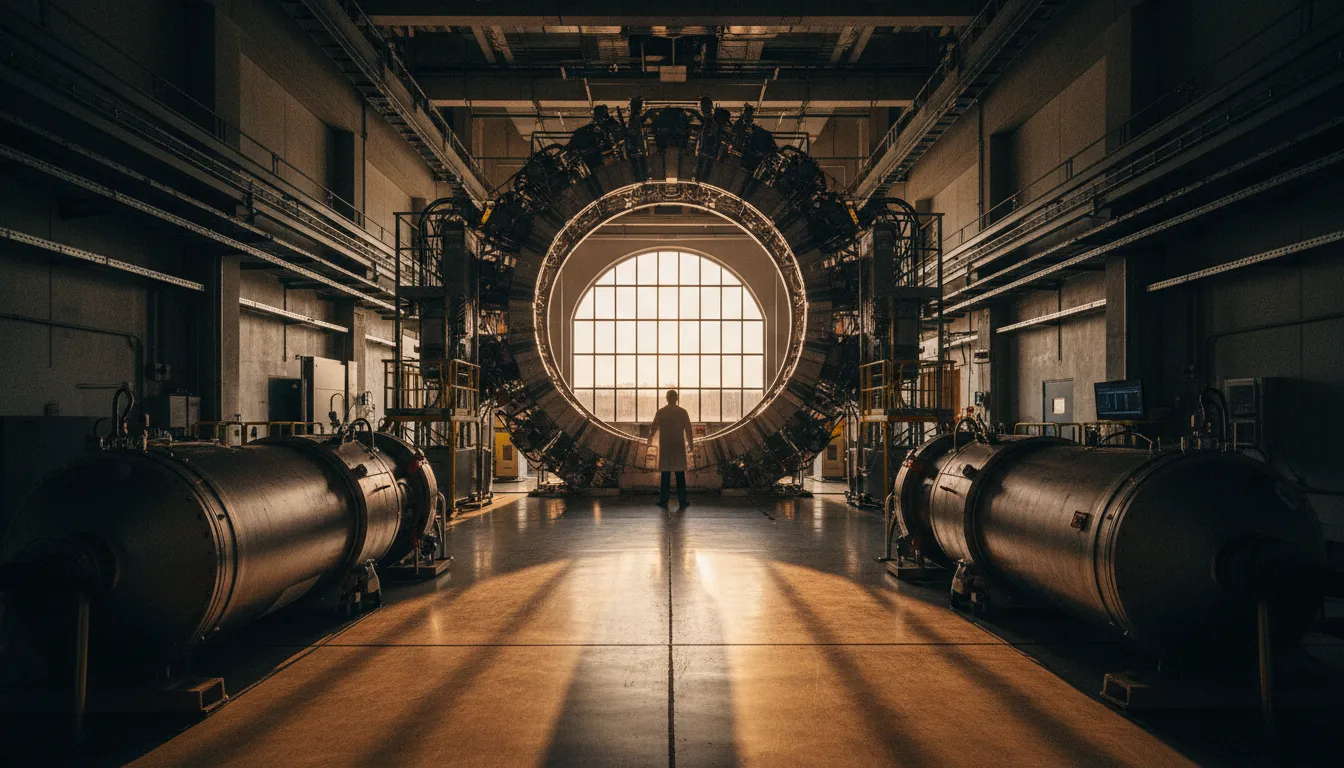
Mu2e uses a chain of three superconducting solenoid magnets, each with a distinct role:
- Production Solenoid: An 8 GeV proton beam from Fermilab's Booster accelerator slams into a pencil-sized tungsten target, producing a shower of pions that quickly decay into muons. The system generates between 200 and 500 quadrillion muons per year.
- Transport Solenoid: Fifty separate superconducting electromagnets guide and filter the muon beam by charge and momentum, directing low-energy negative muons toward the detector while discarding unwanted particles.
- Detector Solenoid: Muons strike a thin aluminum stopping target (roughly 0.2 mm thick) and are captured into orbit around aluminum nuclei. If a muon converts directly into an electron, that electron flies out with a telltale energy of exactly 104.97 MeV—a unique signature that separates it from ordinary decay products.
Two instruments catch the signal. A straw-tube tracker made of 18 panels with 96 straw tubes each measures the electron's momentum with extreme precision. Downstream, an electromagnetic calorimeter built from cesium iodide crystals confirms the particle's energy and timing. A cosmic ray veto system surrounding the apparatus filters out background noise from space.
10,000 Times More Sensitive
Mu2e is designed to reach a sensitivity of 5 × 10⁻¹⁷—four orders of magnitude beyond the previous best experiment, SINDRUM II, which ran at the Paul Scherrer Institute in Switzerland. At this level, the detector can probe effective energy scales up to 10,000 TeV, far beyond what any particle collider, including the Large Hadron Collider, can reach directly.
This indirect reach is what makes CLFV searches so powerful. Rather than smashing particles at higher and higher energies, Mu2e looks for the subtle quantum fingerprints that massive, undiscovered particles would leave on muon behavior.
What Discovery Would Mean
If Mu2e detects even a single confirmed muon-to-electron conversion, it would be the first direct evidence of charged lepton flavor violation and an unambiguous sign of physics beyond the Standard Model. Such a discovery could help explain some of the deepest puzzles in physics: why matter dominates over antimatter in the universe, and what gives neutrinos their tiny masses.
Even a null result would be valuable, ruling out large swaths of theoretical parameter space and tightening constraints on models from supersymmetry to heavy neutral leptons.
With over 240 scientists from 40 institutions across six countries, and a price tag of $271 million, Mu2e represents one of the most ambitious precision physics experiments of its generation. As co-spokesperson Stefano Miscetti put it after more than a decade of construction: "We finally see the experiment taking shape." The physics community is watching closely—because if Mu2e finds what it is looking for, particle physics will never be the same.