How Combat Search and Rescue Works Behind Enemy Lines
When a military pilot is shot down over hostile territory, a complex rescue machine springs into action. Here is how combat search and rescue missions locate, protect, and extract isolated personnel from the world's most dangerous environments.
The Mission No One Wants—but Everyone Plans For
Every combat pilot knows the risk: an engine failure, a missile strike, and suddenly you are descending by parachute into hostile territory. What happens next depends on one of the most intricate military operations ever devised—Combat Search and Rescue, or CSAR. It is the discipline of locating, communicating with, and recovering isolated personnel from enemy-controlled environments, and it can mean the difference between life and captivity.
The United States Air Force serves as the Department of Defense's lead service for CSAR, maintaining specially trained units, dedicated aircraft, and rehearsed procedures designed to bring people home from the worst places on Earth.
What a Downed Pilot Does First
Long before a pilot ever faces a real emergency, every aircrew member completes SERE training—Survival, Evasion, Resistance, and Escape. This intensive program, originally developed by the British during World War II, teaches four core skills: staying alive in extreme conditions, avoiding detection by enemy forces, resisting interrogation if captured, and escaping back to friendly lines.
When a pilot ejects, the survival clock starts immediately. While still descending by parachute, they are trained to scan the terrain below for cover, threats, and potential rally points. Upon landing, the ejection seat's built-in survival kit becomes their mobile base. It typically includes a radio, signal mirror, flares, water, first-aid supplies, a compass, and sometimes a sidearm. Many pilots also carry a "blood chit"—a multilingual document offering a reward to any civilian who helps return the service member to friendly forces.
The pilot's first priority is to move away from the landing site, find concealment, and establish radio contact with overhead aircraft or a rescue coordination center.
How the Rescue Machine Activates
The moment an aircraft goes down, the military's personnel recovery apparatus kicks into gear. A Joint Personnel Recovery Center verifies the loss and begins coordinating assets. A typical CSAR task force is a carefully orchestrated package that may include:
- Rescue helicopters—such as the HH-60W Jolly Green II, an armed, all-weather aircraft with aerial refueling capability and a combat range of roughly 690 miles
- Fighter escorts to suppress enemy air defenses along the ingress route
- Electronic warfare aircraft to jam radar and communications
- Aerial refueling tankers to extend the helicopters' reach deep into hostile territory
- An airborne command post orchestrating the entire operation in real time
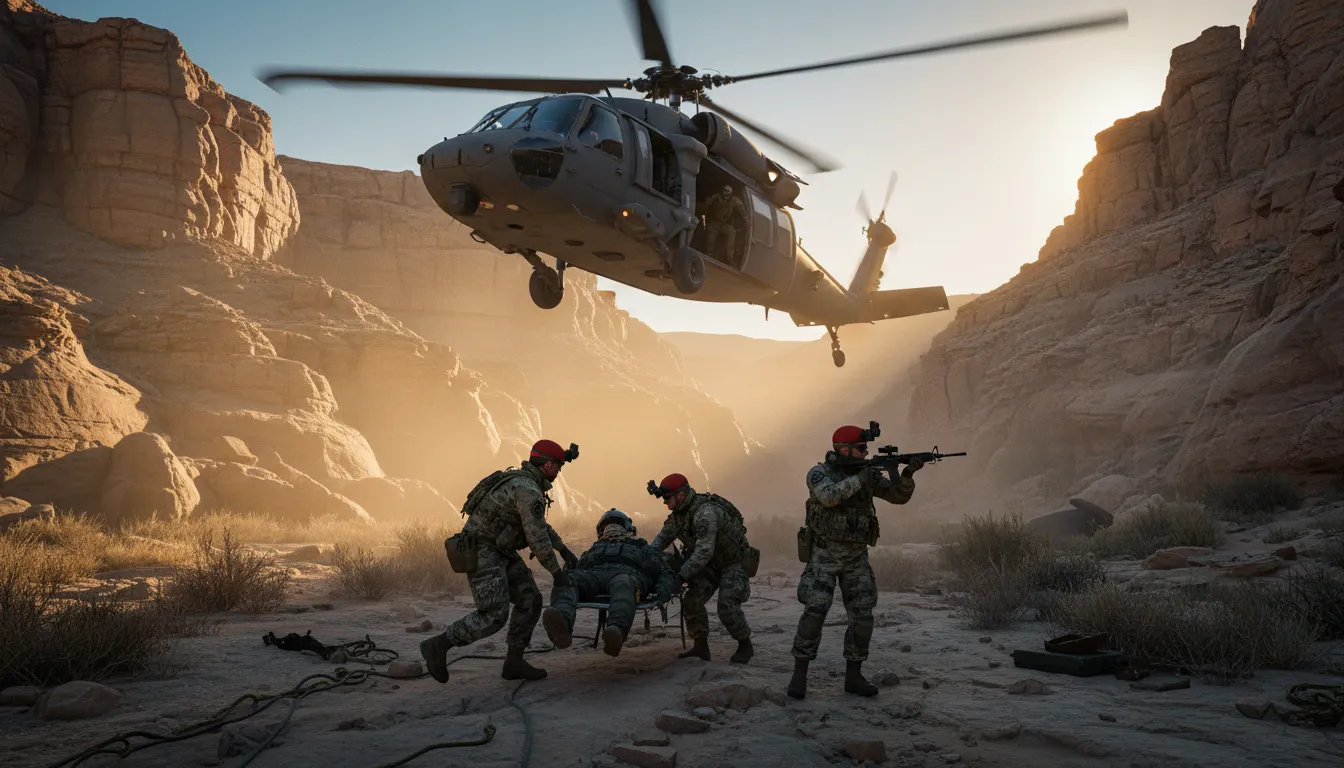
At the tip of this spear are the Pararescuemen, universally known as PJs. Their motto—"These Things We Do, That Others May Live"—captures a dual identity: they are both elite special operators and fully qualified paramedics. PJs parachute, fast-rope, or land by helicopter into hostile terrain, locate the survivor, provide emergency medical care, and coordinate extraction.
Why CSAR Matters Beyond One Pilot
Combat search and rescue is not merely a humanitarian gesture. It carries profound strategic value. Knowing that their military will move mountains to bring them home gives pilots and special operators the confidence to fly deep into contested airspace. If personnel recovery fails—or worse, if a captured pilot is paraded on enemy television—the psychological and political damage can shift the trajectory of a conflict.
The discipline traces its modern roots to World War II, when surgeons parachuted into the jungles of Burma in 1943 to treat crash survivors. It matured during the Vietnam War, where figures like Airman Duane Hackney earned the Air Force Cross for rescuing downed crews under fire. Every conflict since has refined the doctrine further.
The Evolving Challenge
Modern CSAR faces threats previous generations never imagined. Advanced surface-to-air missiles, networked air defenses, surveillance drones, and thermal imaging make evasion harder and rescue flights more dangerous. The Air Force's newest rescue platform, the HH-60W Jolly Green II, was designed specifically for this environment, with a digital glass cockpit, improved high-altitude performance, enhanced self-defense systems, and double the internal fuel capacity of its predecessor.
Despite the technology, the core of CSAR remains unchanged: highly trained people risking their lives so that no one is left behind. It is among the most dangerous missions any military unit can undertake—and among the most essential.