How Nuclear Meltdowns Work—From Fuel Rod to Fallout
A nuclear meltdown occurs when reactor fuel overheats beyond cooling capacity. Understanding the physics of decay heat, loss-of-coolant accidents, and containment failure explains why meltdowns happen and how modern safety systems aim to prevent them.
What Is a Nuclear Meltdown?
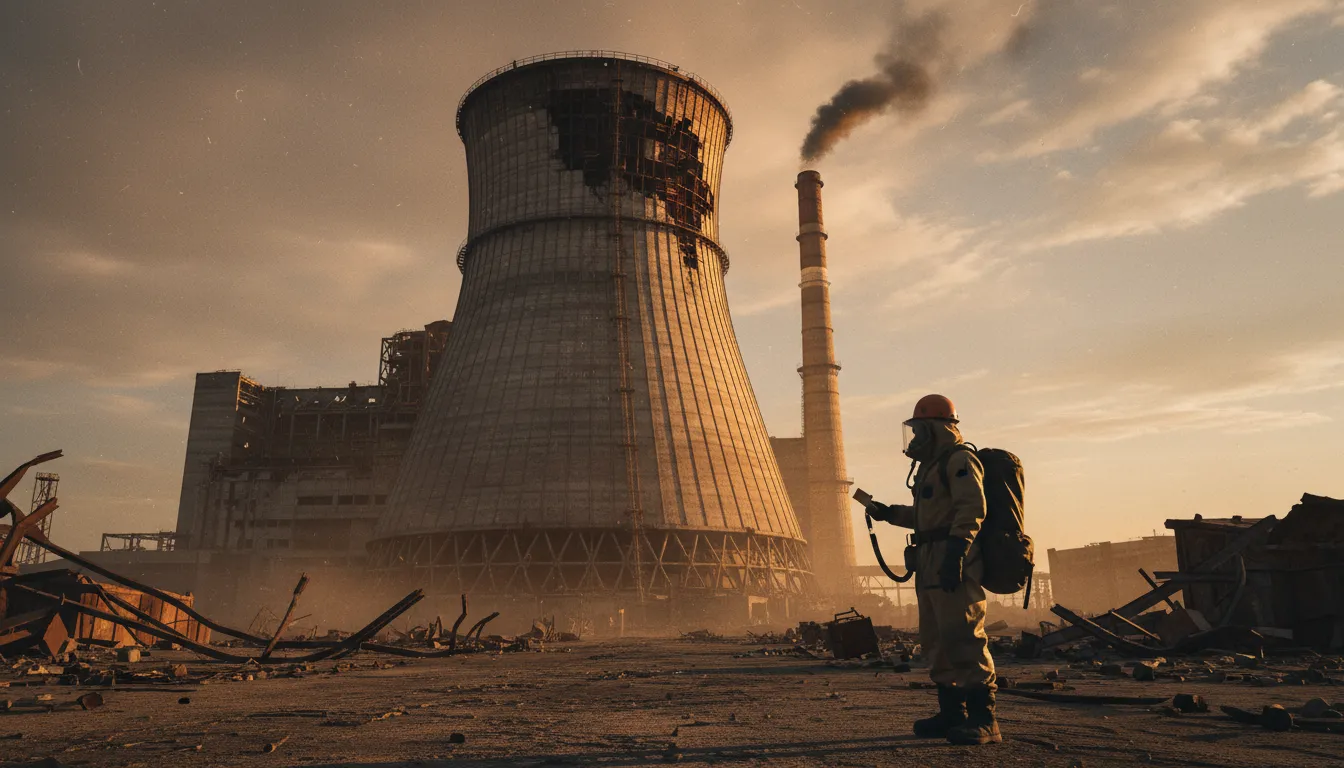
A nuclear meltdown is a severe reactor accident in which the fuel core overheats to the point where fuel elements begin to melt. It is not an explosion in the nuclear-weapon sense—no reactor can detonate like a bomb—but it can release enormous amounts of radioactive material into the environment. Three major meltdowns have shaped public understanding of nuclear risk: Three Mile Island (1979), Chernobyl (1986), and Fukushima Daiichi (2011).
The Root Cause: Decay Heat
Even after operators insert control rods and halt the fission chain reaction, the fuel keeps generating heat. This decay heat—produced by the ongoing radioactive decay of fission products—initially equals about 5–6% of the reactor's full thermal output. That may sound modest, but for a large power reactor it translates to tens of megawatts of heat with no way to switch it off. If the cooling system fails at this stage, temperatures climb relentlessly.
Every meltdown scenario ultimately traces back to the same problem: heat production outpaces heat removal. The trigger can be a loss-of-coolant accident (a pipe break that drains water from the core), a power failure that stops coolant pumps, or—as at Chernobyl—an uncontrolled power surge that overwhelms cooling capacity.
How a Meltdown Unfolds—Stage by Stage
A meltdown is not a single event but a cascade of failures, each raising temperatures further:
- Cladding failure (~600 °C): The zirconium-alloy tubes encasing the fuel pellets begin to balloon and burst, breaching the first barrier against radiation release.
- Rapid oxidation (~1,230 °C): Steam reacts with the zirconium cladding, producing hydrogen gas and releasing additional heat that can exceed decay heat itself. Hydrogen accumulation is dangerous—it caused the explosions that blew the roofs off reactor buildings at Fukushima.
- Core melting (~1,430 °C and above): Control materials liquefy and flow downward. If temperatures continue rising past 2,800 °C, the uranium dioxide fuel itself melts into a molten mass called corium—an intensely radioactive lava that can burn through the steel reactor vessel.
- Containment threat: If corium breaches the vessel and contacts water, steam explosions can challenge the concrete containment structure—the last barrier between radioactive material and the outside world.
Defense in Depth: Four Barriers
Reactor designers assume that any single safety system can fail. The principle of defense in depth layers multiple independent barriers between radioactive fuel and the environment:
- Fuel ceramic: Uranium dioxide pellets are inherently resistant to high temperatures.
- Fuel cladding: Zirconium-alloy tubes seal each fuel rod.
- Reactor vessel and coolant system: A steel pressure vessel with walls up to 30 cm thick contains the core.
- Containment building: A reinforced concrete structure with walls at least one metre thick, designed to withstand internal pressures of 275–550 kPa.
A meltdown becomes a large-scale disaster only when all four barriers are breached. At Three Mile Island, the containment held and environmental releases were minimal. At Chernobyl, the reactor had no robust containment building, and the explosive power surge scattered fuel directly into the atmosphere.
Measuring Severity: The INES Scale
The International Nuclear and Radiological Event Scale (INES), introduced by the IAEA in 1990, rates nuclear events on a logarithmic scale from 0 to 7—each level roughly ten times more severe than the last. Three Mile Island rated Level 5 (accident with wider consequences), while both Chernobyl and Fukushima received the maximum Level 7 (major accident). However, Chernobyl released roughly ten times more radioactivity than Fukushima, illustrating the scale's limitations in distinguishing between events at its upper bound.
Modern Safeguards
Today's advanced reactor designs incorporate passive safety systems that rely on gravity, natural convection, and compressed gas rather than pumps or human operators. The Westinghouse AP1000, for example, can cool its core indefinitely after shutdown without external power—a feature sometimes described as "walk-away safe." These designs aim to make the sequence of failures that leads to a meltdown physically impossible, not merely unlikely.
Four decades after Chernobyl, nuclear meltdowns remain rare but consequential events. Understanding the physics behind them—decay heat, hydrogen generation, containment failure—is essential for anyone evaluating the risks and benefits of nuclear energy.