How Continental Rifting Works—Africa's Next Ocean
The East African Rift is slowly splitting the continent in two. Here's how tectonic forces tear landmasses apart and eventually create new ocean basins.
A Continent in Slow Motion
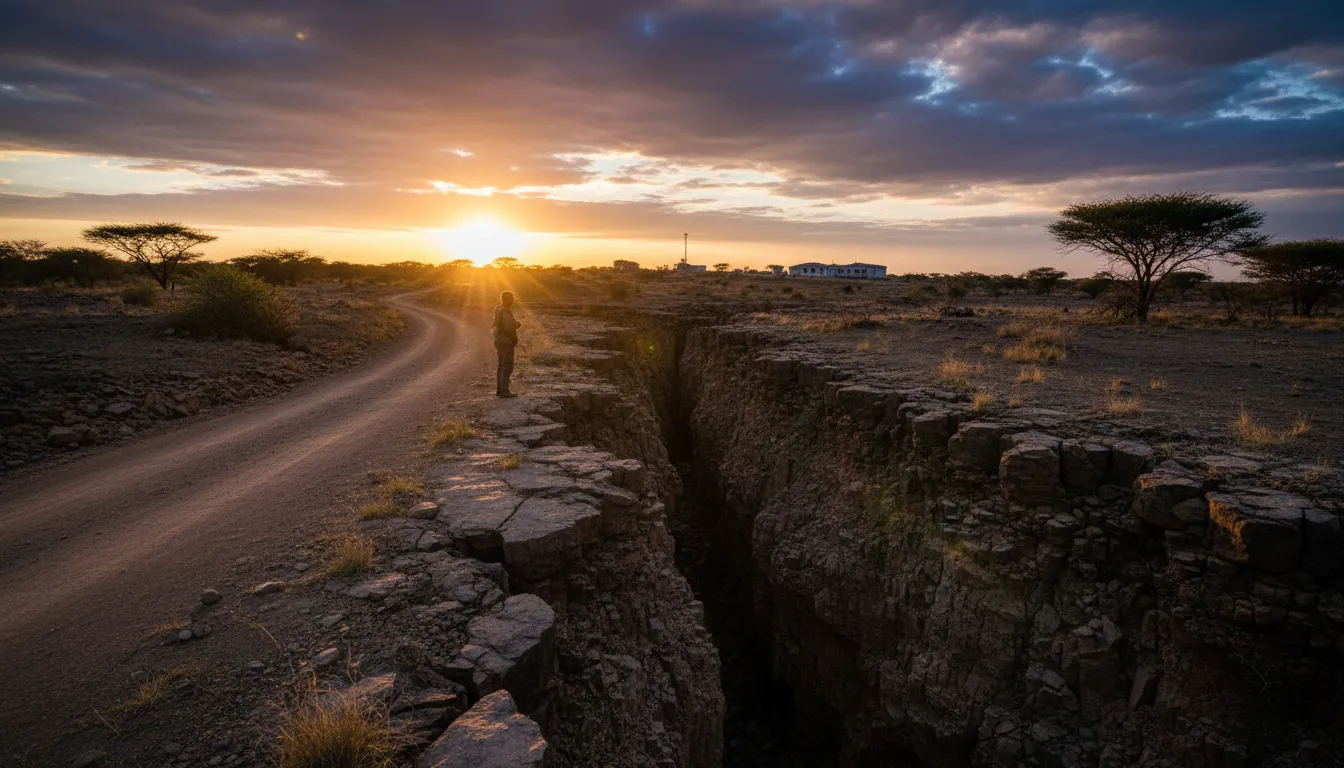
A 3,000-kilometer fracture runs through the heart of East Africa, from the Afar Depression in Ethiopia to Mozambique. It is the most visible example on Earth of continental rifting—the geological process by which a single tectonic plate tears itself apart, eventually creating a new ocean basin. The East African Rift System (EARS) offers scientists a rare, real-time window into the earliest stages of ocean formation, a process that has shaped every ocean on the planet.
What Drives the Split
Continental rifting begins deep below the surface. Mantle plumes—columns of abnormally hot rock rising from Earth's interior—push upward against the base of the lithosphere. This upwelling heats and weakens the rigid crust above, causing it to dome upward and stretch. As tensional forces pull the plate in opposite directions, the thinning crust fractures along normal faults, and blocks of rock drop downward to form rift valleys.
At the Afar triple junction in northern Ethiopia, three rift arms meet: the Red Sea Rift, the Gulf of Aden Rift, and the Main Ethiopian Rift. According to research published in Nature Geoscience, a single, asymmetric mantle upwelling beneath Afar feeds all three arms, controlling the composition and volume of magma that intrudes into the crust. This magma weakens the plate further, accelerating the separation.
The Three Stages of Rifting
Geologists describe continental rifting as a progression through distinct stages:
- Initial rifting: The crust stretches and thins. Normal faults create a rift valley flanked by elevated shoulders. Volcanic activity may begin as decompression melting produces magma. The southern part of the EARS, running through Kenya and Tanzania, is at this early stage.
- Advanced rifting: The continental crust thins dramatically, and basaltic magma begins to intrude along the rift axis—resembling the processes at a mid-ocean ridge, but still on land. The Afar Depression, where the crust is only about 20 kilometers thick, represents this transitional phase.
- Seafloor spreading: The continent fully separates, new oceanic crust forms between the two fragments, and seawater floods in. The Red Sea is a textbook example of a rift that has already reached this final stage.
The East African Rift did not begin all at once. The Gulf of Aden arm started rifting around 35 million years ago, the Red Sea arm around 23 million years ago, and the Main Ethiopian Rift only about 11 million years ago, according to the Geological Society of London.
How Fast Is Africa Splitting?
The Nubian plate (western Africa) and the Somali plate (eastern Africa) are moving apart at roughly 6 to 7 millimeters per year—about the speed at which fingernails grow. That may sound glacial, but over geological time it adds up. Scientists estimate that in 5 to 10 million years, the rift will widen enough for the Indian Ocean to flood in, creating a narrow sea that could eventually rival the Red Sea in size.
Recent observations in the Afar region have confirmed the presence of oceanic-type crust forming beneath the rift—direct evidence that the transition from continent to ocean floor is already underway. As the U.S. National Park Service's geology program explains, once continental crust fully ruptures, the denser, thinner oceanic crust that replaces it sinks below sea level, allowing water to fill the gap.
Why It Matters
The EARS is more than a geological curiosity. The rift valley's unique topography has created the lakes, highlands, and volcanic soils that support millions of people across Ethiopia, Kenya, Uganda, and Tanzania. Many of Africa's Great Lakes—including Tanganyika and Malawi—sit in rift-formed basins. Geothermal energy tapped from rift volcanism already powers a significant share of Kenya's electricity grid.
The rift also holds clues to human origins. The faulting and erosion that shaped the valley have exposed fossil-rich sediments where some of the oldest hominin remains were discovered, making East Africa the cradle of paleoanthropology.
Continental rifting is the opening act of the Wilson Cycle—the grand tectonic process that assembles and breaks apart supercontinents over hundreds of millions of years. Every ocean on Earth, from the Atlantic to the Pacific, began as a crack much like the one running through East Africa. The EARS lets researchers watch that process unfold in real time—one millimeter at a time.