How Organ Cryopreservation Works—and Why It Matters
Scientists are learning to freeze organs without destroying them, using vitrification and nanowarming to turn tissue into glass and bring it back. If perfected, the technology could end the transplant organ shortage that kills thousands each year.
The Organ Shortage Problem
More than 100,000 people sit on the U.S. transplant waiting list at any given time. Every 7.5 minutes, another name is added. Roughly 13 to 16 people die each day because a matching organ does not arrive in time, according to the U.S. Department of Health and Human Services. Part of the problem is supply—fewer than 60 percent of Americans register as donors—but a large part is logistics. A donated kidney survives outside the body for about 24 to 36 hours on ice. A heart lasts four to six hours. If surgeons cannot match, transport, and implant an organ within that window, it goes to waste.
Cryopreservation—freezing organs for weeks, months, or even years—could shatter that bottleneck. The concept has tantalized scientists since the 1950s, but ice has always stood in the way.
Why Ice Destroys Organs
When water freezes, it expands and forms sharp crystals. Inside living tissue, those crystals puncture cell membranes and shred the delicate networks of blood vessels an organ needs to function. Simple freezing, the kind that preserves a bag of peas, is lethal to a human kidney.
The solution researchers have pursued for decades is called vitrification—cooling tissue so rapidly that water molecules never have time to organize into ice. Instead, they lock into an amorphous, glass-like solid. Cells are effectively "frozen in time" without crystal damage.
How Vitrification Works
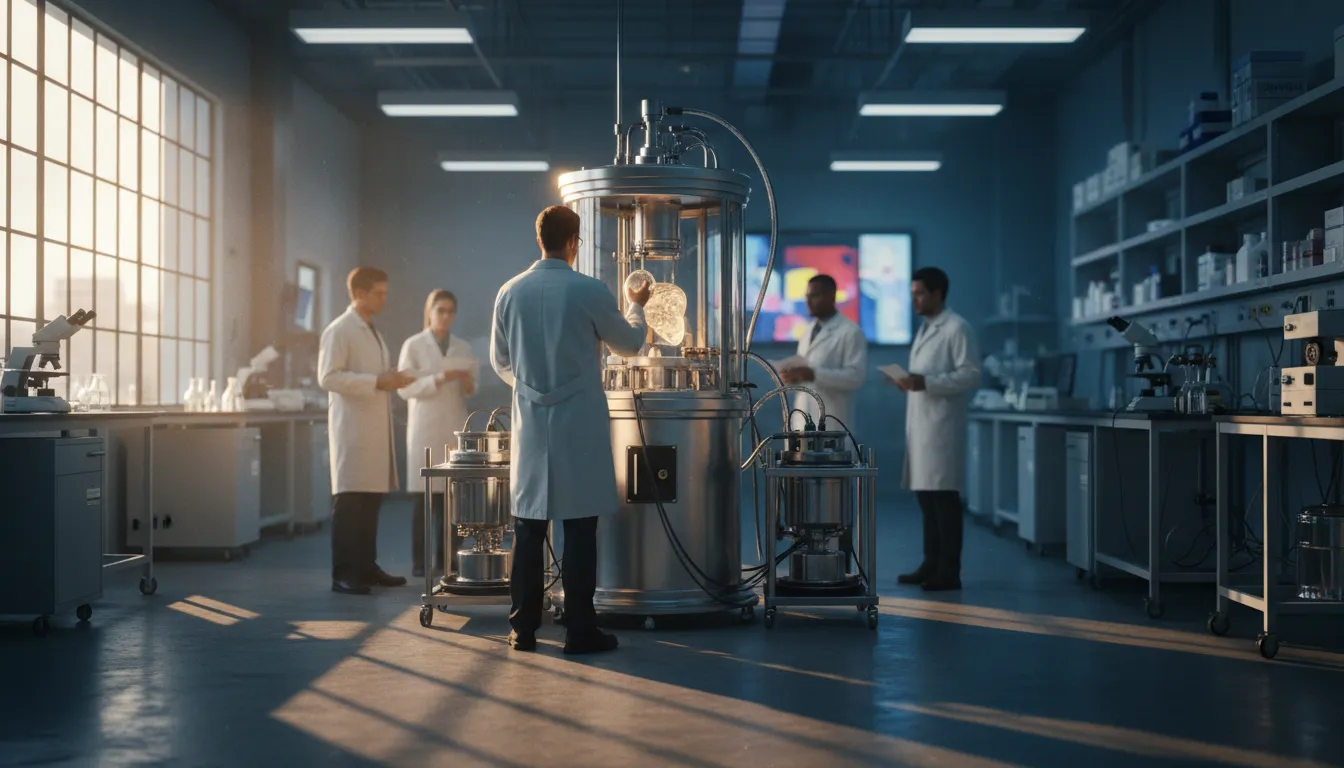
The process begins with cryoprotective agents (CPAs), chemical cocktails—often based on glycerol, dimethyl sulfoxide, or proprietary formulas—that are perfused through the organ's blood vessels. CPAs lower the freezing point and increase the viscosity of water inside cells, making it far more likely to vitrify rather than crystallize.
Once saturated, the organ is cooled to roughly −130 °C or below. At that temperature, molecular motion nearly stops and biological decay halts. In theory, a vitrified organ could be stored indefinitely.
In practice, two enormous problems remain: cracking and rewarming.
The Cracking Problem
As a vitrified organ cools further, thermal stress builds. Different layers contract at different rates, and the glass-like tissue can fracture—sometimes catastrophically. These cracks render the organ useless. Researchers at Texas A&M University, led by Dr. Matthew Powell-Palm, recently showed that the glass transition temperature—the point at which tissue enters its glassy state—plays a dominant role in whether cracks form. By engineering CPA solutions with higher glass transition temperatures, the team demonstrated that cracking can be significantly reduced, a finding published in 2025 and highlighted across scientific media in April 2026.
Nanowarming: Thawing Without Damage
Even a perfectly vitrified organ can be destroyed during rewarming. If heat penetrates unevenly—warm on the outside, still frozen inside—ice crystals form in the cold core before it thaws. The organ fails.
A technique called nanowarming, developed at the University of Minnesota, tackles this by distributing iron-oxide nanoparticles throughout the organ's vascular network. When an alternating magnetic field is applied, every nanoparticle heats simultaneously, warming the organ rapidly and uniformly from the inside out. The nanoparticles are then flushed out by perfusion. In a landmark 2023 study published in Nature Communications, researchers used this method to store rat kidneys for up to 100 days, rewarm them, transplant them, and restore full life-sustaining renal function.
From Rats to Humans
Scaling from a rat kidney to a human liver—roughly 100 times larger—is the field's central challenge. Larger organs require more uniform CPA distribution and more carefully controlled cooling and warming rates. Several groups are now working on liter-scale vitrification systems designed for human-sized organs. If they succeed, the implications go beyond transplantation: cryopreserved tissue banks could support biodiversity conservation, vaccine stabilization, and even food preservation.
For the more than 100,000 patients waiting for an organ, the stakes are existential. Cryopreservation will not create more donors, but it could ensure that no donated organ is ever wasted—and that time, for once, is on the patient's side.