How Osmotic Power Works—and Why It Could Run 24/7
Osmotic power harvests electricity from the natural mixing of saltwater and freshwater. Unlike solar or wind, it runs around the clock—but scaling up remains a challenge.
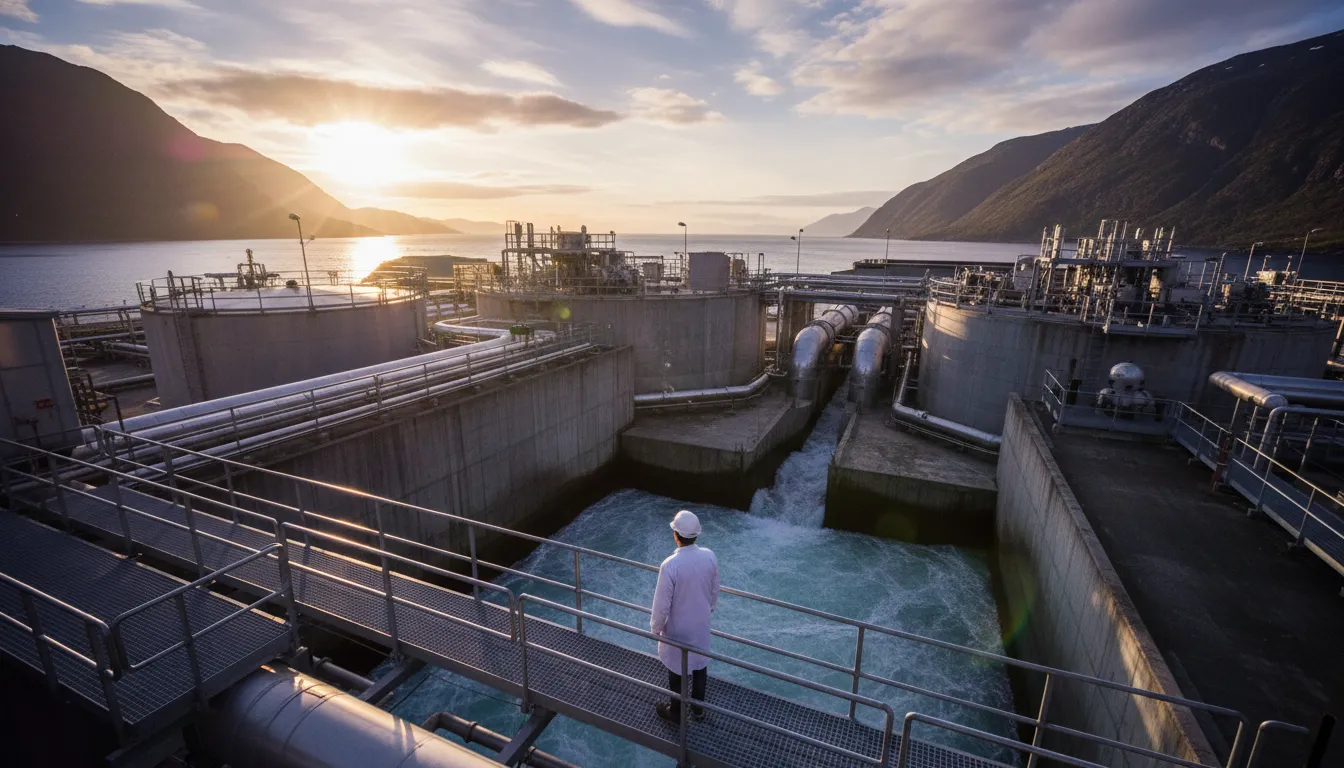
The Energy Hiding Where Rivers Meet the Sea
Every second of every day, rivers around the world pour freshwater into the ocean. That mixing releases enormous amounts of energy—roughly equivalent to a 200-meter waterfall for every cubic meter of freshwater that meets saltwater. Osmotic power, often called blue energy, aims to capture that energy and turn it into clean electricity.
Unlike solar panels or wind turbines, osmotic power does not depend on weather or time of day. As long as rivers flow into oceans—which they always do—the energy source never stops. Scientists estimate that the global potential of salinity gradient energy could reach 2.6 terawatts, enough to cover a significant share of the world's electricity demand.
How It Actually Works
Osmotic power exploits a basic principle of chemistry: when two solutions of different salt concentrations are separated by a membrane, nature tries to equalize them. Ions and water molecules move across the barrier, and that movement can be converted into electricity.
Two main technologies compete to harness this effect:
- Pressure Retarded Osmosis (PRO) uses a semipermeable membrane that lets water through but blocks salt. Freshwater naturally pushes toward the saltier side, creating hydraulic pressure that drives a turbine—much like a conventional hydroelectric generator.
- Reverse Electrodialysis (RED) takes a different approach. It stacks alternating membranes—one selective for sodium ions, another for chloride ions—creating an electrochemical potential. As ions migrate through the stack, they generate a direct electric current without any moving parts.
Both methods produce zero carbon emissions during operation and require no fuel beyond the water itself.
A Brief History of Blue Energy
The concept dates back to the 1950s, when researcher Sidney Loeb first explored generating electricity through osmosis. Serious engineering work began in the 1990s when Norwegian scientists Torleif Holt and Thor Thorsen partnered with Statkraft, Norway's state-owned energy company, to build a working prototype.
In 2009, Statkraft opened the world's first osmotic power plant in Hurum, Norway. The pilot demonstrated that the technology worked, but output was far too low—roughly enough to power a coffee machine. Statkraft shelved the project in 2013, citing insufficient membrane performance and high costs.
The torch passed to France. Sweetch Energy, a startup spun out of research at École Normale Supérieure in Paris, developed a novel approach called Ionic Nano Osmotic Diffusion (INOD). By the end of 2024, the company launched its pilot plant, OsmoRhône, at the mouth of the Rhône River on the Mediterranean coast. Sweetch raised €25 million to scale the technology, claiming it could make osmotic power commercially viable for the first time.
The Membrane Problem
The central challenge has always been the membrane. To generate meaningful power, membranes must allow ions to pass through quickly, selectively, and cheaply—at industrial scale. Traditional membranes struggle on all three fronts.
A breakthrough published in Nature Energy by researchers at EPFL in Switzerland showed a promising new direction. The team coated nanoscale pores with lipid molecules—the same fatty compounds that form cell membranes in living organisms. This created an ultra-slippery surface that reduced friction for passing ions, boosting power output two to three times over conventional designs.
To reach economic parity with offshore wind, researchers estimate that membrane power density needs to exceed 8.4 watts per square meter, or equipment costs must fall below $97 per square meter. Current prototypes are closing in on those targets but have not yet reached them consistently.
Why It Matters
Blue energy fills a gap that other renewables cannot. Solar and wind are intermittent—they need batteries or backup generation for nights and calm days. Osmotic power runs continuously, providing baseload generation comparable to fossil fuels or nuclear plants, but with zero emissions and no waste.
The resource is also vast and geographically widespread. Every river delta, every estuary, and every coastal wastewater outfall is a potential power site. Countries with large river systems—Brazil, China, India, the United States—could tap enormous reserves of salinity gradient energy.
Commercial-scale blue energy remains years away. Membrane durability, biofouling from microorganisms, and the sheer cost of scaling up are real obstacles. But with renewed investment, advancing nanotechnology, and growing urgency around clean baseload power, osmotic energy may finally be approaching its moment.