How Para Ice Hockey Works—and Why the US Dominates
Para ice hockey lets athletes with lower-body impairments play full-contact ice hockey from custom sleds. Here's how the sport works, where it came from, and why the United States has won five straight Paralympic gold medals.
Born in a Swedish Rehabilitation Centre
Para ice hockey — also called sledge hockey — traces its roots to the early 1960s in Stockholm, Sweden. Two men at a rehabilitation centre refused to give up the sport after acquiring physical disabilities. They engineered a low-framed metal sled fitted with two ice-hockey skate blades spaced wide enough for a puck to slide underneath. For sticks, they improvised poles with bicycle-handle grips on one end and a blade on the other.
By 1969, Stockholm had a five-team league that mixed disabled and able-bodied players. The sport spread to Great Britain in 1981, Canada in 1982, and the United States in 1990. When para ice hockey debuted at the 1994 Lillehammer Winter Paralympics, Sweden claimed the inaugural gold medal.
How the Game Is Played
Para ice hockey closely mirrors the standing game. Each team fields six players — five skaters and a goaltender — on a standard Olympic-size rink. Matches consist of three 15-minute periods, with sudden-death overtime if scores are tied at the end of regulation.
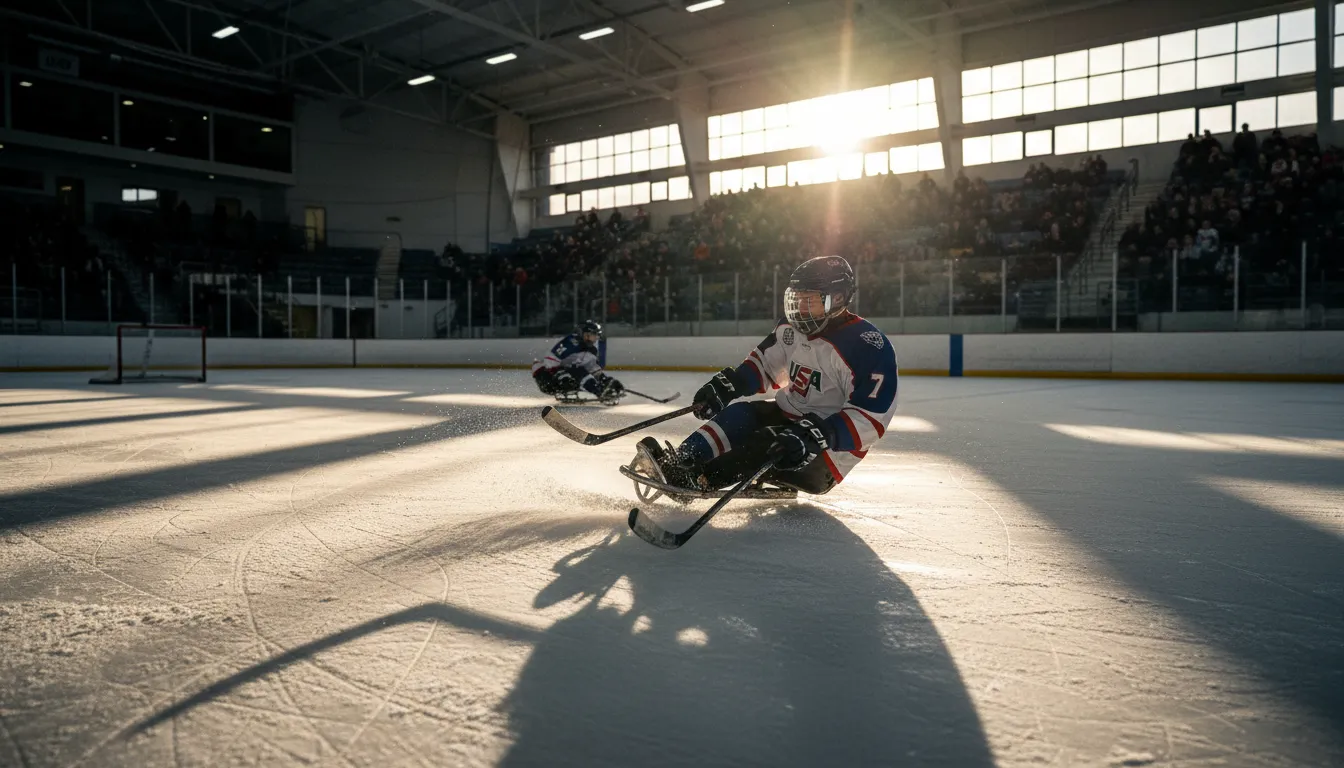
The defining feature is the sled. Players sit in a bucket seat mounted on a reinforced aluminium or steel frame, supported by two standard hockey skate blades. The frame sits low enough that the puck passes freely underneath, preserving the same on-ice dynamics as the standing game.
Instead of one stick, each player wields two sticks up to one metre long, typically made of carbon fibre. A quick flip of the wrist switches the stick from propulsion mode — a metal spike digs into the ice to push the player forward — to playing mode, where the blade end shoots or passes the puck. This dual technique demands exceptional upper-body strength, coordination, and endurance.
Since 2010, the sport has been open to both male and female athletes with a physical impairment in the lower body, according to the International Paralympic Committee.
Rules: Familiar but Adapted
The rulebook closely follows standard ice hockey. Penalties, icing, offsides, and power plays all apply. Goalkeepers use a modified stick with a wider blade and the same spike end for mobility. Helmets with visors or full-cage protection are mandatory for all players.
Equipment standards are strict: sleds must be at least 80 centimetres long, and the frame must allow an unobstructed gap beneath the seat for puck passage. Modern sleds are made of reinforced aluminium or steel and custom-fitted to each athlete's body dimensions.
Why the United States Has Dominated
Since winning a surprise gold medal at the 2002 Salt Lake City Winter Paralympics on home ice, the United States built one of the most sustained dynasties in Paralympic history — claiming gold again in 2010, 2014, 2018, 2022, and 2026. Their 6-2 victory over Canada at the Milano Cortina 2026 Winter Paralympics made them the first team in any winter Olympic or Paralympic sport to win five consecutive golds, according to NBC Olympics.
Coaches and analysts point to several factors behind the run:
- Roster continuity: The 2026 squad included 13 athletes with at least one prior Paralympics appearance, and six with three or more.
- Development pipeline: USA Hockey's national sled program has produced a steady stream of elite talent since the 2002 breakthrough sparked nationwide interest.
- High-calibre rivalry: Consistent competition against Canada — which won back-to-back golds in 1998 and 2006 — has kept both programs sharp. Together, the two nations have claimed 12 of the 14 world titles ever contested.
Why It Matters Beyond the Medal Stand
Para ice hockey has become a gateway sport for veterans, people with spinal cord injuries, amputees, and those with congenital lower-body conditions. Organizations like USA Hockey and the Challenged Athletes Foundation run youth programs at rinks across the country.
The sport's rise also reflects a broader shift in how adaptive athletics are perceived — not as charity exhibitions but as elite competition demanding the same speed, tactical sophistication, and physical aggression as any professional league. As equipment technology advances and participation grows, para ice hockey's place at the centre of winter Paralympic sport looks more secure than ever.