What Is El Niño and How Does It Affect the World?
El Niño is a periodic warming of the tropical Pacific Ocean that disrupts weather patterns across the globe, triggering droughts, floods, and economic losses that can last over a decade.
A Warm Patch With Worldwide Consequences
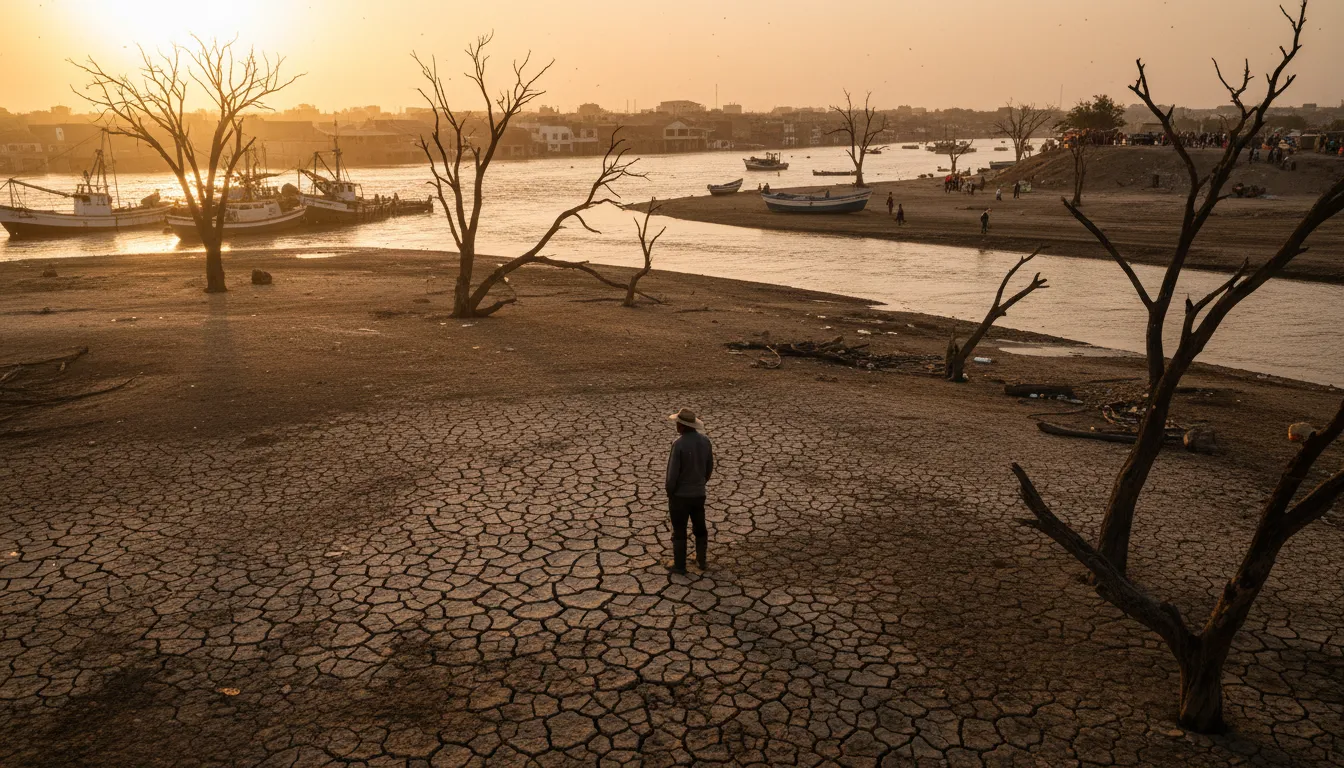
Every few years, a strip of ocean water along the equatorial Pacific grows unusually warm — and the entire planet feels it. Droughts grip Australia and Southeast Asia. Devastating floods sweep Peru. Hurricanes intensify over the Atlantic. Fisheries collapse. Crop harvests fail. This chain reaction has a name: El Niño.
El Niño is not just a weather event. It is the warm phase of a larger climate cycle called the El Niño–Southern Oscillation (ENSO), a natural, recurring shift in ocean temperatures and atmospheric pressure across the tropical Pacific. Understanding how it works helps explain why a warming ocean thousands of miles away can bring drought to one continent and floods to another.
How the Pacific Ocean Normally Works
Under normal conditions, powerful trade winds blow from east to west along the equator, pushing warm surface water toward Asia and Australia. As warm water piles up in the western Pacific, cooler water from the depths rises to replace it along the coasts of South America — a process called upwelling. This cold, nutrient-rich water fuels some of the world's most productive fisheries, including Peru's anchovy industry.
The ocean and atmosphere work together in a self-reinforcing loop. Warm water in the west heats the air above it, generating rainfall and low pressure. Cooler air in the east creates high pressure. The pressure difference drives the trade winds, which in turn maintain the warm-west, cold-east pattern. Scientists call this the Bjerknes feedback, after the Norwegian meteorologist who first described it in 1969.
What Happens During El Niño
During an El Niño event, the trade winds weaken — sometimes dramatically. Without strong winds pushing warm water westward, it slips back toward South America. Sea surface temperatures in the central and eastern tropical Pacific rise well above normal, often by 1–3°C, and sometimes by more than 4°C during severe events.
This shift reshapes atmospheric circulation worldwide. The jet streams — fast-moving air currents high in the atmosphere — change course, redirecting rain and storms to unusual places. According to NOAA, El Niño events occur on average every two to seven years and typically last nine to twelve months.
La Niña: The Opposite Phase
After most El Niño events, the system overcorrects into its opposite phase: La Niña. Trade winds strengthen beyond normal, pushing even more warm water westward. Upwelling intensifies, cooling the eastern Pacific. Where El Niño brings drought to Australia, La Niña brings flooding. Where El Niño soaks the U.S. Gulf Coast, La Niña dries it out.
Together, El Niño and La Niña represent the two extremes of ENSO. Between them lies a neutral state. The cycle keeps oscillating, shaping regional climates in ways that forecasters can predict months in advance — one of the most powerful tools in climate science.
Global Impacts: Floods, Droughts, and Fisheries
The consequences extend far beyond the Pacific. As National Geographic documents, major El Niño events have been linked to:
- Droughts in Indonesia, Australia, India, and southern Africa, threatening water supplies and agriculture
- Floods and landslides in Peru, Ecuador, and the western United States
- Weakened monsoons in South Asia, reducing rainfall critical to billions of farmers
- Coral bleaching triggered by warmer ocean temperatures
- Reduced hurricane activity in the Atlantic but increased storms in the central Pacific
Upwelling also weakens during El Niño, starving fish of nutrients. Peru's anchovy catch — the world's largest single-species fishery — can collapse almost entirely during strong events, with cascading effects on global fish meal and poultry feed markets.
The Economic Toll
The financial damage from El Niño is staggering and long-lasting. Research published in the journal Science and highlighted by Dartmouth College found that the 1982–83 El Niño caused $4.1 trillion in global income losses, while the 1997–98 event — the strongest ever recorded at the time — triggered $5.7 trillion in losses. Critically, the economic damage compound over time: GDP in affected countries can remain depressed for more than five years after an event ends.
As climate change warms the planet's baseline temperatures, scientists expect ENSO events to become more intense. Some models project that the economic cost of El Niño events over the 21st century could reach $84 trillion.
Forecasting El Niño
Meteorologists monitor a network of buoys, satellites, and ocean sensors across the Pacific to detect early signs of an El Niño developing. The key indicator is the Oceanic Niño Index (ONI), which tracks sea surface temperature anomalies in a defined region of the central Pacific. When temperatures there exceed 0.5°C above average for five consecutive overlapping three-month periods, NOAA officially declares an El Niño event.
Modern forecast models can predict El Niño with reasonable accuracy six to twelve months in advance, giving governments, farmers, and disaster-relief agencies time to prepare. Early warning has already saved lives and reduced crop losses in vulnerable regions — making El Niño one of the clearest examples of how climate science translates directly into human benefit.