How Rip Currents Work—and How to Survive Them
Rip currents kill more beachgoers than sharks, hurricanes, and tornadoes combined. Here is how these invisible rivers form, why they catch swimmers off guard, and what science says about escaping them.
The Ocean's Hidden Rivers
Every year, narrow channels of fast-moving water quietly pull unsuspecting swimmers away from shore. Known as rip currents, these seaward-flowing streams are the leading cause of lifeguard rescues at surf beaches worldwide, accounting for more than 80 percent of all surf rescues in the United States, according to the United States Lifesaving Association (USLA). In the U.S. alone, rip currents cause an average of 71 drowning deaths per year—more than sharks, hurricanes, and tornadoes combined. In Australia, rips kill more people than bushfires, floods, and cyclones put together.
How Rip Currents Form
The mechanics are deceptively simple. As waves roll toward shore, they push water up onto the beach. That water has to go somewhere. It flows sideways along the shore until it finds the path of least resistance back out to sea—typically a gap in a sandbar, a deeper channel, or a spot near a pier or jetty.
The result is a concentrated jet of water rushing seaward through the surf zone. According to NOAA, rip currents typically flow at 1–2 feet per second, but speeds can reach 8 feet per second—faster than an Olympic swimmer. They usually measure less than 30 feet wide but can extend hundreds of feet offshore, past the breaking waves, before dissipating.
Three Types Swimmers Should Know
Not all rip currents behave the same way. Scientists classify them into three main categories:
- Fixed (channel) rips — The most common type. These form in semi-permanent channels carved into sandbars and can persist for days or weeks. They appear as darker, calmer-looking gaps between lines of white breaking waves.
- Structural rips — These form against rigid features like jetties, piers, or rocky headlands that interrupt the natural flow of water. Because the structure doesn't move, these rips can persist for months or even years in the same spot.
- Flash rips — The most dangerous and unpredictable variety. Flash rips appear suddenly, last only 15 to 30 minutes, and can form anywhere along the beach without warning. They are triggered by sudden surges in wave energy.
How to Spot a Rip Current
Identifying a rip current from the waterline is notoriously difficult, but several visual clues can help. The National Weather Service advises beachgoers to look for:
- A gap in the breaking waves — a patch of seemingly calm, flat water between areas of white surf
- A channel of darker water extending offshore, caused by the deeper channel the current flows through
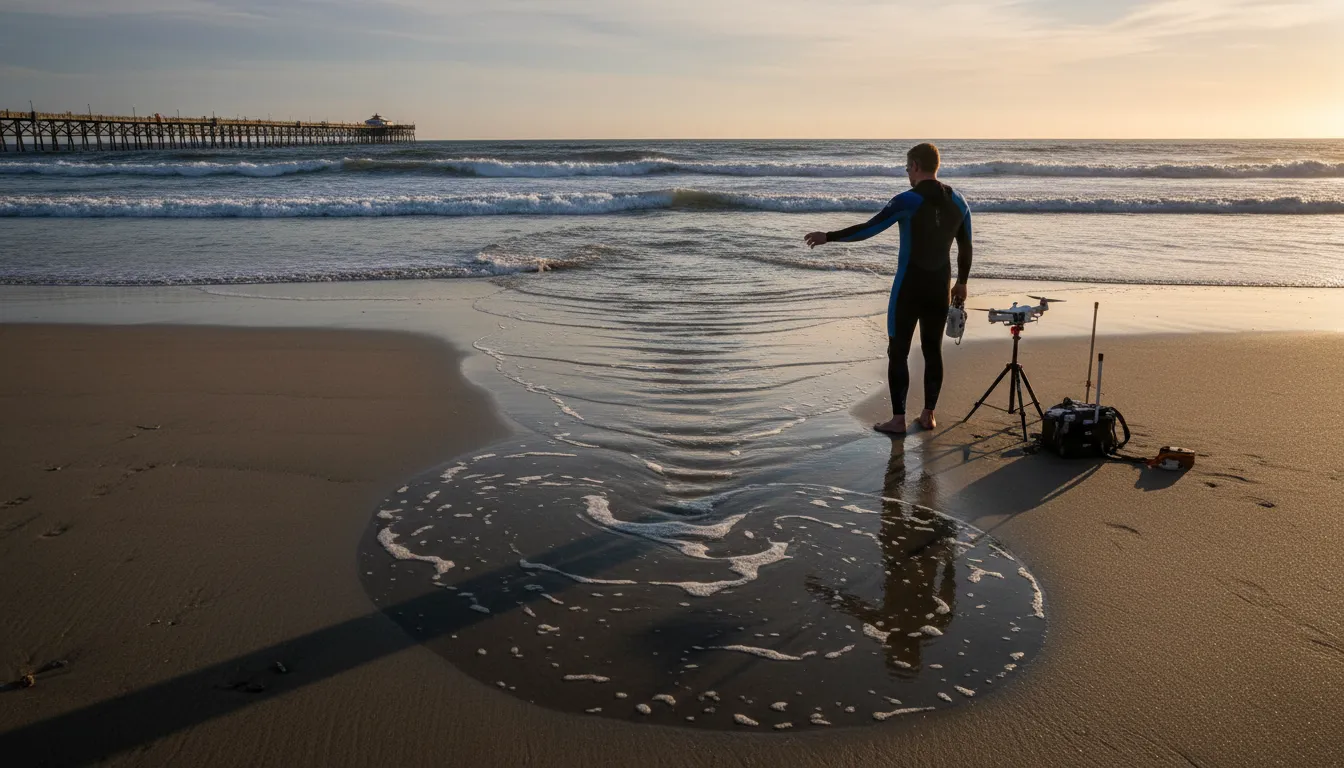
- A stream of foam, seaweed, or sandy discolored water moving steadily away from the beach
- A choppy, rippled texture on the water surface that contrasts with surrounding waves
Ironically, the calm-looking patch that many swimmers seek out is often the most dangerous spot on the beach. Polarized sunglasses and an elevated vantage point—such as a dune or lifeguard stand—make rips considerably easier to spot.
Why People Drown—and How to Escape
A rip current does not pull swimmers underwater. It pulls them away from shore horizontally, like a treadmill moving in the wrong direction. Drownings happen because panicked swimmers exhaust themselves fighting directly against the current—a battle no human can win against an 8-foot-per-second flow.
The science-backed escape strategy is straightforward:
- Don't panic. A rip current will not drag you under.
- Don't fight it. Swimming directly toward shore against the current wastes energy.
- Swim parallel to the shore to exit the narrow channel, then angle back toward the beach once free of the current.
- If too tired to swim, float or tread water. Most rips dissipate just beyond the surf zone and will release you naturally.
The USLA emphasizes that awareness is the best defense. Swimmers should always check conditions with a lifeguard, observe the water from high ground before entering, and never swim alone at unguarded beaches.
A Growing Concern
Researchers warn that rising sea levels and changing storm patterns may alter sandbar formations and wave dynamics, potentially increasing rip current frequency and intensity at popular beaches. Understanding how these invisible rivers work is not just academic—it is a survival skill for anyone who steps into the surf.