How Robotaxis Work—and Why They're Spreading Fast
Robotaxis use LiDAR, cameras, radar, and AI to navigate city streets without a human driver. Here's how the technology works, where it's available, and what challenges remain.
What Is a Robotaxi?
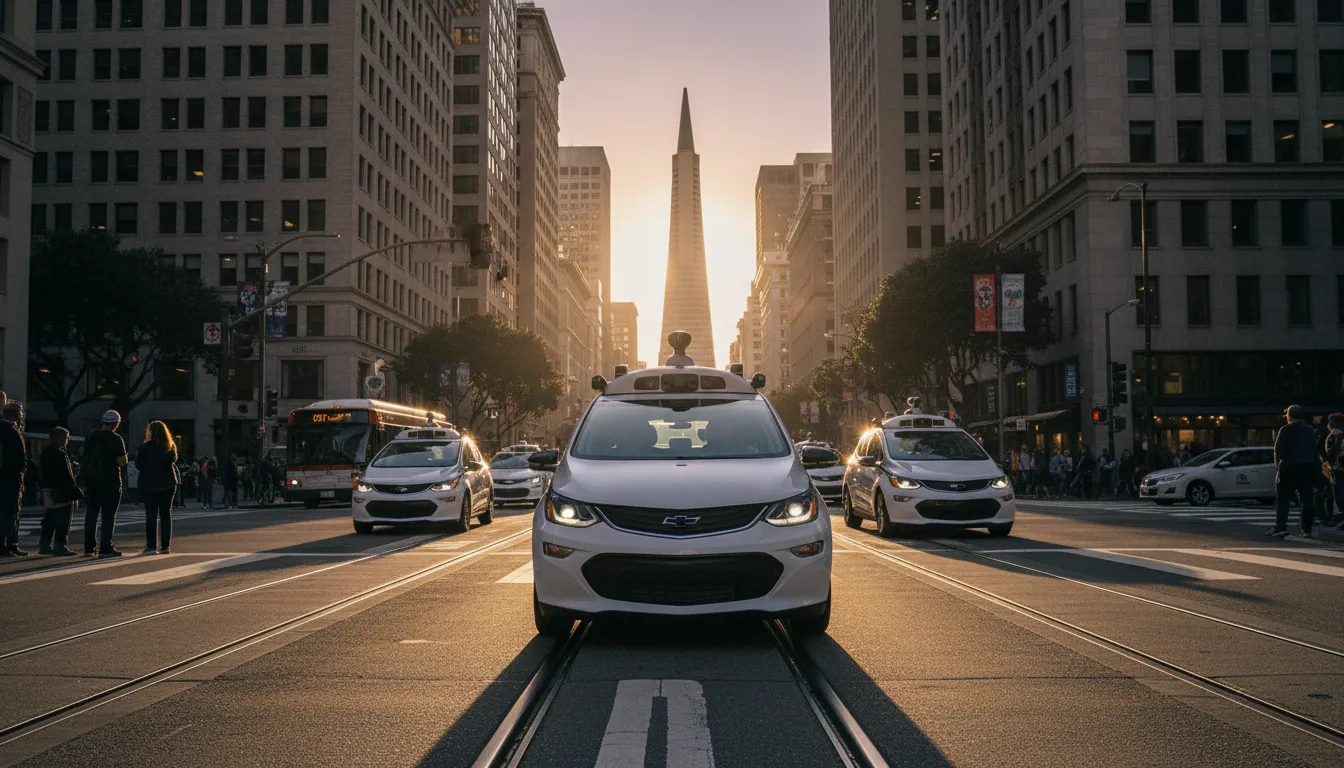
A robotaxi is a self-driving vehicle that operates as a ride-hailing service—like Uber or Lyft—but with no human behind the wheel. Passengers request a ride through a smartphone app, and an autonomous car picks them up, navigates city streets, and drops them at their destination entirely on its own.
Unlike personal self-driving cars, robotaxis are commercial fleet vehicles. They operate at SAE Level 4 autonomy, meaning they can handle all driving tasks within a defined geographic area without any human intervention. (The scale runs from Level 0, no automation, to Level 5, full autonomy everywhere—a milestone no company has yet achieved.)
The Technology Under the Hood
Robotaxis rely on a layered system of sensors, maps, and artificial intelligence working in concert.
Sensors: Eyes on Every Angle
A typical robotaxi bristles with hardware. Waymo's latest vehicles carry 13 cameras, four LiDAR units, six radars, and external microphones. Each sensor type has a distinct role:
- LiDAR (Light Detection and Ranging) fires millions of laser pulses per second and measures their reflections to build a precise 3D map of the surroundings, detecting objects up to 300 metres away.
- Cameras read traffic lights, lane markings, road signs, and identify pedestrians or cyclists.
- Radar tracks the speed and distance of nearby vehicles, performing well even in rain, fog, or darkness.
- Microphones listen for emergency sirens so the vehicle can yield to first responders.
Sensor Fusion and AI
Raw data from all these sensors is fused together in real time. Deep-learning algorithms merge LiDAR point clouds with camera images and radar readings into a single, rich model of the environment. The AI then performs three critical tasks: perception (what objects are around me?), prediction (what will they do next?), and planning (how should I steer, brake, or accelerate?).
HD Maps
Robotaxis don't navigate with consumer GPS alone. They rely on centimetre-accurate high-definition maps that include lane geometry, curb heights, traffic-signal positions, and speed limits. The vehicle constantly matches its live sensor data against these maps to pinpoint its location within a few centimetres.
Where Robotaxis Operate Today
Alphabet's Waymo is the clear market leader. As of late 2025, it operated roughly 2,500 vehicles across Phoenix, San Francisco, Los Angeles, Austin, and Atlanta, completing more than 450,000 rides per week—a 157% increase in just twelve months. The company plans to expand to cities including Denver, Houston, Las Vegas, Nashville, and Washington, D.C., with an international launch in London.
Amazon's Zoox runs a smaller service in Las Vegas and parts of the San Francisco Bay Area. In China, Baidu's Apollo Go operates the world's largest robotaxi fleet across multiple cities including Beijing, Shanghai, and Wuhan, completing millions of rides annually.
New entrants keep arriving. In March 2026, Uber announced a $1.25 billion investment in Rivian to deploy up to 50,000 autonomous R2 electric robotaxis across 25 cities in the US, Canada, and Europe by 2031.
Safety: Better or Worse Than Humans?
The safety picture is nuanced. A 2024 meta-analysis in Nature Communications found that autonomous vehicles were involved in far fewer pedestrian crashes—roughly 3% of incidents per mile driven, compared with 15% for human drivers. However, overall minor-collision rates vary by company and context, and high-profile incidents—such as a Cruise robotaxi dragging a pedestrian in San Francisco in 2023—have drawn intense scrutiny.
Regulation remains a patchwork. More than 29 US states have passed some form of autonomous-vehicle legislation, but no comprehensive federal framework exists. Each city sets its own rules on where and when robotaxis can operate.
What Comes Next
The robotaxi industry is scaling fast but still faces real hurdles: handling extreme weather, navigating construction zones, winning public trust, and resolving legal liability when crashes occur. Costs remain high—each sensor-laden vehicle can cost hundreds of thousands of dollars—though prices are falling as LiDAR and computing hardware mature.
Still, the trajectory points one direction. Waymo aims to reach one million trips per week by the end of 2026. With billions of dollars flowing in from automakers and tech giants alike, driverless rides are moving from novelty to everyday urban transport.