How Scientists Predict Volcanic Eruptions
From seismometers to satellite radar, volcanologists combine multiple monitoring tools to forecast eruptions days or even hours in advance—saving thousands of lives.
Reading a Volcano's Vital Signs
More than 1,500 potentially active volcanoes dot the planet, and roughly 50 erupt in any given year. Predicting when one will blow remains one of geology's greatest challenges. Unlike weather forecasting, which relies on well-understood atmospheric physics, eruption prediction depends on reading a complex set of underground signals—each volcano with its own personality and quirks.
Yet scientists have made remarkable progress. The successful forecast of the 1991 Mount Pinatubo eruption in the Philippines saved thousands of lives, demonstrating what modern monitoring can achieve. Today, volcanologists combine at least six distinct "vital signs" to judge whether a volcano is heading toward eruption.
Seismology: The First Warning
Earthquake activity is the most reliable early indicator of volcanic unrest. As magma forces its way upward through rock, it triggers swarms of small earthquakes. Scientists distinguish between volcano-tectonic earthquakes, caused by rock fracturing, and long-period earthquakes, generated by pressurized fluids moving through cracks. A third type—harmonic tremor—signals that magma is actively flowing underground.
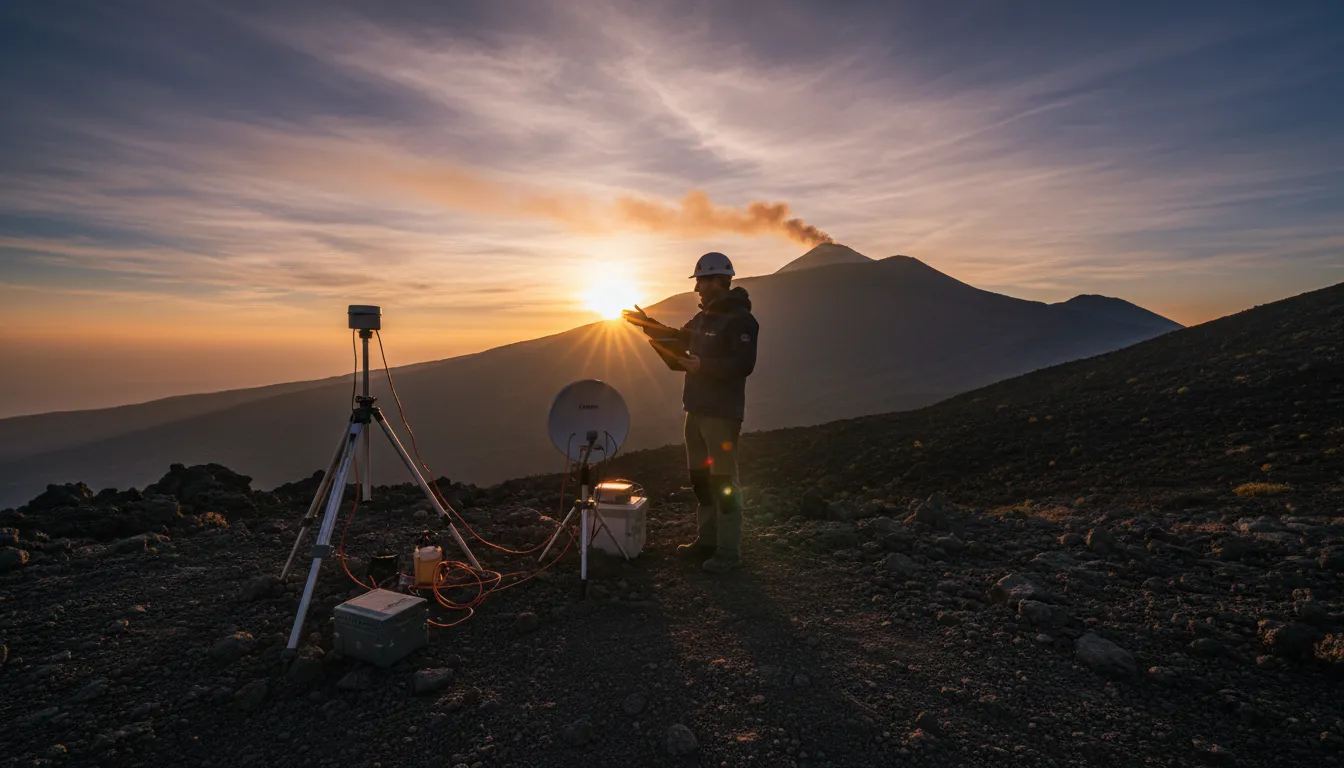
High-threat volcanoes require dense instrument networks. The U.S. Geological Survey recommends at least 12 to 20 permanent seismic stations within 20 kilometers of a volcano's main vent. In Hawai'i, the USGS monitors Kīlauea and Mauna Loa with more than 50 continuous GPS receivers and extensive seismic arrays.
Ground Deformation and Gas
When magma accumulates beneath a volcano, the surface swells—sometimes by centimeters, sometimes by meters. Scientists track this ground deformation using GPS stations, borehole tiltmeters, and interferometric synthetic aperture radar (InSAR) from satellites, which can detect millimeter-scale changes across vast areas.
Volcanic gases offer another window into the underground. Water vapor dominates, but shifts in sulfur dioxide (SO₂) and carbon dioxide (CO₂) ratios often signal fresh magma rising toward the surface. The USGS measures these gases using UV spectrometers at fumaroles and airborne sensors aboard research aircraft.
A New Signal: The "Jerk" Method
A breakthrough technique developed by researchers at the GFZ Helmholtz Centre and the Institut de Physique du Globe de Paris detects extremely subtle ground movements measured in nanometers per second cubed. Called the "Jerk" method, it picks up very-low-frequency signals produced when magma intrusions push through rock deep below.
Tested over a decade at Piton de la Fournaise on La Réunion island, the system successfully forecast 92 percent of 24 eruptions between 2014 and 2023, providing warnings ranging from minutes to 8.5 hours. Only 14 percent of alerts were "false"—and even those detected genuine magma intrusions that simply stalled before reaching the surface. Researchers plan to deploy the system at Mount Etna in Italy.
Why Prediction Remains Imperfect
Despite these advances, reliable forecasts rarely extend more than a few days before an eruption. Each volcano behaves differently, and wholly new precursor patterns can appear without warning. According to the Smithsonian's Global Volcanism Program, recurrence-interval forecasts—predicting eruptions based on past timing—are "notoriously unreliable" because most volcanoes lack detailed eruptive histories.
Observatory officials also face a difficult balancing act: issue warnings too early and risk public skepticism; wait too long and risk lives. Of the 169 geologically active volcanoes in the United States alone, 55 rank as "very high" or "high" threat, yet many still lack adequate monitoring equipment.
The best forecasts combine multiple data streams—seismic, deformation, gas, hydrology, and satellite imagery—into an integrated picture. No single sensor can predict an eruption on its own, but together they give communities precious hours or days to evacuate. As new tools like the Jerk method expand to more volcanoes worldwide, the science of eruption forecasting continues to close the gap between warning and catastrophe.