How Scientists Read Erased Ancient Texts With X-Rays
Palimpsests — manuscripts scraped clean and rewritten centuries ago — hide lost works by history's greatest minds. Modern imaging technologies, from multispectral cameras to synchrotron X-rays, now reveal what was thought destroyed forever.
What Is a Palimpsest?
Parchment was once among the most expensive writing materials in the world. Made from the treated skins of goats, sheep, or calves, a single book could require an entire flock. When scribes needed fresh pages, they often recycled old ones — scraping off existing ink with pumice stone, washing the surface with a weak acid such as lemon juice, and writing over it. The result is called a palimpsest, from the Greek palimpsestos, meaning "scraped again."
This practice was common from late antiquity through the medieval period, and it means that countless ancient texts — philosophical treatises, scientific works, medical manuals — were deliberately erased to make room for prayers, hymns, and liturgical books. For centuries, scholars assumed these originals were lost forever.
They were wrong.
Why Erased Ink Never Truly Disappears
Ancient inks were typically made from carbon soot or iron-gall compounds mixed with plant gum. When scribes scraped a page clean, they removed most visible pigment, but trace amounts of iron and other metals remained bonded to the collagen fibers within the parchment. These chemical residues are invisible to the naked eye — but not to modern physics.
This quirk of chemistry is what makes recovery possible. The original text leaves a faint but permanent chemical fingerprint embedded in the animal skin, waiting for the right technology to read it.
Multispectral Imaging: The First Breakthrough
The earliest modern technique for reading palimpsests is multispectral imaging (MSI). Researchers photograph each page under dozens of different wavelengths of light, from deep ultraviolet to near-infrared. Different inks absorb and reflect each wavelength differently, so by combining the resulting images digitally, scientists can separate the overwritten text from the original beneath it.
The largest MSI project to date is the Sinai Palimpsests Project, a collaboration between St. Catherine's Monastery in Egypt, the Early Manuscripts Electronic Library, and UCLA. The team imaged 6,800 pages from 74 palimpsest manuscripts and recovered 305 erased texts in 10 languages — including Greek, Syriac, Arabic, Latin, and the extremely rare Caucasian Albanian script. Eight of the recovered classical works had never been seen before.
Synchrotron X-Rays: Reading the Unreadable
When multispectral imaging reaches its limits — for example, when pages are heavily damaged, charred, or painted over — physicists turn to a far more powerful tool: the synchrotron.
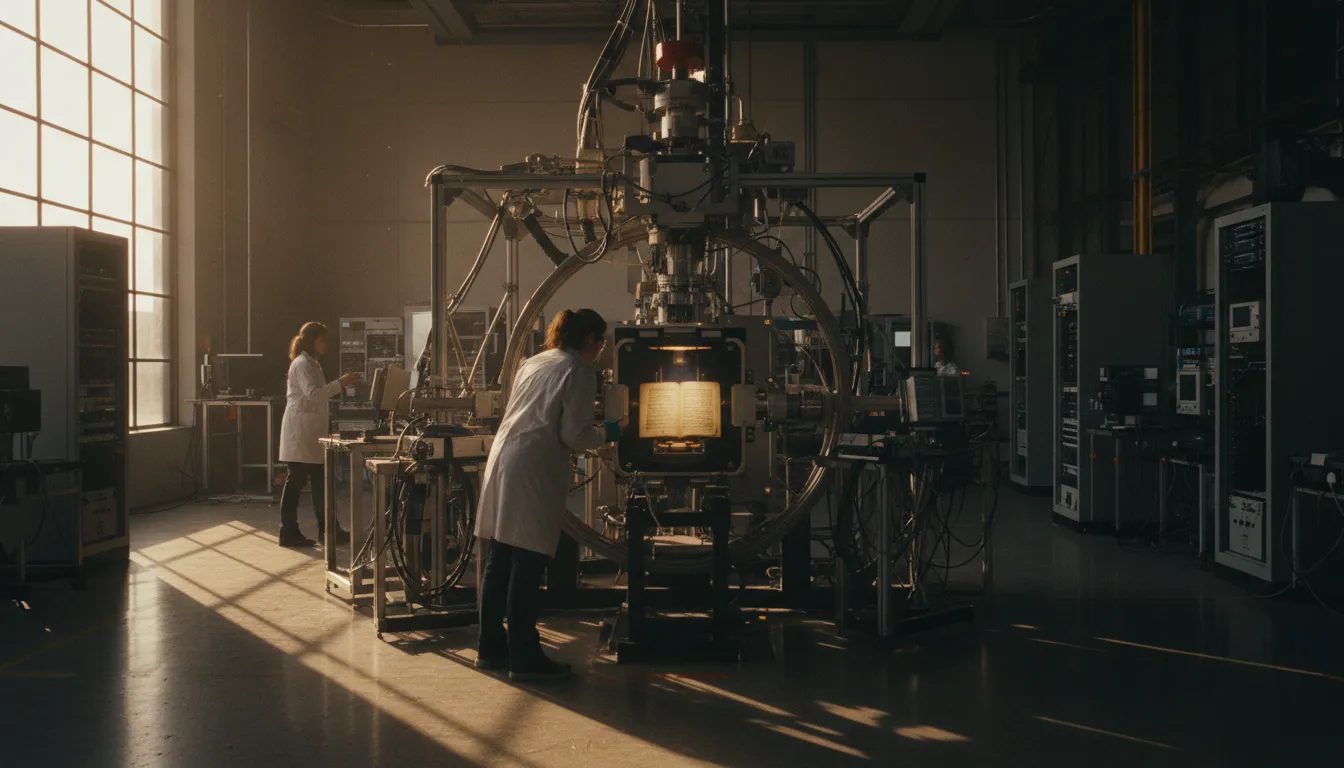
A synchrotron is a type of particle accelerator that whips electrons around a curved track at nearly the speed of light. As the electrons change direction, they emit extraordinarily intense beams of X-ray light — billions of times brighter than a hospital X-ray machine. When this beam hits a palimpsest page, it causes the residual iron atoms in the ancient ink to fluoresce, emitting their own characteristic X-ray signal. A detector maps these signals dot by dot, reconstructing the erased text like a slow-motion printer.
The technique was pioneered at the SLAC National Accelerator Laboratory at Stanford, where physicist Uwe Bergmann realized that iron-based inks would respond to X-ray fluorescence imaging. His team's most famous subject was the Archimedes Palimpsest — a 10th-century copy of works by the Greek mathematician, scraped clean in the 13th century and overwritten with prayers. Synchrotron scanning revealed previously unreadable passages, giving scholars the most complete record of Archimedes' writings since antiquity.
From Archimedes to the Stars
In January 2026, the same SLAC facility made headlines again. Researchers transported 11 pages of a medieval manuscript known as the Codex Climaci Rescriptus to the synchrotron and recovered star coordinates linked to Hipparchus of Nicaea, the ancient Greek astronomer who created the first known systematic catalog of the night sky around 150 B.C. His original catalog had been lost for nearly two millennia — until X-rays pulled it from beneath layers of later writing.
The discovery confirmed what historians long suspected: Hipparchus' measurements were remarkably precise, accurate to within about one degree. It also demonstrated that synchrotron imaging continues to unlock texts that no other method can reach.
Why It Matters
Palimpsest recovery is more than a technical curiosity. Every erased page is a potential window into lost knowledge — forgotten scientific methods, unknown literary works, extinct languages. As imaging technology improves and becomes more accessible, scholars estimate that thousands of palimpsest pages in libraries and monasteries worldwide remain unexamined.
The monks who scraped those pages clean never imagined that physics would one day undo their work. What they erased, X-rays now remember.