How Space Radiation Works—and Why It Threatens Astronauts
Beyond Earth's magnetic shield, astronauts face three invisible hazards: trapped particles in the Van Allen belts, unpredictable solar storms, and a relentless rain of galactic cosmic rays that no practical shield can fully stop.
The Invisible Barrier to Deep Space
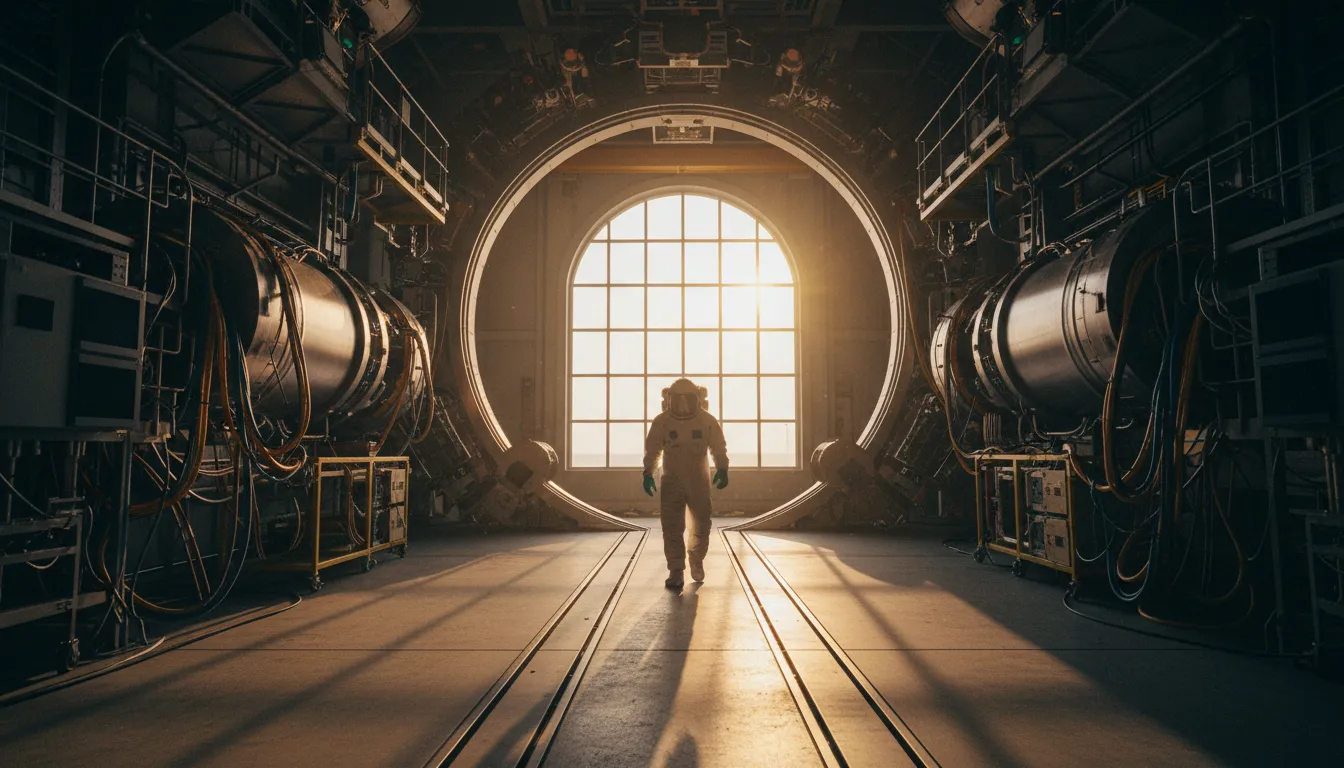
Earth's magnetic field acts like a giant force field, deflecting most charged particles that barrel through the solar system. Astronauts aboard the International Space Station still benefit from partial magnetic protection in low Earth orbit. But the moment a spacecraft pushes beyond that cocoon—as NASA's Artemis II crew did on their lunar flyby—its occupants face the full brunt of the cosmos. Space radiation is widely considered the single greatest health risk for missions beyond low Earth orbit, and solving it remains one of the hardest problems in human spaceflight.
Three Threats, Three Timescales
Space radiation comes in three distinct flavors, each dangerous in its own way.
Van Allen Belts
Surrounding Earth are doughnut-shaped zones of trapped electrons and protons called the Van Allen belts. Spacecraft must punch through them on the way out and on the way back. The exposure is intense but brief—transit takes only minutes to hours—so mission planners can minimize risk by choosing the fastest trajectory through the thinnest part of the belts.
Solar Particle Events
The Sun periodically erupts in violent outbursts that hurl streams of high-energy protons into space. These solar particle events (SPEs) are intermittent and unpredictable, but when they hit, dose rates can spike to dangerous levels within hours. A major SPE during an unshielded spacewalk could deliver a potentially lethal dose. NASA and NOAA monitor solar activity around the clock using the Solar Dynamics Observatory, the Solar and Heliospheric Observatory, and other spacecraft to give crews advance warning.
Galactic Cosmic Rays
The most insidious threat comes from galactic cosmic rays (GCRs)—atomic nuclei accelerated to near light speed by distant supernova explosions. GCRs form a constant, low-dose background that never switches off. Among them are high-charge, high-energy (HZE) particles—iron nuclei and other heavy ions that tear through DNA like a bullet through tissue paper, leaving dense trails of molecular damage that cells struggle to repair.
Why Shielding Alone Won't Work
For solar particle events, adding mass to the spacecraft helps considerably. Artemis II astronauts, for instance, can reconfigure their cabin by repositioning stored equipment to create an improvised radiation shelter. But for galactic cosmic rays, shielding becomes paradoxical. When a high-energy heavy ion slams into a metal wall, it can fragment into a shower of secondary particles—including neutrons—that may cause even more biological damage than the original particle. According to NASA research, the mass of shielding needed to meaningfully reduce GCR exposure on a Mars-bound mission would exceed any realistic launch capacity.
What Radiation Does to the Body
NASA's Space Radiation Element identifies four primary health concerns:
- Cancer: Ionizing radiation damages DNA directly or generates free radicals that attack it. HZE particles cause complex, clustered DNA breaks that are harder to repair correctly, raising the long-term risk of tumor formation.
- Central nervous system effects: Animal studies show that cosmic-ray-like particles can impair memory, decision-making, and mood—raising concerns about crew performance on years-long missions.
- Degenerative diseases: Cataracts, cardiovascular damage, and accelerated tissue aging have all been linked to space radiation exposure.
- Acute radiation sickness: A large solar particle event without adequate shelter could cause nausea, immune suppression, and in extreme cases, death.
How NASA Measures the Risk
Radiation exposure is not a single number. Dose rate, particle type, direction, and shielding all matter. NASA uses the Hybrid Electronic Radiation Assessor (HERA) system aboard Orion, which employs six sensors to measure dose rates throughout the cabin in real time. Astronauts also wear personal dosimeters. On the ground, the NASA Space Radiation Laboratory at Brookhaven National Laboratory simulates cosmic rays by firing heavy-ion beams at biological samples and shielding materials, building the risk models that will determine how long future crews can safely stay in deep space.
The Road Ahead
For a ten-day lunar mission like Artemis II, the expected dose—roughly equivalent to a whole-body CT scan—is manageable. But a two-to-three-year Mars mission changes the calculus entirely. Researchers are exploring biological countermeasures, including drugs that boost DNA repair or scavenge free radicals. Others are investigating active magnetic shielding that could deflect charged particles the way Earth's field does, though the engineering challenges remain immense. Until these solutions mature, space radiation will remain the invisible gatekeeper standing between humanity and the deeper solar system.