How the G7 Works—and Why It Still Matters
The Group of Seven has no charter, no headquarters, and no binding authority—yet its annual summits shape global policy on everything from climate to security. Here's how the world's most exclusive diplomatic club actually operates.
A Club With No Rulebook
The Group of Seven—better known as the G7—is one of the most influential bodies in international affairs, yet it has no legal charter, no permanent headquarters, and no secretariat. It is, at its core, an informal forum where the leaders of seven wealthy democracies meet annually to coordinate responses to the world's biggest challenges.
The members are the United States, Canada, France, Germany, Italy, Japan, and the United Kingdom. The European Union has participated fully since 1981, represented by the presidents of the European Council and the European Commission, though it does not host summits or take part in the presidency rotation.
How It Started
The G7 traces its roots to 1973, when finance ministers from West Germany, France, the UK, and the United States gathered informally at the White House to discuss the oil crisis and monetary instability. By 1975, France organized the first formal summit of six nations in Rambouillet. Canada joined in 1976, completing the Group of Seven.
Russia was invited to participate after the Cold War, turning the group into the G8 from 1998 onward. That experiment ended in 2014, when Russia's membership was suspended following the annexation of Crimea, reverting the forum back to G7.
How the Presidency and Summits Work
The G7 presidency rotates annually in a fixed order: France, United States, United Kingdom, Germany, Japan, Italy, Canada. The presiding country sets the agenda, hosts the leaders' summit, and organizes ministerial meetings throughout the year.
Preparation falls to so-called "sherpas"—senior advisors to each head of state who negotiate policy positions in advance. By the time leaders sit down together, most of the substantive work has already been hashed out. Ministerial tracks cover areas such as foreign affairs, finance, trade, the environment, and digital policy.
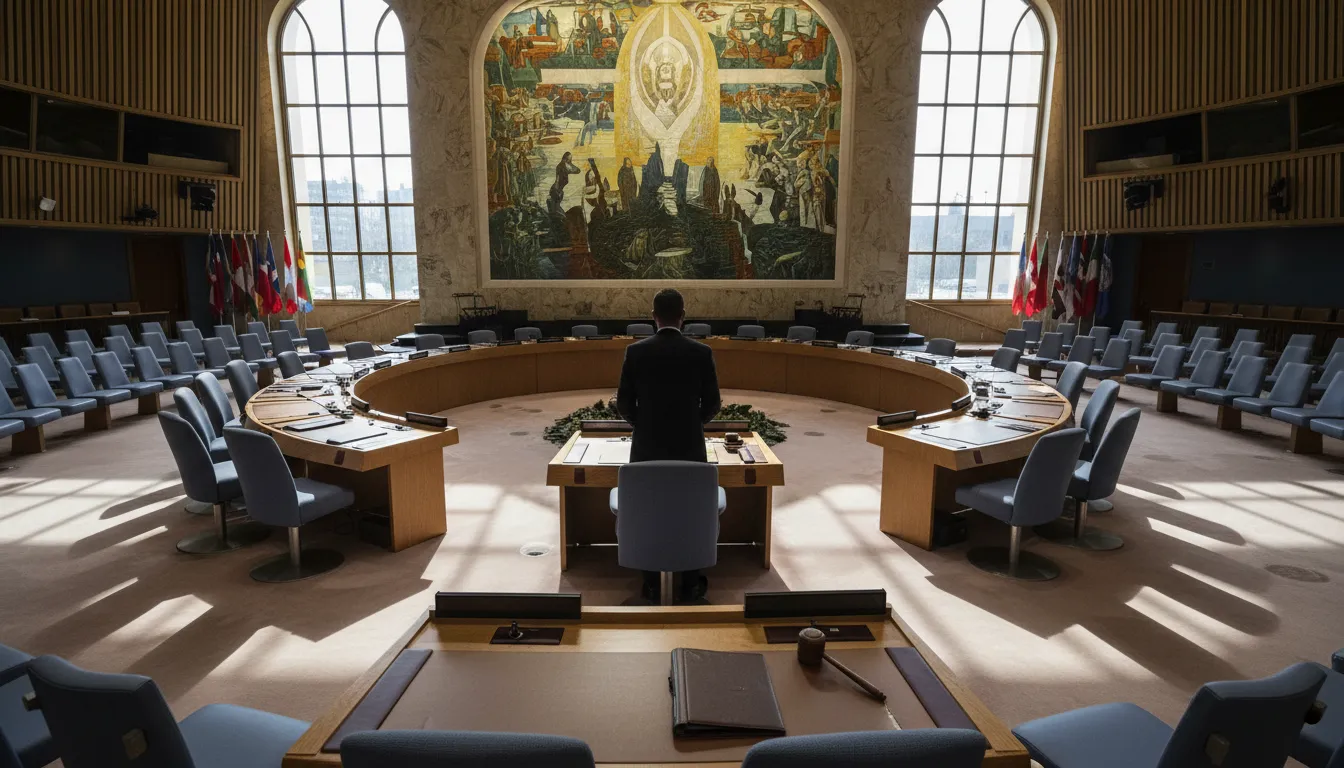
At the summit's close, leaders release a joint communiqué—a consensus statement outlining agreed policy commitments. Unlike a UN Security Council resolution, this communiqué is politically binding rather than legally enforceable. Every member must agree; there is no majority vote.
What the G7 Actually Does
Without enforcement power, the G7 relies on agenda-setting and coordinated pressure. Over the decades, it has catalyzed major global initiatives:
- Mobilizing billions for the fight against HIV/AIDS and malaria in developing countries
- Coordinating the economic response to the 2008 financial crisis
- Building consensus that led to the 2015 Paris Agreement on climate change
- Imposing coordinated sanctions against Russia over Ukraine
According to the Council on Foreign Relations, the combined GDP of G7 nations is nearly $57 trillion—roughly 29 percent of the global economy. That economic weight gives the group's statements real market and diplomatic impact, even without legal teeth.
G7 vs. G20: What's the Difference?
The G20, formed in 1999, includes 19 nations plus the EU and represents about 85 percent of global GDP. It brings major emerging economies—China, India, Brazil, Saudi Arabia—to the table, making it far more representative.
The G7, by contrast, is deliberately small and like-minded. Its members share broadly similar political systems and economic philosophies, which allows for stronger, more specific language in communiqués than the G20 typically achieves. The trade-off is legitimacy: the G7 speaks for the world's richest democracies, not the world.
Criticism and Relevance
Critics argue the G7 is outdated and unrepresentative. It excludes China—the world's second-largest economy—and has no permanent members from Africa, Latin America, or South and Southeast Asia. Some analysts at think tanks like Bruegel have called for expanding or restructuring the group to reflect modern geopolitical realities.
Defenders counter that the G7's strength lies precisely in its exclusivity. A small group of democracies with aligned values can move faster and speak more candidly than a larger, more diverse forum. In an era of deepening rivalry between democracies and authoritarian states, that alignment may matter more than ever.
Whether the G7 remains the world's steering committee or fades into diplomatic ceremony depends largely on whether its members can translate summit communiqués into real action—something its critics say remains the group's greatest weakness.