How Holographic Data Storage Works—and Why It Matters
Holographic data storage encodes information throughout the volume of a crystal using laser light, enabling massively parallel reading and writing that could shrink data centers and outpace conventional drives.
Storing Data Inside Light
Every photo, email, and streaming video lives on a magnetic disk or flash chip—technologies that record data one bit at a time across flat surfaces. Holographic data storage takes an entirely different approach. Instead of writing to a surface, it embeds information throughout the entire volume of a transparent medium, typically a crystal of lithium niobate or a specialized photopolymer. The result is a storage method that can record and read millions of bits simultaneously, promising dramatic leaps in both capacity and speed.
How It Works
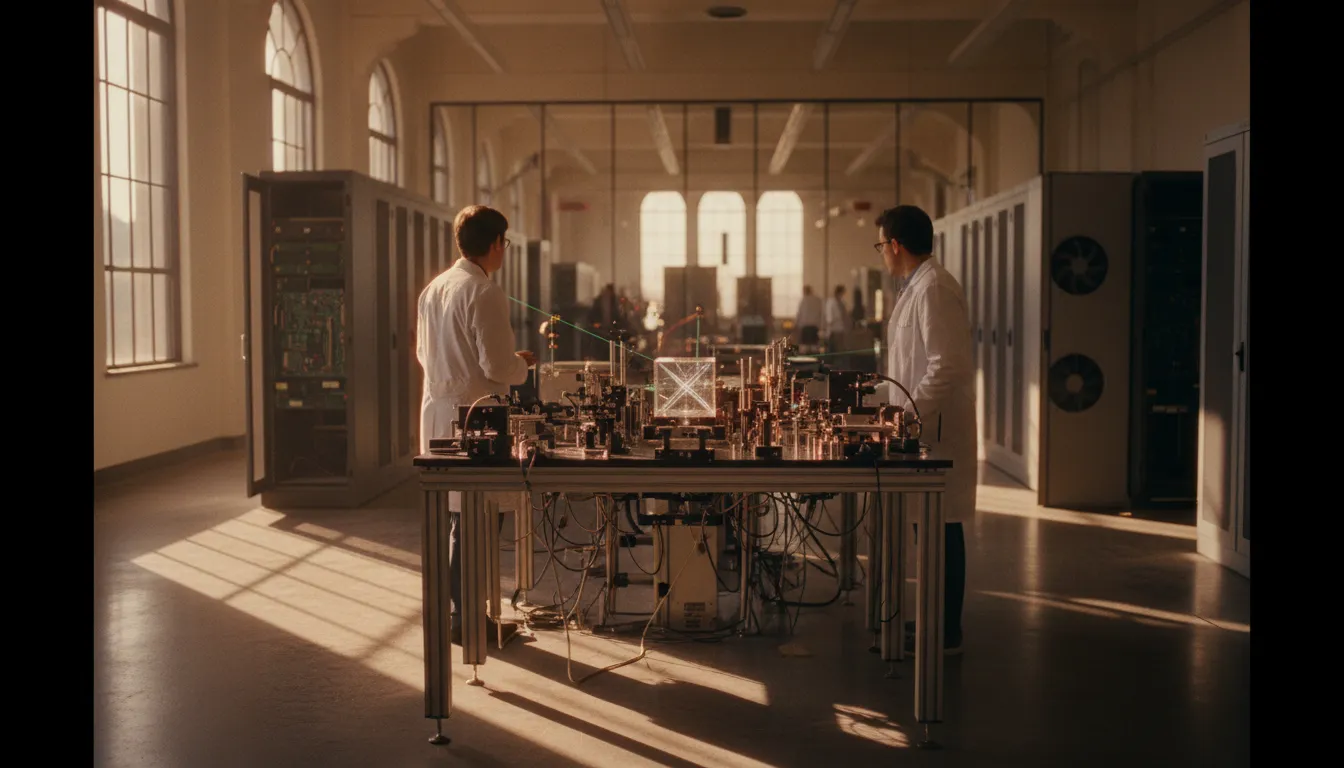
The process starts with a single laser beam split into two paths. One beam—the reference beam—travels directly into the recording medium. The other passes through a device called a spatial light modulator (SLM), which acts like a grid of tiny shutters. Each point on the grid either passes or blocks light, encoding ones and zeros into a two-dimensional page of data.
When the two beams meet inside the crystal, they create an interference pattern—a three-dimensional hologram that the medium captures as changes in its refractive index. Thousands of these data pages can be layered in the same physical volume simply by changing the angle, wavelength, or phase of the reference beam, a technique called multiplexing.
To retrieve data, the reference beam shines into the crystal at the exact angle used during recording. The stored interference pattern reconstructs the original data page, which a camera sensor reads in a single flash—millions of bits at once.
Why Capacity Could Dwarf Today's Drives
Because data pages overlap in three dimensions rather than spreading across a flat platter, holographic storage achieves extraordinary density. Laboratory demonstrations have exceeded 2.4 terabits per cubic inch, and theoretical models suggest a sugar-cube-sized crystal could eventually hold multiple petabytes. By comparison, the largest conventional hard drives top out around 30–40 TB per unit today, and the technology is approaching its physical ceiling.
Speed is equally striking. Reading an entire page of bits in parallel means transfer rates can far surpass those of optical or magnetic media, where a read head must trace a sequential path across a spinning surface.
Recent Advances
A study published in Optica demonstrated a new technique that encodes data across three properties of light simultaneously—amplitude, phase, and polarization. A convolutional neural network then reconstructs all three dimensions from intensity-based measurements, substantially increasing the information carried by each holographic page.
Meanwhile, Microsoft's Project HSD is redesigning holographic storage from the ground up for cloud data centers. The team achieved 1.8 times higher density than previous benchmarks using commodity smartphone-grade camera sensors and machine-learning algorithms to compensate for optical noise—a sign that practical components may already exist.
The Challenges Ahead
Despite decades of research, no holographic storage product has reached the commercial market. The recording media degrade over repeated write cycles, and the energy required to store each bit remains one to two orders of magnitude too high to compete with magnetic drives on cost. Spatial multiplexing—packing more pages into the same crystal—must improve without introducing unacceptable crosstalk between neighboring holograms.
A review in ACM Transactions on Storage concluded that holographic technology still needs "fundamental advances in the physical media" before it can match the density, scalability, and energy efficiency of incumbent storage systems.
Why It Still Matters
Global data creation is projected to exceed 180 zettabytes by 2025, and traditional storage technologies are nearing their physical limits. Holographic storage offers a path beyond those limits—volumetric, massively parallel, and potentially far more durable than magnetic media. Whether it arrives in data centers within a decade or remains a laboratory curiosity depends on breakthroughs in materials science and optical engineering. But the underlying physics is sound, and the incentive to solve the data deluge has never been greater.