How the Migdal Effect Works—and Why It Hunts Dark Matter
The Migdal effect is a quantum phenomenon where a recoiling atomic nucleus ejects an electron, amplifying faint signals that could reveal lightweight dark matter particles hiding below current detection thresholds.
An 87-Year-Old Prediction Meets Modern Physics
Dark matter makes up roughly 85% of the universe's mass, yet no one has directly detected it. One reason: the lightest dark matter candidates barely nudge atomic nuclei when they collide, producing signals too faint for even the most sensitive detectors to register. A quantum phenomenon called the Migdal effect could change that—by turning an invisible nudge into a measurable flash.
First predicted in 1939 by Soviet physicist Arkady Migdal, the effect describes what happens inside an atom when its nucleus is suddenly knocked sideways. For nearly nine decades, no experiment could confirm it in neutral-particle collisions. That changed when a Chinese research team finally observed the effect directly, reaching the five-sigma gold standard of statistical confidence.
What Actually Happens Inside the Atom
Picture an atom as a heavy bowling ball (the nucleus) surrounded by a swarm of lightweight ping-pong balls (electrons). Under normal conditions, the electrons orbit in stable clouds around the nucleus. When an incoming particle—a neutron, or potentially a dark matter particle—strikes the nucleus and sends it recoiling, something counter-intuitive occurs.
The electron cloud does not move instantly with the nucleus. For a brief moment, the electrons are left behind. In that fraction of a second, the atom's internal electric field shifts so abruptly that one electron can be ejected entirely. This ionization event is the Migdal effect.
The ejected electron carries far more energy than the original nuclear recoil alone. As Phys.org reports, once an electron is ejected, a detector can capture 100% of its energy—effectively amplifying a whisper-quiet nuclear signal into something instruments can actually measure.
Why Dark Matter Detectors Need It
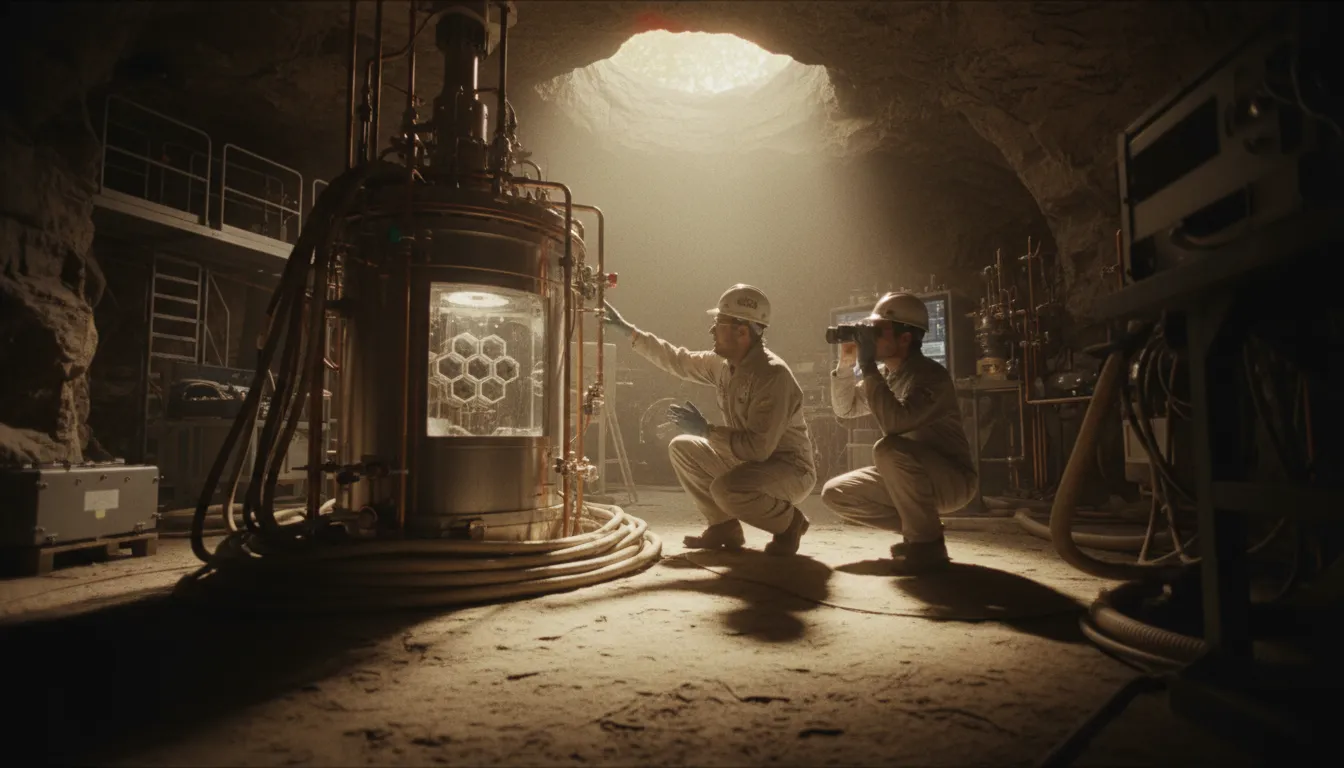
Current dark matter experiments use massive tanks of liquefied noble gases—typically xenon or argon—waiting for a dark matter particle to bump into an atomic nucleus. These detectors have achieved remarkable sensitivity, with energy thresholds around 100 electron-volts (eV). Yet for lightweight dark matter candidates below roughly 10 GeV (about ten times the mass of a proton), even these thresholds are not low enough.
The Migdal effect offers an elegant workaround. Instead of trying to measure the feeble nuclear recoil directly, physicists can look for the secondary electron signal it triggers. Because the electron carries significantly more detectable energy, existing detectors could reach down to dark matter masses that would otherwise be completely invisible—without any hardware upgrades.
How Scientists Finally Proved It
A team led by researchers at the University of the Chinese Academy of Sciences built a specialized gaseous pixel detector—essentially an "atomic camera"—using a mixture of helium and dimethyl ether as an imaging medium. They bombarded the gas with neutrons from a generator and recorded roughly 800,000 candidate events over about 150 hours of data collection.
The telltale signature: two particle tracks emerging from the same point—one from the recoiling nucleus, one from the ejected Migdal electron. Out of hundreds of thousands of events, six clear signals passed all selection criteria, enough to cross the five-sigma threshold.
"For over 80 years, the Migdal effect in neutral particle collisions had never been directly confirmed by experiments," said Zheng Yangheng, the study's corresponding author and professor at UCAS.
A Parallel Effort in the UK
The Chinese observation is not the only Migdal-focused programme. At the Rutherford Appleton Laboratory in the UK, the aptly named MIGDAL experiment (Migdal In Galactic Dark mAtter expLoration) has been running since 2023, accumulating millions of detector images across multiple science runs. Using a different detector design and neutron sources at various energies, the UK collaboration aims to characterize the effect across a broader range of conditions relevant to dark matter searches.
What Comes Next
With the Migdal effect now experimentally confirmed, the next step is applying it inside actual dark matter detectors. Major experiments like LZ (LUX-ZEPLIN), XENONnT, and PandaX could reanalyze existing data looking for Migdal-type events, potentially extending their sensitivity to lighter dark matter particles without building new hardware.
The effect does not guarantee dark matter will be found—but it dramatically widens the window of masses where physicists can look. In a field where decades of searching have produced no confirmed detection, every new tool matters. The Migdal effect, predicted before the Second World War and confirmed nearly a century later, may finally help physicists hear the quietest knock in the universe.