How Water Ice Survives on the Moon and Why It Matters
The Moon looks bone-dry, yet billions of years of comet impacts and solar chemistry have deposited water ice inside permanently shadowed polar craters — a resource that could one day fuel rockets and sustain astronauts.
Cold Traps at the Poles
The Moon appears to be the driest place imaginable. Its surface bakes in fierce solar radiation, holds no atmosphere, and loses any exposed moisture instantly to the vacuum of space. Yet beneath that parched exterior — locked inside deep polar craters that have never seen sunlight — sits water ice, and possibly a great deal of it.
The key lies in the Moon's extraordinarily small axial tilt of less than two degrees. Unlike Earth, which tilts 23.5 degrees and cycles through seasons, the Moon barely wobbles at all. As a result, the floors of certain deep craters near the lunar poles never tilt toward the Sun — not even once across billions of years. Sunlight grazes the crater rims but never penetrates to the bottom.
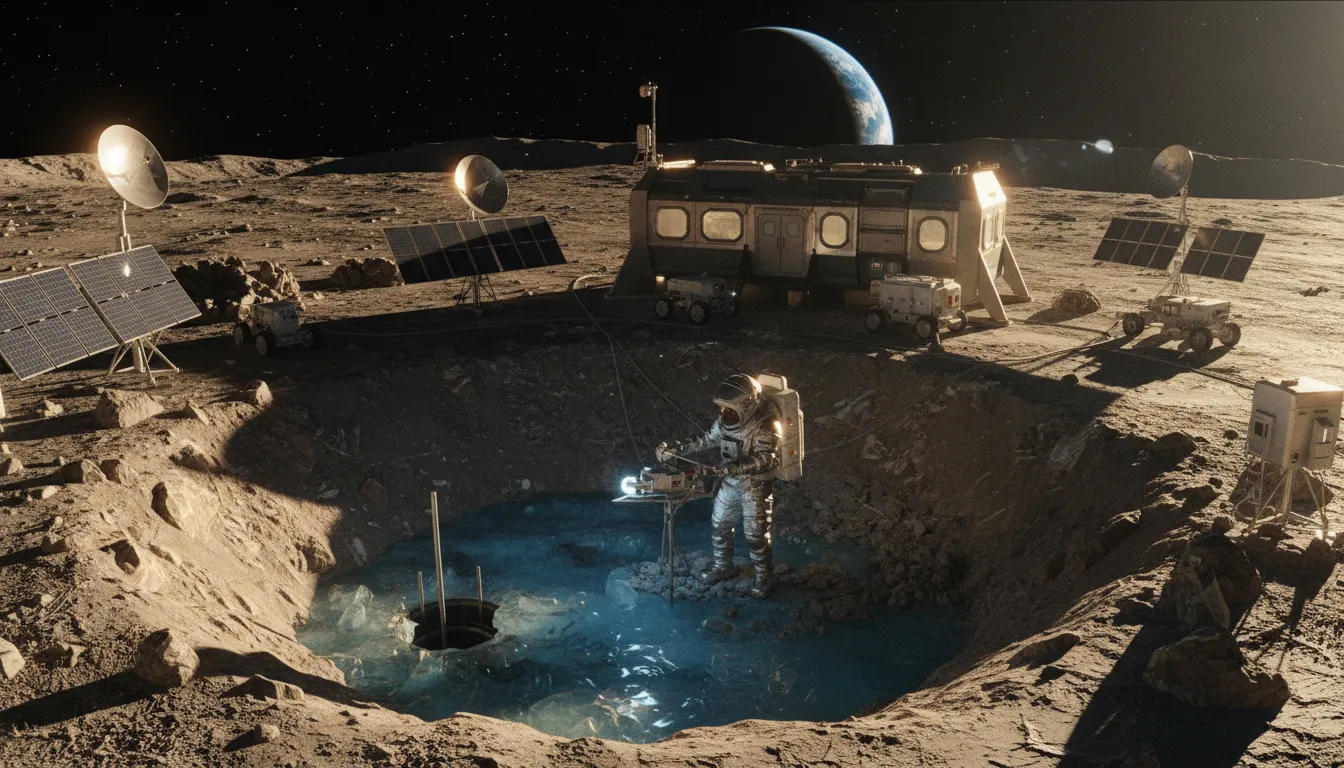
Without any solar radiation, temperatures in these permanently shadowed regions (PSRs) plunge to around –240°C (–400°F), making them among the coldest spots in the entire solar system — colder even than the surface of Pluto. At those extremes, water molecules that drift in cannot escape. Scientists call these locations cold traps, and they act like natural deep-freezers that have been running, uninterrupted, for geological time.
How Scientists Confirmed It
Hints of polar water emerged from radar data collected by NASA's Clementine spacecraft in 1994 and Lunar Prospector in 1998. But definitive proof came on October 9, 2009, when NASA deliberately crashed the LCROSS mission's spent Centaur rocket stage into Cabeus crater near the lunar south pole. The impact blasted a plume of debris roughly 30 kilometres high. A trailing spacecraft flew through the plume and detected water vapour and ice crystals — confirming a water concentration of approximately 6 percent in the target area, with some spots containing near-pure ice crystals.
More detailed confirmation arrived in 2018, when a study published in PNAS used data from NASA's Moon Mineralogy Mapper instrument to map surface-exposed ice directly at both poles. The ice clustered in PSRs exactly where cold-trap models predicted — providing the clearest visual evidence yet that the Moon's poles are genuinely icy.
Where Did the Water Come From?
Scientists believe multiple sources contributed over billions of years:
- Comets and asteroids: Icy bodies colliding with the Moon deposited water molecules that migrated poleward rather than escaping to space. A 2022 analysis led by Johns Hopkins University Applied Physics Laboratory found that comets are the dominant source, based on molecular fingerprints in the LCROSS plume.
- Micrometeorites: Tiny, dust-sized impactors constantly rain water-bearing minerals onto the surface, releasing molecules that can hop to cold traps.
- Solar wind chemistry: Hydrogen ions streaming from the Sun react with oxygen in lunar soil to form hydroxyl (OH) and trace amounts of water (H₂O) — a slow but continuous drip across geological time.
How Much Ice Is There?
Estimates vary widely, because mapping PSRs is technically difficult — no orbiting camera can photograph a surface that reflects no sunlight. Combining radar data from NASA's Lunar Reconnaissance Orbiter and India's Chandrayaan-1, current models suggest the two poles together may hold hundreds of millions of metric tons of water ice spread across roughly 1,850 km² of icy terrain.
Newer studies caution, however, that much of this ice may be diluted into loose regolith at low concentrations rather than existing as pure, easily mineable sheets. How cleanly it can be extracted remains an open engineering question.
Why It Could Transform Space Exploration
Water is the most valuable resource humanity could find beyond Earth. Shipping a single kilogram from Earth to the lunar surface costs an estimated $2,000 to $20,000 depending on the launch vehicle. A long-duration lunar base could require dozens of tonnes per year. Lunar ice could solve that problem three ways:
- Drinking water and life support — extracted, filtered, and used directly by astronauts.
- Breathable oxygen — electrolysis splits water into hydrogen and oxygen, providing air as a byproduct.
- Rocket propellant — liquid hydrogen and liquid oxygen derived from split water are the very propellants used in some of the most powerful rocket engines, enabling refuelling depots that could dramatically cut the cost of journeys to Mars.
NASA's Artemis program has identified the south polar region — particularly the Shackleton crater rim and adjacent PSRs — as a priority landing target partly for this reason. China's Chang'E-7 mission includes a dedicated instrument to measure south-polar water ice. And NASA's Lunar Trailblazer satellite aims to map the distribution, abundance, and physical form of lunar water in unprecedented detail.
An Ancient Resource in the Dark
The Moon's water is not a lake or a river. It is a thin, scattered, ancient deposit — assembled grain by grain from comet impacts and solar chemistry across billions of years and preserved by perpetual darkness. Understanding precisely where it hides, how deep it extends, and how cleanly it can be recovered may determine whether humanity can build a permanent foothold beyond Earth — and whether the Moon becomes a waypoint to the rest of the solar system, or simply another destination.