Milan-Cortina 2026 Closes with 'Beauty in Action'
The 2026 Winter Olympics came to a spectacular close on February 22 at Verona's ancient Roman arena, celebrating Italian culture alongside 17 days of record-breaking winter sport before handing the flag to the French Alps for 2030.
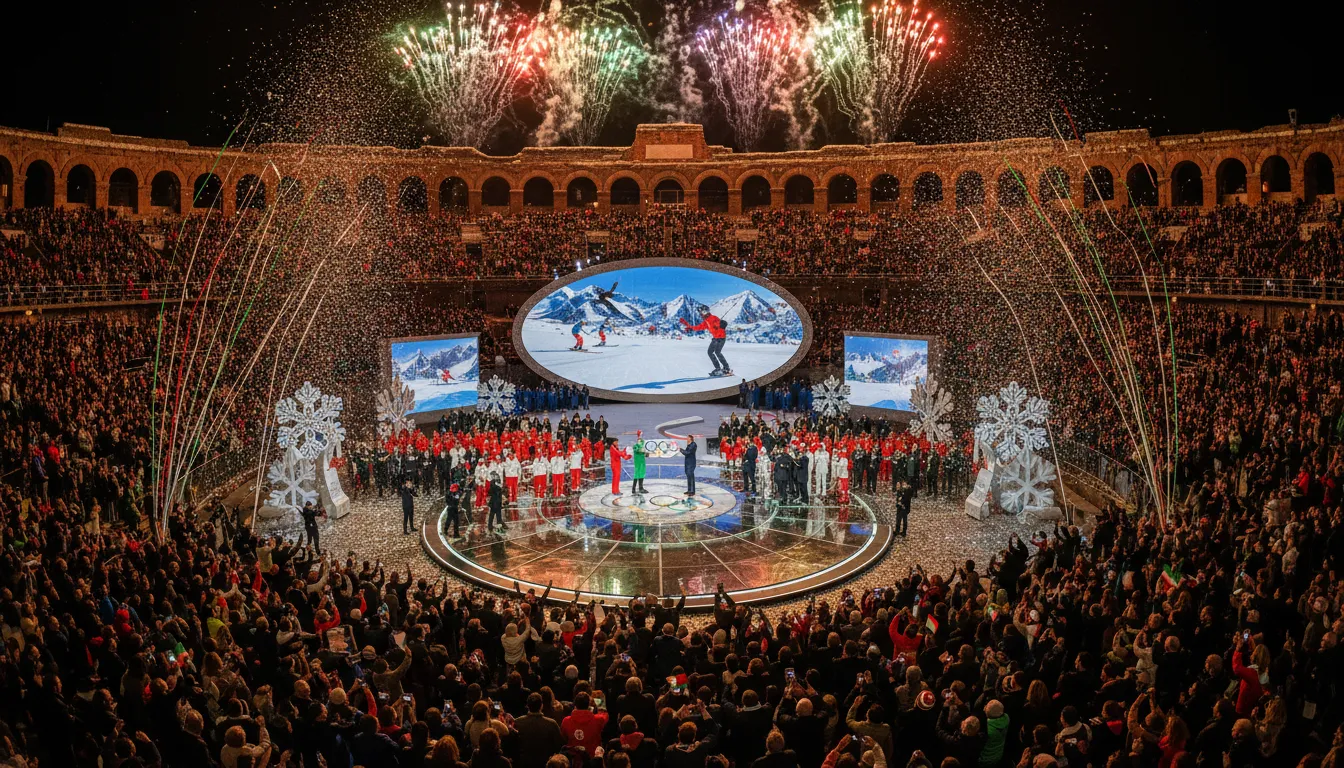
A Historic Farewell in an Ancient Amphitheater
The XXV Olympic Winter Games drew to a close on February 22, 2026, with a ceremony unlike any in modern Olympic history. Some 12,000 spectators filled the Arena di Verona — a first-century Roman amphitheater and UNESCO World Heritage Site — for a 2.5-hour spectacular titled "Beauty in Action." It marked the first time since the 1896 Athens Games that an ancient monument served as the stage for an Olympic ceremony.
The decision to hold the closing in Verona, separate from the host cities of Milan and Cortina d'Ampezzo, was itself a statement: these Games were never about a single place. Spread across roughly 22,000 square kilometers of northern Italy, Milano Cortina 2026 was the most geographically dispersed Winter Olympics ever staged.
Italy's Cultural Showcase
The ceremony wove together threads of Italian artistic identity, from lyric opera to contemporary pop. Roberto Bolle, one of the world's most celebrated ballet dancers, made his first-ever aerial performance — descending through a blazing ring meant to evoke the sun, then landing on a stage designed to mirror the Venetian lagoon, complete with gondolas. He danced to a haunting melody by Italian singer Joan Thiele.
Singer Achille Lauro and DJ Gabry Ponte followed, bringing the roughly 1,500 athletes on the arena floor to their feet in a confetti-drenched finale. The celebration honored everything from ancient Roman grandeur to Italy's thriving contemporary music scene — a deliberate fusion of heritage and modernity that organizers had promised from the outset.
Two Olympic cauldrons — one in Milan, one in Cortina d'Ampezzo — were extinguished simultaneously via video link during the ceremony, a logistical first for the Winter Games. The dual cauldrons had been a signature feature of a Games defined by its multi-city format.
Records on the Snow and Ice
The athletic scorecard was equally impressive. Approximately 2,880 athletes from 92 nations competed across 116 medal events in eight sports and 16 disciplines over 17 days. Ski mountaineering made its Olympic debut, expanding the program's reach into alpine endurance.
Norway topped the overall medal table with 41 medals, including 18 gold — breaking its own record set at the 2018 PyeongChang Games. Cross-country skiing legend Johannes Høsflot Klæbo claimed a record sixth gold of these Games alone.
The United States fielded its largest-ever Winter Olympics team of 232 athletes and secured a record 12 gold medals — a milestone celebrated by USOPC CEO Sarah Hirshland as "a truly historic performance." The host nation, Italy, surpassed all expectations, finishing with 30 total medals (10 gold, 6 silver, 14 bronze) — its best Winter Games result ever, eclipsing the 20-medal haul from the 1994 Lillehammer Games.
Handover to the French Alps
IOC President Kirsty Coventry closed the Games with praise for Italian organizers, saying they "delivered a new kind of Winter Games and set a very high standard for the future." The Olympic flag was formally handed to France, whose Riviera Alps region will host the 2030 Winter Games, following a similarly dispersed model that may even see speed skating held in Italy or the Netherlands.
The Paralympic Winter Games will return to Verona's arena for their opening ceremony on March 6, extending Italy's Olympic moment through mid-March. For now, the twin flames are out — but the image of Verona's ancient stones lit by Olympic fire is one the sporting world is unlikely to forget.