Military Laser Downs Own Drone in Texas, Exposing Agency Chaos
For the second time in February, a US military laser system shot down American government equipment near the Texas-Mexico border — this time a CBP surveillance drone — exposing a dangerous breakdown in coordination between the Pentagon, Customs and Border Protection, and the FAA.
Second Friendly-Fire Incident in Two Weeks
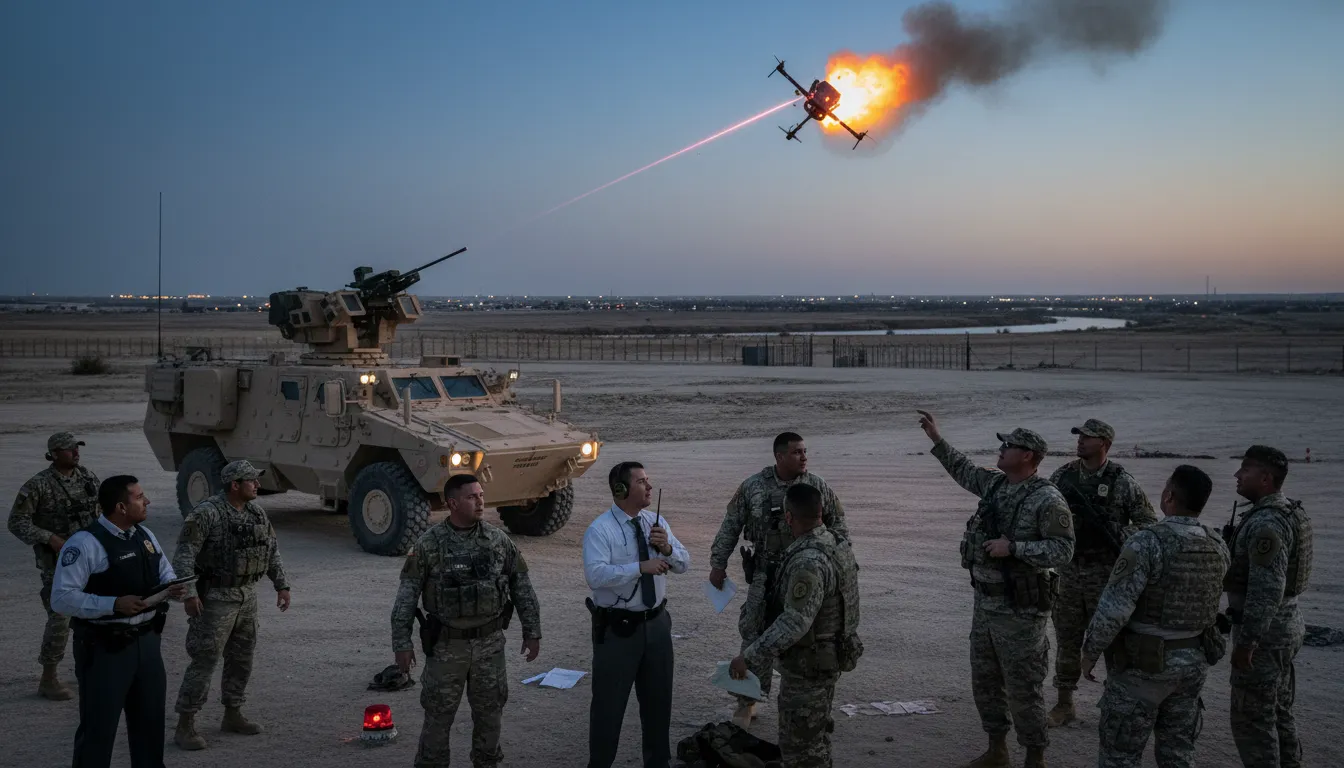
For the second time in February, the US government accidentally fired a military-grade laser at its own equipment near the Texas-Mexico border — and nobody told anybody else it was happening. On February 26, the Pentagon's counter-drone laser system detected what it assessed as a threatening unmanned aerial vehicle operating in restricted military airspace near Fort Hancock, Texas, and destroyed it. The target turned out to be a drone operated by US Customs and Border Protection (CBP). CBP had simply not informed the Defense Department it was flying one, according to NPR and congressional aides briefed on the matter.
A Pattern of Dangerous Miscommunication
The Fort Hancock incident was not an isolated failure. Just two weeks earlier, on February 11, CBP operatives fired the same type of high-energy laser near Fort Bliss — without coordinating with the Federal Aviation Administration. The system hit metallic party balloons, but the FAA, unaware a directed-energy weapon was being used near a major airport, shut down El Paso International Airport for roughly eight hours. Fourteen flights were canceled and medical evacuation aircraft were diverted 45 miles to Las Cruces, New Mexico, according to CNN.
The February 26 closure was smaller in scope — affecting airspace below 18,000 feet over Fort Hancock rather than a major hub — but the FAA imposed flight restrictions extending until June 24, a sign of how seriously officials are treating the ongoing safety risk.
Three Agencies, No Shared Playbook
What both incidents exposed is a striking absence of interagency coordination. According to administration officials, none of the three agencies involved — the Pentagon, CBP, and the FAA — maintains a real-time shared operational picture for counter-drone activities along the southern border. Both the Pentagon and CBP independently believed they could deploy the laser system without first obtaining FAA clearance, a dangerous procedural misunderstanding with tangible consequences for civilian aviation.
The laser is a directed-energy weapon loaned to CBP as part of the Trump administration's push to militarize border security. Its deployment without deconfliction protocols created the conditions for exactly this kind of mishap, as Al Jazeera reported.
Lawmakers Demand Accountability
Congressional Democrats, including Senator Tammy Duckworth, called for independent investigations. Members of key oversight committees declared their outrage, with one lawmaker saying: "Our heads are exploding over the news." They accused the administration of bypassing a bipartisan, tri-committee bill that would have mandated coordination training among the Pentagon, the Department of Homeland Security, and the FAA for counter-drone operations.
The Pentagon acknowledged the February 26 incident in a joint statement with the FAA and CBP, confirming the military "employed counter-unmanned aircraft system authorities to mitigate a seemingly threatening unmanned aerial system operating within military airspace," while noting the action occurred far from populated areas and commercial flight paths.
Drones, Lasers, and the Skies Above America
The twin incidents highlight a broader tension as the US government rapidly expands its use of directed-energy weapons in domestic border operations. The same technology designed to neutralize adversarial drones is now shooting down American government property and disrupting commercial aviation. With drone traffic in US airspace growing steadily — for surveillance, delivery, and border enforcement alike — the absence of a coordinated legal and operational framework is not merely a bureaucratic gap. It is a mounting safety hazard.
As pressure on the administration intensifies, the question is no longer whether these systems will misfire again — but what they might hit next.