Nuclear Umbrella for Europe: Macron's Speech and Merz's Plans
On March 2, 2026, French President Macron will deliver a landmark speech on European nuclear deterrence from Île Longue. Chancellor Merz has already confirmed confidential talks with Paris – a historic shift in German security policy.
Historic Speech from Nuclear Submarine Base
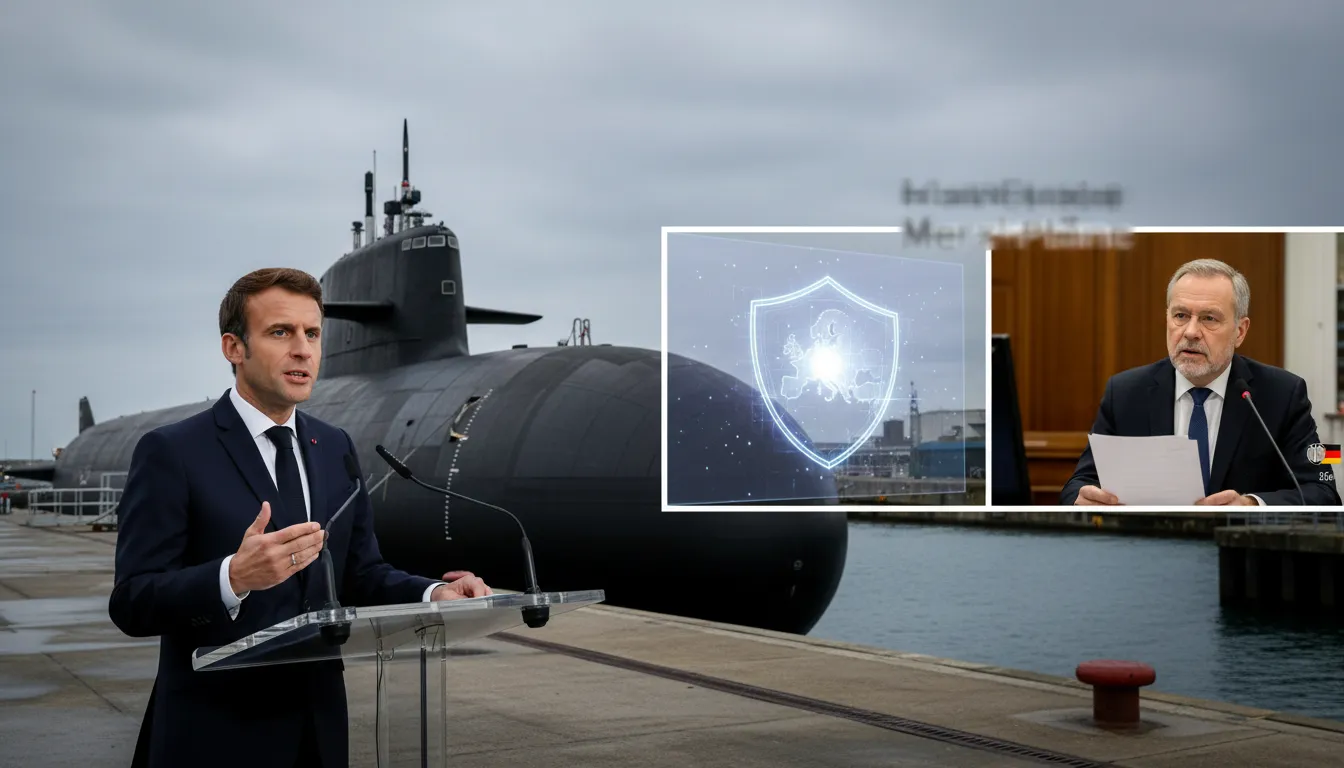
On March 2, 2026, French President Emmanuel Macron will deliver a highly anticipated speech on nuclear deterrence from the Île Longue peninsula in Brittany, the home port of France's four nuclear submarines. The Élysée Palace described the appearance as "an important moment in his term" with "undoubtedly significant developments." Macron intends to outline how France's nuclear strategy could take on a European dimension – without replacing the role of the United States in NATO.
Merz Confirms Confidential Talks
The decisive impetus came from Chancellor Friedrich Merz at the Munich Security Conference on February 13. "I have initiated initial talks with the French President on European nuclear deterrence," Merz stated publicly. He emphasized that Germany would not develop its own nuclear weapons – the Two Plus Four Agreement of 1990 prohibits this – but is interested in including French and British nuclear weapons in a common European security umbrella.
Macron had already made a similar offer in 2020, during Trump's first term. At the time, both Chancellor Angela Merkel and her successor Olaf Scholz ignored the offer. With Merz, Macron now finds a German head of government for the first time who is openly receptive to this debate.
Trump as Catalyst: Doubts About NATO Assistance
Donald Trump's return to the White House has raised significant doubts in European capitals about the reliability of NATO's Article 5 mutual defense clause. Merz warned after the federal election that Germany must prepare for Washington to "no longer fully" honor its pledge of assistance. Combined with the ongoing Russian war of aggression against Ukraine, the desire for a more independent European defense architecture is growing.
As the EU's only nuclear power, France has around 290 nuclear warheads, while the United Kingdom possesses 225. Paris recently deepened its nuclear cooperation with London through the so-called Northwood Declaration, which establishes a joint nuclear steering group. According to Euronews, Macron will emphasize that the French offer is intended to complement – not replace – US deterrence.
Divided Reactions in Berlin
Disagreement prevails within the German coalition. Foreign Minister Johann Wadephul (CDU) urged restraint: "Frankly, there are enough nuclear weapons in the world." Defense Minister Boris Pistorius (SPD) considers the debate to be "the wrong signal" and doubts that Europe could build an independent nuclear capability within five to ten years. SPD leader Lars Klingbeil supports talks with France but explicitly excludes German nuclear weapons. Jens Spahn, leader of the CDU/CSU parliamentary group, expressed doubts about whether future heads of government in Paris or London could be trusted unconditionally.
Outlook: A New Security Architecture?
Whether Macron's speech on March 2 will represent a concrete treaty, a declaration of intent, or initially just political signals remains to be seen. What is clear is that the debate on European nuclear deterrence, which has been taboo for years, has become a matter of geopolitical urgency due to Trump's return and the war in Ukraine. This poses completely new strategic and legal questions for Germany as the EU's largest non-nuclear power – with potential consequences also for Austria and Switzerland, which, as neutral states, are closely following developments.