Perseverance Drives Mars Solo: AI Takes the Wheel
NASA's Perseverance rover completed the first Mars drives planned entirely by artificial intelligence in December 2025, covering 456 meters without human operators — a milestone that could transform deep-space exploration.
A Giant Leap for Autonomous Exploration
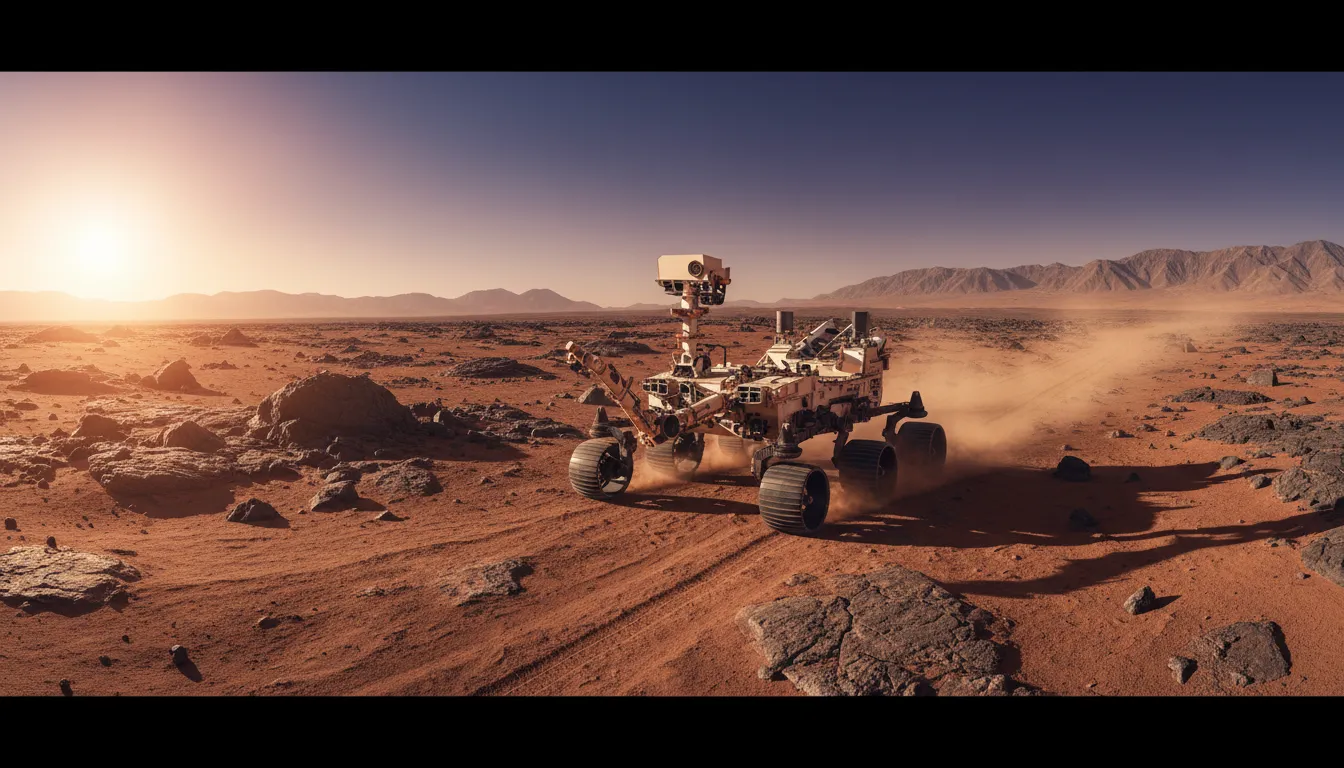
For the first time in the history of planetary exploration, a rover has driven across the surface of another world following routes planned entirely by artificial intelligence — with no human operator drawing the path. On December 8 and 10, 2025, NASA's Perseverance rover completed two demonstration drives in Mars's Jezero Crater using waypoints generated by generative AI, marking a milestone that engineers at the Jet Propulsion Laboratory (JPL) say could fundamentally reshape how humanity explores distant worlds.
How It Worked
The initiative was led by JPL's Rover Operations Center in collaboration with Anthropic, whose Claude vision-language models served as the AI brain behind the experiment. Rather than rely on human planners poring over images and manually selecting waypoints, the AI analyzed the same data sets those planners typically use: orbital imagery from the Mars Reconnaissance Orbiter's HiRISE camera and digital elevation models of the Martian terrain.
The system identified hazards — sand traps, boulder fields, exposed bedrock, and rocky outcrops — and charted a safe path defined by a series of waypoints. On sol 1,707 (Perseverance's 1,707th Martian day), the rover drove 210 meters using the AI-generated plan; two sols later, it completed a second traverse of 246 meters. Together, the two runs covered 456 meters (roughly 1,496 feet) — entirely without a human hand guiding the route.
Safety First: The Digital Twin Checkpoint
Despite the headline-grabbing autonomy, engineers built in a critical safeguard. Before any command reached Mars, JPL's digital twin of Perseverance — a high-fidelity software replica — validated every instruction against more than 500,000 telemetry variables to confirm compatibility with the rover's flight software. Only after clearing that gauntlet were the commands uplinked to the spacecraft. The AI planned the routes; humans still held the final verification key.
Why This Matters: The Light-Speed Problem
At the heart of this advance lies an inescapable physics constraint. A radio signal traveling between Earth and Mars currently takes roughly 25 minutes round-trip — meaning that real-time remote control is impossible. Traditional operations require mission teams to plan routes in advance, with waypoints spaced no more than 100 meters apart to minimize risk. AI-assisted planning can accelerate that process, potentially allowing the rover to cover more scientifically valuable ground per Martian day.
"The fundamental elements of generative AI are showing a lot of promise in streamlining the pillars of autonomous navigation for off-planet driving," said Vandi Verma, a space roboticist at JPL.
NASA Administrator Jared Isaacman framed it in broader terms: "This demonstration shows how far our capabilities have advanced and broadens how we will explore other worlds."
The Road Ahead
The December tests are just the opening act. NASA engineers acknowledge that remaining challenges include AI-enabled re-localization — reducing the positional uncertainty that accumulates over longer autonomous drives. Solving that problem would allow rovers to navigate even more confidently across unfamiliar terrain.
Beyond Mars, the implications extend to the Moon, the asteroid belt, and eventually the outer solar system. As missions venture further from Earth, the communication delay only grows, making autonomous AI navigation not a luxury but a necessity. The Perseverance demonstration may one day be remembered as the moment the leash between Earth and its robotic explorers began, quietly and irreversibly, to loosen.