Ring of Fire Eclipse Dazzles Antarctica Today
An annular solar eclipse creates a stunning 'Ring of Fire' over Antarctica on February 17, 2026, with partial views across southern South America and Africa — but most humans will miss it.
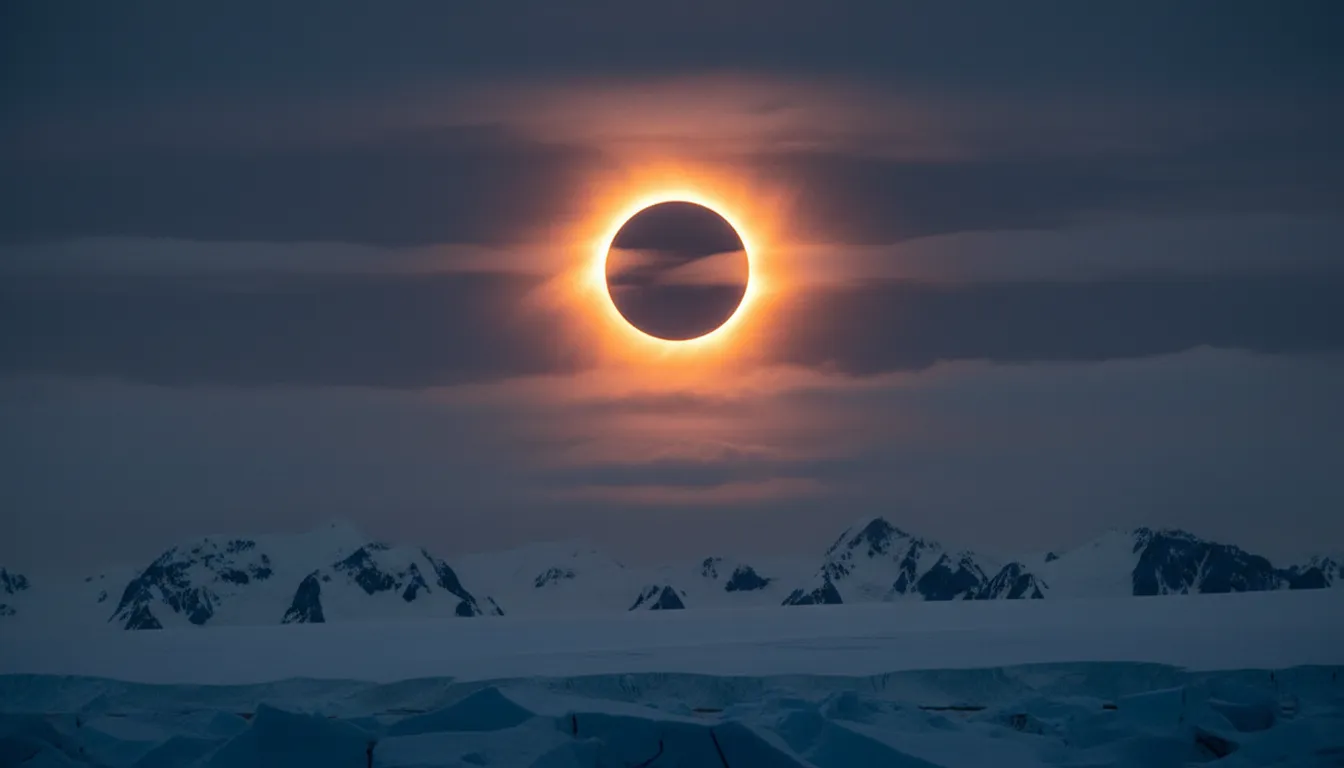
A Celestial Spectacle in Earth's Most Remote Corner
On February 17, 2026, an annular solar eclipse — popularly known as the "Ring of Fire" — is sweeping across one of the most inaccessible places on Earth. The full annular effect is visible only from a narrow path crossing Antarctica and the Southern Ocean, making this one of the least-observed solar eclipses in recent memory.
The eclipse began its partial phases at 09:56 UTC and reaches maximum annularity at 12:12 UTC, when the Moon will block roughly 96% of the Sun's disk. For about 2 minutes and 20 seconds, observers in the path of annularity will witness a brilliant ring of sunlight surrounding the Moon's dark silhouette — a sight that occurs when the Moon is too far from Earth in its orbit to fully cover the solar disk.
Who Gets to Watch?
The short answer: almost nobody. The annular path stretches 4,282 kilometers long and 616 kilometers wide, but it crosses primarily open ocean and the frozen Antarctic interior. Only a handful of research stations lie along or near the path, including Europe's Concordia Research Station (a joint French-Italian facility) and Russia's Mirny Station in Queen Mary Land. The American McMurdo Station will experience an 86% partial eclipse.
As Live Science wryly noted, this eclipse is "mostly a skywatching spectacle for penguins." Only about 176 million people — roughly 2% of the global population — will see any portion of the event, and all of them will witness only a partial eclipse.
Partial Views Across the Southern Hemisphere
While the ring of fire remains exclusive to Antarctica, a partial solar eclipse is visible across a broader swath of the Southern Hemisphere. Skywatchers in the southern tips of Argentina and Chile can observe the partial eclipse beginning around 7:00 a.m. local time. Across southern Africa — including South Africa, Botswana, Lesotho, Zimbabwe, Mozambique, and Madagascar — the partial eclipse appears during early to mid-afternoon.
Southern Madagascar offers the best view from any populated area, with approximately 40% of the Sun's disk obscured by the Moon. Observers in Cape Town, Johannesburg, and other southern African cities will see a more modest but still noticeable bite taken out of the solar disk.
The Science Behind the Ring
An annular eclipse differs fundamentally from a total eclipse. The Moon's orbit around Earth is not perfectly circular — its distance varies between about 356,000 and 407,000 kilometers. When a solar eclipse occurs while the Moon is near its farthest point (apogee), the lunar disk appears too small to fully cover the Sun, leaving a dazzling ring of light.
According to Universe Today, annular eclipses are becoming slightly more common over geological time as the Moon gradually recedes from Earth at a rate of about 3.8 centimeters per year.
The antumbral shadow of the Moon just skims our planet on Tuesday, grazing the edge of the Antarctic continent.
What Comes Next
This eclipse marks just the beginning of a busy year for celestial events. A total lunar eclipse follows on March 3, 2026. Then, on August 12, 2026, a total solar eclipse will cross the Arctic, Greenland, Iceland, and Spain — offering far better viewing opportunities for millions of people in the Northern Hemisphere.
For those hoping to see an annular eclipse from more accessible locations, the wait extends to 2028, when the next ring of fire will be visible from populated regions. In the meantime, today's Antarctic spectacle serves as a reminder that the cosmos operates on its own schedule — indifferent to human convenience, yet no less magnificent for it.
Safety note: An annular eclipse is never safe to view without proper eye protection. Observers must use ISO 12312-2 certified solar eclipse glasses or pinhole projectors — regular sunglasses are not sufficient.