Spain: Ten Million Foreign-Born Residents
For the first time in its history, Spain has surpassed 10 million residents born outside the country, according to the INE. This milestone redefines the national demographics and opens an urgent debate on integration, housing, the labor market, and the sustainability of the pension system.
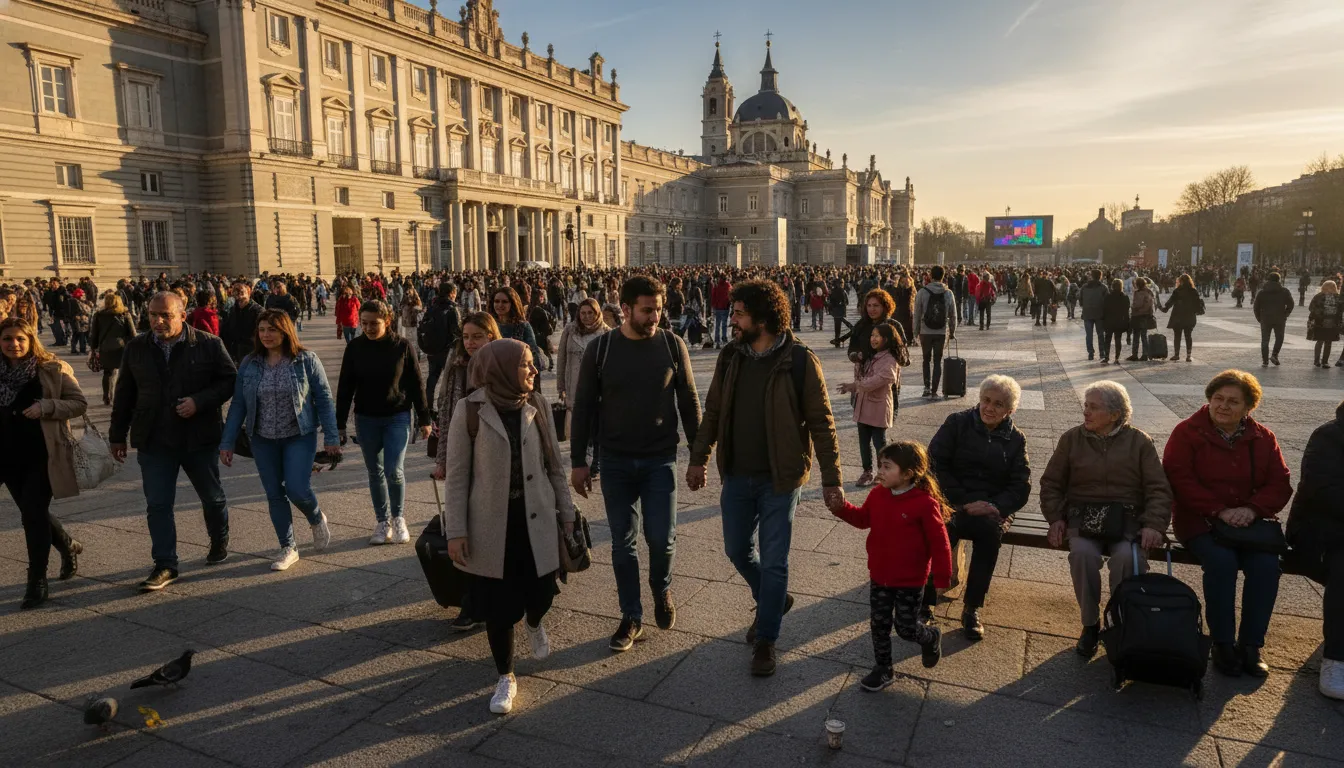
An Unprecedented Milestone in Spanish Demographic History
The National Statistics Institute (INE) confirmed in February 2026 that Spain had reached, for the first time in its history, the figure of 10,004,581 residents born abroad, with data referring to January 1, 2026. Out of a total of 49,570,725 inhabitants—an absolute historical record—one in five Spaniards was born outside the country's borders. Immigration has become, without qualification, the sole engine of demographic growth for a nation whose native population is aging rapidly.
Latin America Takes Center Stage
The most represented countries of origin among foreign residents are Morocco, Colombia, and Venezuela, although the Latin American group dominates the most recent flows. Linguistic and cultural proximity facilitates the integration of these groups, which also benefit from accelerated naturalization pathways provided for in Spanish legislation for Ibero-American citizens. Of the ten million foreign-born residents, approximately 2.8 million have already acquired Spanish nationality, while the remaining 7.2 million retain their original citizenship. In Madrid, those born in Latin America already exceed one million people, representing one in seven inhabitants of the capital.
Economic Engine, But With Nuances
A study by Funcas published in February 2026 puts the contribution of immigration to Spanish GDP growth since 2022 at 47%. Foreign workers affiliated with Social Security exceed 3.1 million, 14.1% of the total number of contributors, and in the last year have generated 40.1% of the new jobs created in the country. Sectors such as hospitality, construction, commerce, and care are structurally dependent on this workforce.
However, experts warn that the average wages of immigrant workers are still lower than those of natives, which limits their net contribution to the sustainability of the pension system. The Bank of Spain estimates that the country will need about 24-25 million additional migrant workers until 2053 to maintain the balance of Social Security accounts, a projection that illustrates the magnitude of the challenge.
Housing and Integration: The Tensions of Growth
The impact of immigration is not perceived neutrally in Spanish society. According to the CIS barometer of February 2026, housing is the primary concern of citizens with 42.8% of mentions—an all-time high—followed by immigration, which has climbed to second place. The pressure on the rental market in large cities is reaching historical highs, and although economists point out that the structural cause is the lack of supply, public debate tends to link both phenomena.
Spain today, along with Luxembourg, Germany, and Sweden, is in the group of countries in the European Union with the highest proportion of foreign-born population. The challenge for the coming years will be to design effective integration policies that maximize the economic and social contribution of these residents, while managing the pressure on public services and access to housing.
A Transforming Identity
The milestone of ten million is not just a statistical figure: it is a reflection of a Spain that has transformed profoundly in just two decades. A country that in the 1990s was a net sender of emigrants has become one of the main migratory destinations in Europe. The question that underpins the national debate is no longer whether Spain is a diverse society, but how to manage that diversity in a fair, sustainable, and cohesive manner.