Supreme Court Strikes Down Trump's IEEPA Tariffs
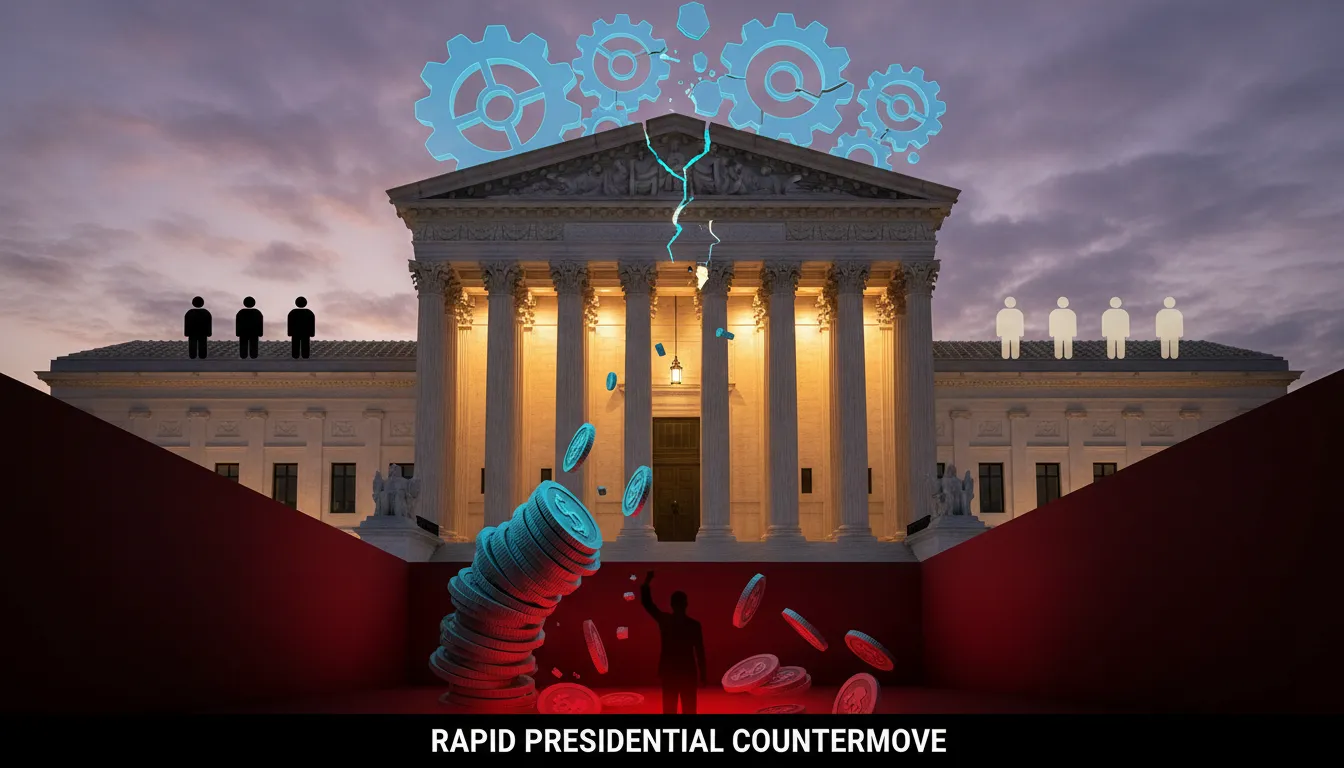
The U.S. Supreme Court ruled 6-3 on February 20, 2026, that Trump's sweeping tariffs imposed under a 1977 emergency powers law are unconstitutional, wiping out $1.4 trillion in projected revenue and triggering a rapid presidential countermove.
A Landmark Rebuke of Executive Power
In a decision that will reshape American trade policy for a generation, the U.S. Supreme Court ruled 6-3 on February 20, 2026, that President Donald Trump had no legal authority to impose sweeping tariffs using the International Emergency Economic Powers Act (IEEPA) of 1977. The case, Learning Resources, Inc. v. Trump, marked one of the most significant judicial checks on executive power in decades.
Chief Justice John Roberts, writing for the majority, was unambiguous: "IEEPA contains no reference to tariffs or duties," and the words "regulate" and "importation" in the statute cannot sustain the sweeping tariff regime the administration erected. The Court applied the so-called major questions doctrine — a legal principle requiring that Congress provide clear authorization before the executive branch takes actions of vast economic significance.
Who Voted and Why
The majority coalition crossed ideological lines, pairing conservative Chief Justice Roberts and Justices Neil Gorsuch and Amy Coney Barrett with the court's three liberal justices — Sonia Sotomayor, Elena Kagan, and Ketanji Brown Jackson. Gorsuch filed a sweeping 46-page concurrence reinforcing limits on presidential economic power.
The three dissenters — Justices Brett Kavanaugh, Clarence Thomas, and Samuel Alito — argued in a 63-page dissent that IEEPA's broad language did permit the tariffs and that the court was overstepping into executive foreign-policy territory.
Staggering Financial Stakes
The ruling's economic consequences are enormous. The IEEPA tariffs had already collected an estimated $160 billion in revenue by the ruling date, with the Penn Wharton Budget Model projecting they would have generated $1.4 trillion over the 2026–2035 decade. The Tax Foundation estimates the average U.S. tariff rate will fall from roughly 17% to around 7%, and that removing the duties will prevent a 0.3% contraction in long-run GDP.
Yet uncertainty looms over the question of refunds. The ruling remands the case to the Court of International Trade to determine procedures for reimbursing importers — a potentially massive accounting exercise involving hundreds of billions of dollars in duties already passed through global supply chains.
Markets reacted positively: stocks jumped immediately after the ruling, reflecting relief from businesses that had absorbed escalating costs. Harvard economist Gita Gopinath had previously noted that "nearly all the cost of Trump's tariffs are being paid by U.S. importers, not foreign suppliers." Manufacturing payrolls shed 108,000 jobs during 2025 as the tariff burden rippled through the economy.
Trump Strikes Back — Immediately
The president wasted little time. Hours after the ruling, Trump signed an executive order imposing a 10% global tariff under Section 122 of the Trade Act of 1974 — an entirely different statutory basis. He called the Supreme Court justices a "disgrace" and vowed the tariff regime would continue by other means.
The Section 122 maneuver comes with built-in constraints, however: tariffs under that provision can only last 150 days, after which congressional approval is required. The administration also signaled it would lean on Section 232 (national security) and Section 301 (unfair trade practices) authorities — tools that require formal investigative processes through the Commerce Department and the U.S. Trade Representative respectively, and that carry narrower legal scope.
What Remains — and What Doesn't
Critically, the ruling does not touch Section 232 tariffs on steel, aluminum, automobiles, semiconductors, and copper — duties projected to generate $635 billion over a decade and costing the average American household an estimated $400 in 2026 alone. Retaliatory tariffs targeting trade-surplus nations like Brazil and the EU's broader reciprocal measures, however, fall outside remaining legal frameworks.
The court's decision lands at a pivotal moment for global trade architecture. Chinese imports had already fallen from 12% to 8% of total U.S. imports between 2024 and late 2025 as supply chains rerouted. Whether the ruling triggers a durable reset — or merely a temporary legal detour around an administration determined to pursue protectionism — will define the contours of international commerce for years to come.