Three Breakthroughs Bring Quantum Computing Closer
Three simultaneous advances in February 2026 — in-vacuum cryoelectronics for ion traps, readable Majorana qubits, and ultra-fast qubit monitoring — signal that fault-tolerant quantum computers may arrive sooner than expected.
In-Vacuum Control: Fewer Wires, More Qubits
One of the biggest engineering headaches in quantum computing is the sheer volume of wiring required to connect room-temperature control electronics to the frigid ion traps where qubits live. Each additional qubit demands additional connections, and heat leaking through thousands of cables into the cryogenic environment becomes unmanageable at scale.
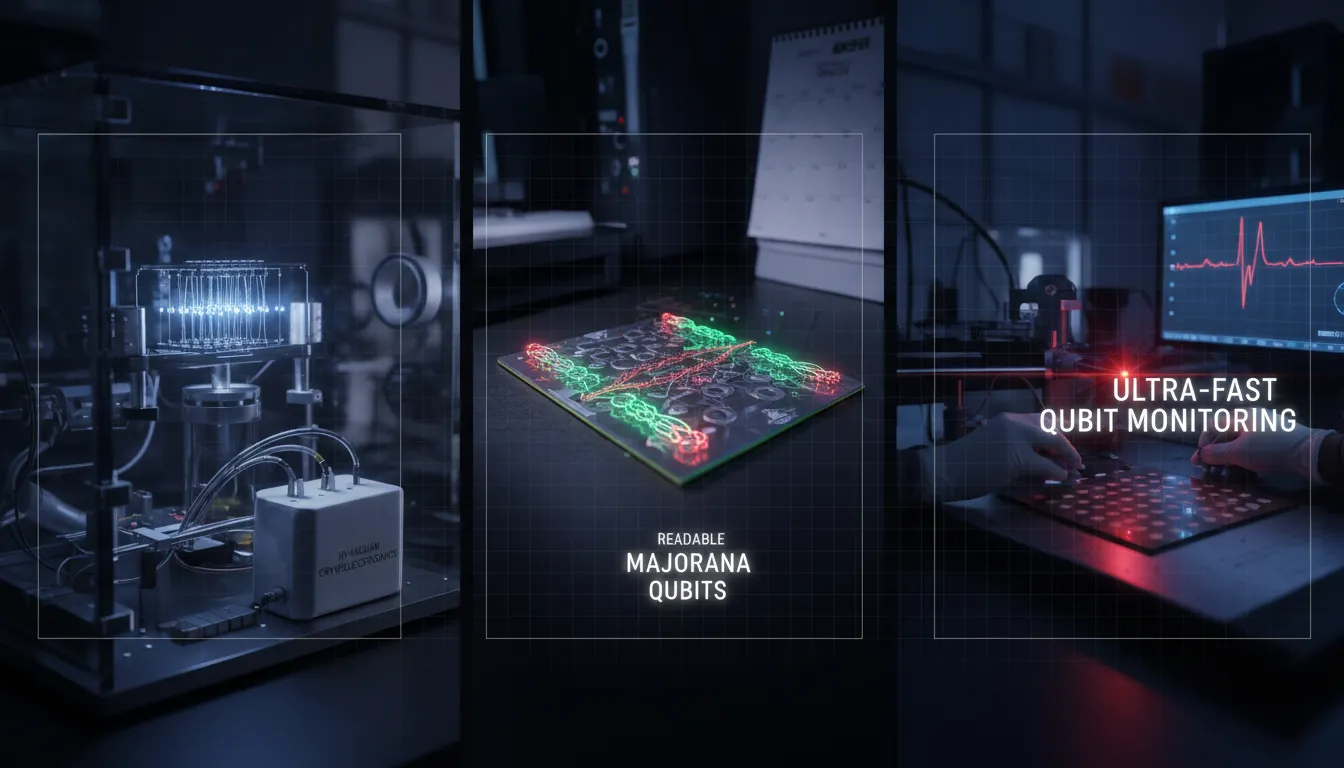
Fermilab and MIT Lincoln Laboratory have now demonstrated a practical alternative. Working under a collaboration backed by the U.S. Department of Energy — through the Quantum Science Center and Quantum Systems Accelerator — the team placed ultra-low-power cryoelectronics directly inside the vacuum chamber alongside the ion traps. The chip-based circuits, developed at Fermilab's Microelectronics Division, successfully moved and held individual ions at temperatures far colder than deep space.
"This approach may be able to accelerate the timeline for scaling quantum computers, bringing closer into reach what seemed decades away," said Farah Fahim, head of Fermilab's Microelectronics Division. Transistors behaved differently at MIT Lincoln Laboratory's colder operating temperatures, and voltage-holding times still need extension — but the fundamental proof of concept is solid. Future systems could theoretically support tens of thousands of electrodes or more.
Cracking the Majorana Qubit Code
Meanwhile, researchers at Delft University of Technology and Madrid's Institute of Materials Science (ICMM-CSIC) solved a long-standing paradox: how to read information stored in Majorana qubits without destroying the very protection that makes them valuable.
Majorana qubits store data across pairs of exotic quantum states — Majorana zero modes — distributed through a material rather than confined to a single point. This non-local storage makes them naturally resistant to local noise. But that same distributed nature has long made them nearly impossible to measure.
The team's solution used quantum capacitance as a global probe. By constructing a minimal Kitaev chain — two quantum dots connected by a superconducting nanowire — they exploited differences in how electron pairs behave under even or odd parity. Measuring charge flow into the superconductor revealed the stored parity state. The experiment achieved parity coherence exceeding one millisecond, which researcher Ramón Aguado called "a very promising value for future operations of a topological qubit." The results appeared in Nature in February 2026.
Watching Qubits Fail — 100 Times Faster
The third advance came from the Niels Bohr Institute at the University of Copenhagen. Even well-built qubits degrade unpredictably: environmental defects can fluctuate hundreds of times per second, causing rapid swings in energy-loss rates. Traditional diagnostics delivered only slow, averaged readings — too sluggish to capture the real dynamics of a failing qubit.
The Copenhagen team deployed a Bayesian algorithm running on a commercial FPGA controller that updates after every single measurement, delivering a real-time picture of qubit behavior on millisecond timescales — roughly 100 times faster than any previous method. The practical payoff is immediate: identifying problematic qubits now takes seconds instead of hours, enabling smarter calibration and faster scaling. The work was published in Physical Review X in February 2026.
A Converging Wave
Each breakthrough addresses a distinct layer of the quantum computing stack: hardware integration, qubit topology, and real-time diagnostics. Fermilab and MIT are solving the wiring problem. Delft and Madrid are unlocking stable, noise-resistant qubit architectures. Copenhagen is building the tools to detect and correct failure in real time.
The road to fault-tolerant quantum computers remains technically demanding. But February 2026 delivered three credible signals that the engineering bottlenecks once thought to be decades away from resolution are yielding ahead of schedule.