Tusk Sides with Magyar Ahead of Hungarian Elections
Prime Minister Donald Tusk publicly expressed his support for the Hungarian opposition party Tisza during a march in Budapest on the Hungarian National Day. Hungarian Foreign Minister Péter Szijjártó responded with a sarcastic retort, adding a new dimension to the Polish-Hungarian political dispute less than a month before the parliamentary elections.
Budapest Divided Ahead of Elections
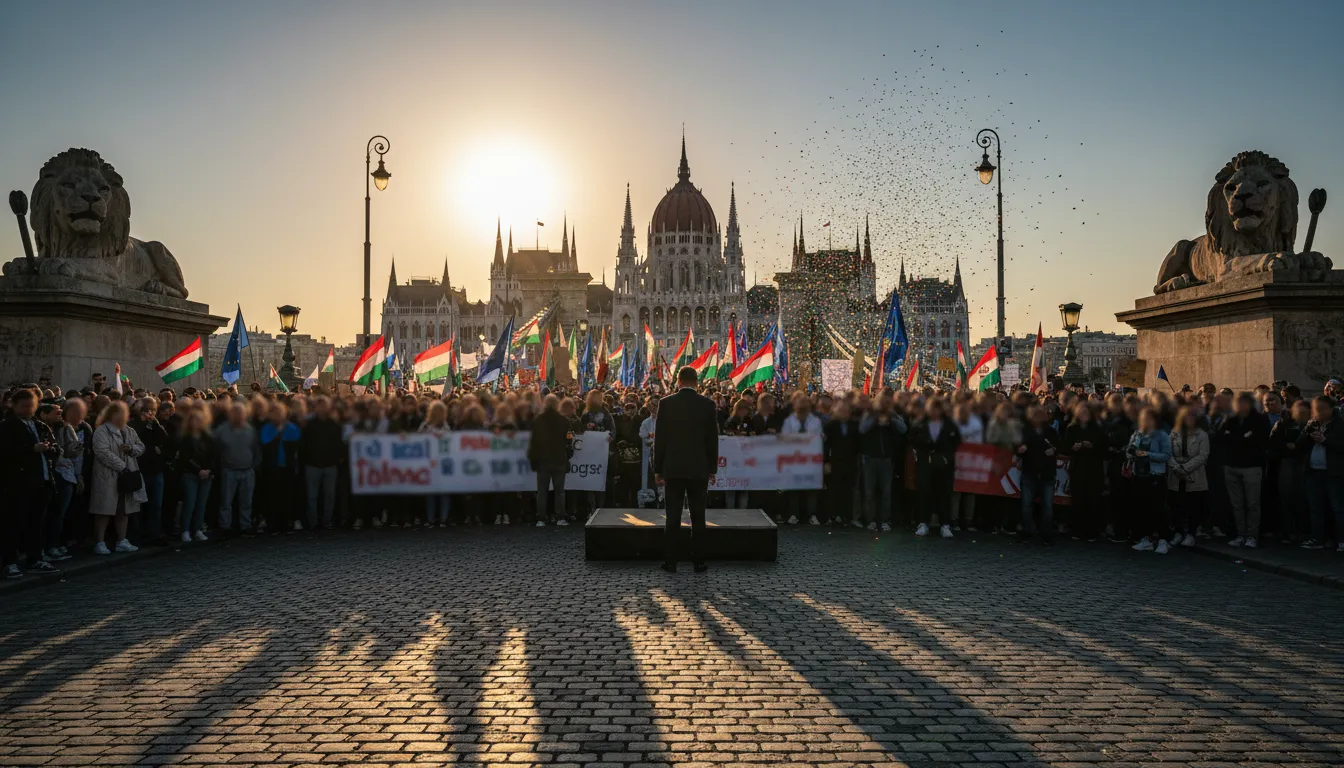
On March 15, 2026, the Hungarian National Day commemorating the 1848 revolution, the streets of Budapest became the scene of an unprecedented political clash. Two massive rallies—one by the ruling Fidesz party and the other by the opposition Tisza party led by Péter Magyar—drew hundreds of thousands of participants less than a month before the parliamentary elections scheduled for April 12, 2026.
Magyar announced that his march at Heroes' Square and along Andrássy Avenue gathered half a million hearts beating as one. Independent observers assessed the turnout more cautiously, but most reports confirmed that Tisza mobilized more supporters than Fidesz. This is a symbolic blow to Orbán, who has monopolized the streets of Budapest for years.
Tusk Redefines Old Friendship
At noon that day, Prime Minister Donald Tusk posted a photo from the Tisza march on the X platform with the caption: "Budapest today. Spring is coming." In another post, the Prime Minister invoked the well-known proverb—"Pole and Hungarian, two good friends"—but used it in a new context: as an expression of solidarity with the pro-Western opposition, not with Orbán's government, as had been the case until now.
This symbolic gesture did not go unnoticed. Tusk consciously broke the hitherto unwritten rule of non-interference in the internal politics of partners from the Visegrád Group. Relations between Warsaw and Budapest, once close under the PiS government, have cooled significantly since 2023—Tusk's and Orbán's governments stand on opposite sides of the barricade on issues of the rule of law, support for Ukraine, and the future of the European Union.
Szijjártó Responds with Mockery
Budapest's response was immediate. Hungarian Foreign Minister Péter Szijjártó commented on Tusk's post with a sarcastic retort: "It's a pity he didn't show up this time. Four years ago, he was at an opposition rally, and then we won by 20 percent." Szijjártó thus implied that Tusk might be a burden for Tisza, not an asset—and that Fidesz does not feel threatened by foreign criticism.
The minister went further, stating that democracy in Hungary is at a significantly higher level than in Poland—a direct attack on Tusk's government, accused by Hungarian politicians of violating the rule of law in its judicial reforms.
Magyar vs. Orbán: The Stakes of the Election
Péter Magyar has clearly sharpened his campaign rhetoric, calling Orbán a traitor and accusing him of inviting Russian agents to interfere in the electoral processes. "Our homeland is part of the West, it is part of the European community, it is part of NATO," the Tisza leader emphasized in his speech.
According to an analysis by the European Council on Foreign Relations (ECFR), Tisza envisages a deep reset of Hungary's foreign policy: an end to blocking EU decisions, a rebuilding of relations with Warsaw, and a reactivation of the Visegrád Group as a forum for real Central European cooperation. Hungary would become "a spoke in the wheel", not a stick inserted into the spokes, as Anita Orbán, the candidate for head of Hungarian diplomacy, put it.
Independent polls consistently indicate Tisza's lead over Fidesz. A February poll by the Median agency gave Magyar a 20 percentage point lead among decided voters. If these results are confirmed on April 12, Poland and Hungary may enter a new phase of relations—this time built on common EU values, not on tactical anti-Brussels solidarity.