Webb Detects Life's Precursors in Galaxy Beyond Milky Way
The James Webb Space Telescope has detected benzene, methane, and the methyl radical for the first time outside the Milky Way, revealing unexpected organic chemical complexity in an ultra-luminous infrared galaxy.
A Chemical Surprise Beyond Our Galaxy
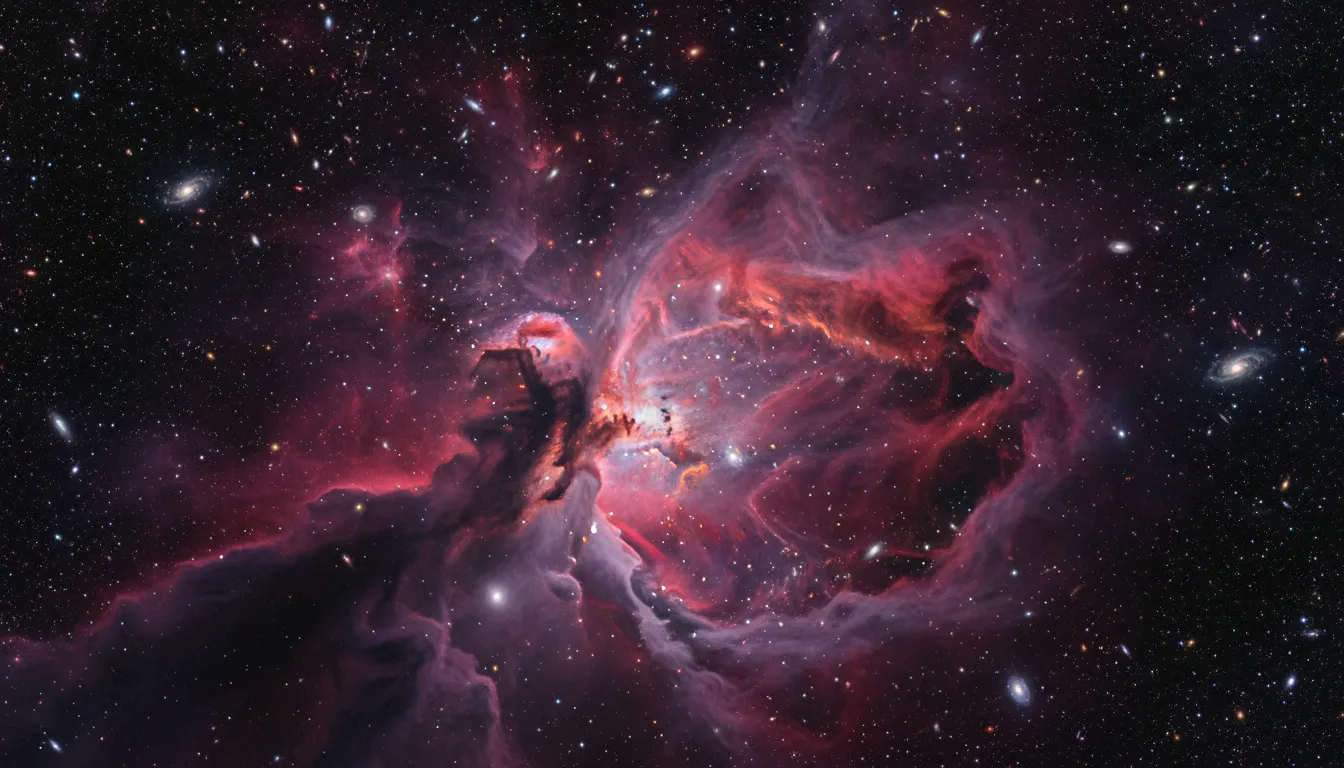
NASA's James Webb Space Telescope has uncovered an extraordinary trove of carbon-rich organic molecules in a galaxy far beyond the Milky Way — a discovery that reshapes our understanding of how the chemical precursors to life form across the universe. The findings, published in Nature Astronomy in February 2026, mark the first time several of these compounds have been detected outside our home galaxy.
The telescope trained its powerful infrared instruments on IRAS 07251-0248, an ultra-luminous infrared galaxy whose core is buried beneath thick layers of gas and dust surrounding a supermassive black hole. Using JWST's NIRSpec and MIRI instruments across wavelengths from 3 to 28 microns, an international team led by Dr. Ismael Garcia Bernete of Spain's Center for Astrobiology identified benzene, methane, acetylene, diacetylene, triacetylene, and — most notably — the methyl radical (CH3), never before seen beyond the Milky Way.
Abundances That Defy Models
"We found an unexpected chemical complexity, with abundances far higher than predicted by current theoretical models," Garcia Bernete said. The concentrations of these organic molecules exceeded what scientists expected from heat driven by the galaxy's black hole or turbulence in surrounding gas. Instead, the team points to cosmic rays as the likely engine behind this chemistry. These high-energy particles can penetrate dense regions where ultraviolet and X-ray light cannot reach, shattering carbon-rich dust grains and polycyclic aromatic hydrocarbons into smaller organic fragments.
Professor Dimitra Rigopoulou of the University of Oxford, a co-author, emphasized the astrobiological significance: "Although small organic molecules are not found in living cells, they could play a vital role in prebiotic chemistry, representing an important step towards" the formation of amino acids and nucleotides — the essential building blocks of life.
A Banner Month for Webb
The organic molecule discovery caps a remarkable stretch of breakthroughs from the $10 billion observatory. In January, a team led by Rohan Naidu at MIT's Kavli Institute confirmed galaxy MoM-z14 as the most distant object ever observed, existing just 280 million years after the Big Bang at a redshift of 14.44. The tiny galaxy — only 240 light-years across, some 400 times smaller than the Milky Way — is brighter and more chemically enriched than any model predicted.
"We are able to see farther than humans ever have before, and it looks nothing like what we predicted," Naidu said. MoM-z14's unexpectedly high nitrogen content challenges existing theories of stellar evolution in the early universe, suggesting that supermassive stars in the dense primordial cosmos could have produced elements far faster than astronomers assumed.
Separately, scientists used Webb data from nearly 800,000 galaxies to assemble the most detailed dark matter map ever produced, published in Nature Astronomy in January 2026. The map, part of the Cosmic Evolution Survey (COSMOS), is twice as sharp as any previous dark matter map and contains ten times more galaxies than ground-based surveys.
What It Means for Science
Taken together, these discoveries illustrate how Webb continues to rewrite textbooks barely three years after beginning science operations. The organic molecule detection suggests that the chemical ingredients for life may be far more widespread across galaxies than previously believed — not confined to the relatively gentle environments of the Milky Way but thriving even in the violent, dust-choked hearts of extreme galaxies. For astrobiologists, this opens a compelling new chapter: if the precursors to life's building blocks are common throughout the cosmos, the conditions for life's emergence may be as well.