What Are Bony Fish and Why All Land Animals Descend From Them
Every amphibian, reptile, bird, and mammal alive today — including humans — can trace its ancestry back to an ancient group of fish with mineralized skeletons. New fossil discoveries help explain how that extraordinary transition happened.
The Fish That Became Everything
Look in the mirror and you are looking at a fish — or rather, at the distant descendant of one. Every land-dwelling vertebrate on Earth, from frogs to elephants to humans, shares a common ancestor with the group of animals scientists call bony fish, or Osteichthyes. Understanding how that group arose, and how it eventually crawled out of ancient seas, is one of the most compelling stories in all of biology.
What Makes a Fish "Bony"?
Not all fish are the same. Sharks and rays belong to a separate group, the cartilaginous fish, whose skeletons are built from flexible cartilage rather than bone. Bony fish — which make up the overwhelming majority of all fish alive today, some 30,000 species — have internal skeletons composed primarily of mineralized bone tissue.
Bony fish are further divided into two great lineages that diverged hundreds of millions of years ago:
- Ray-finned fish (Actinopterygii) — the dominant group today, including salmon, tuna, perch, and goldfish. Their fins are thin webs of skin supported by delicate bony spines.
- Lobe-finned fish (Sarcopterygii) — a smaller but evolutionarily pivotal group with fleshy, muscular fins attached to the body by a single robust bone, the same structural arrangement as a human arm or leg.
That second group, the lobe-finned fish, is the one that eventually gave rise to every land vertebrate that has ever lived.
A 436-Million-Year-Old Clue
In March 2026, researchers from the Chinese Academy of Sciences published two landmark studies in Nature, describing the oldest complete bony fish fossils ever found. Recovered from Early Silurian deposits in Xiushan, Chongqing, the tiny creature — named Eosteus chongqingensis — was just three centimetres long and lived approximately 436 million years ago, well before plants had colonized dry land.
Despite its modest size, Eosteus already possessed the hallmark features of bony fish: jaws, teeth, and a braincase. Crucially, it predates the evolutionary split between ray-finned and lobe-finned fish, placing it at the very base of the bony fish family tree and filling a previously blank chapter in the story of vertebrate life, according to the Chinese Academy of Sciences.
A second species studied in the same research, Megamastax amblyodus from 425 million years ago, was far larger and bore unusual clusters of teeth, offering new insight into how early feeding strategies evolved in bony fish, reports Phys.org.
From Fin to Foot: The Great Transition
By the Devonian Period — roughly 419 to 359 million years ago — lobe-finned fish had diversified dramatically. Some evolved swim bladders that could function as primitive lungs, allowing them to gulp air in oxygen-poor shallow waters. Their fleshy fins, reinforced with an internal skeleton, could prop the body up and even push along the riverbed.
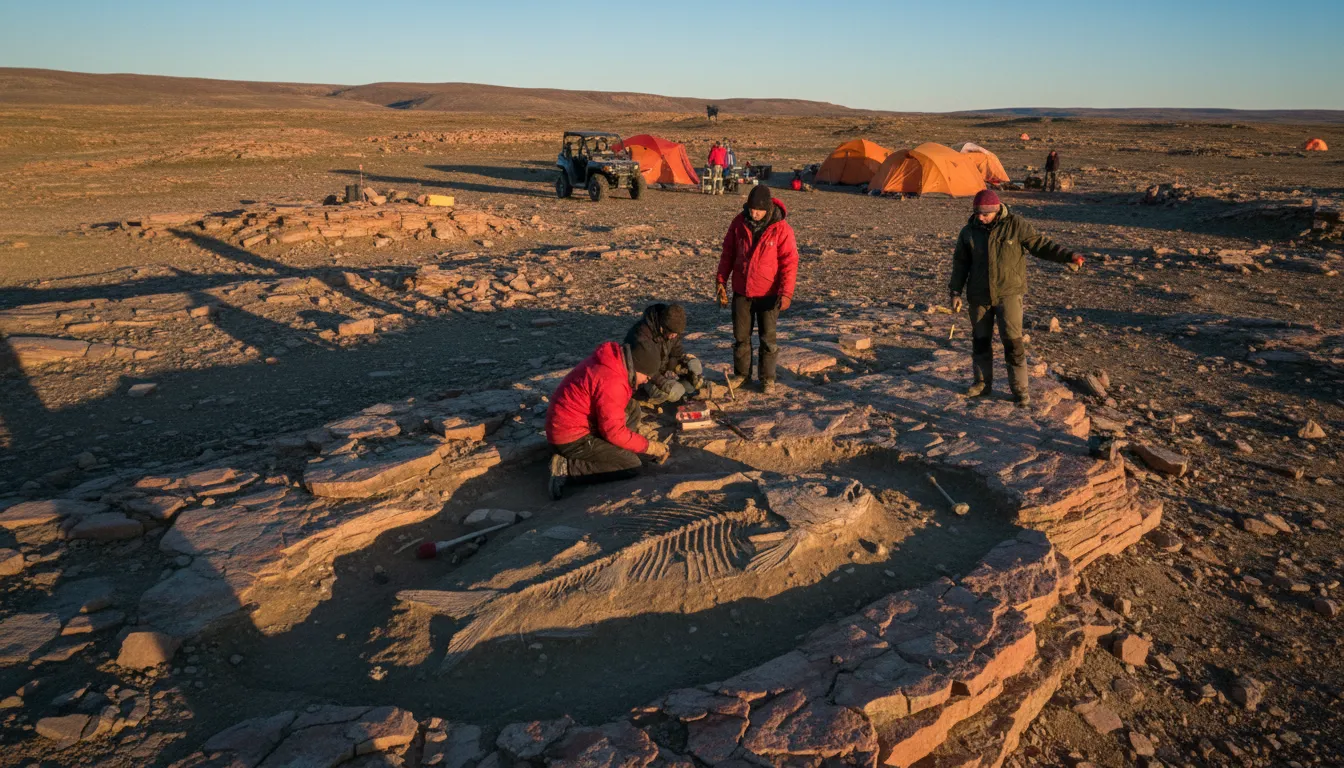
The most famous example of this transitional stage is Tiktaalik roseae, a 375-million-year-old fossil discovered in Arctic Canada. Tiktaalik had scales and gills like a fish, but also a flattened head, a flexible neck, and fins with sturdy interior bones that could bear weight — the precursors of forelimbs. UC Berkeley's evolution resource describes it as one of the most complete snapshots of the water-to-land transition ever found.
The University of Chicago has shown that Tiktaalik could both bite and use suction to capture prey — a hybrid feeding strategy that helped it thrive in shallow, vegetated waterways where fully aquatic fish could not easily maneuver.
Why the Transition Happened
Scientists believe several pressures drove fish toward land. Devonian shallow-water environments were frequently low in dissolved oxygen, making air-breathing a significant advantage. Dense aquatic vegetation created new ecological niches on and near shorelines. And dry land was, at that point, almost entirely free of large predators — a vast, unclaimed territory rich with insects and other invertebrates to eat.
Over millions of years, fins became limbs, gills gave way to lungs, and scales transformed into skin capable of surviving in open air. The result was the first true tetrapods — four-limbed vertebrates — whose descendants would eventually spread to every habitat on Earth.
Why It Matters Today
The bony fish lineage is not just ancient history. Roughly half of all living vertebrate species — by number — are ray-finned fish. Their lobe-finned cousins, though fewer in species count, include the coelacanth and lungfish: living relics that still carry anatomical echoes of the water-to-land transition. And tetrapods, ultimately descended from that same ancient split, account for every bird, reptile, amphibian, and mammal walking, flying, or swimming today.
New fossil finds like Eosteus chongqingensis continue to sharpen our understanding of exactly when and how these pivotal events unfolded — reminding us that our own bodies carry, in bone and blood, the legacy of a 436-million-year journey that began in a shallow Chinese sea.