What Are Lazarus Species and How Do They Survive?
Lazarus species are animals and plants once declared extinct that later turn up alive. Scientists explain why they vanish from the fossil record — and what their rediscovery means for conservation.
Back From the Dead
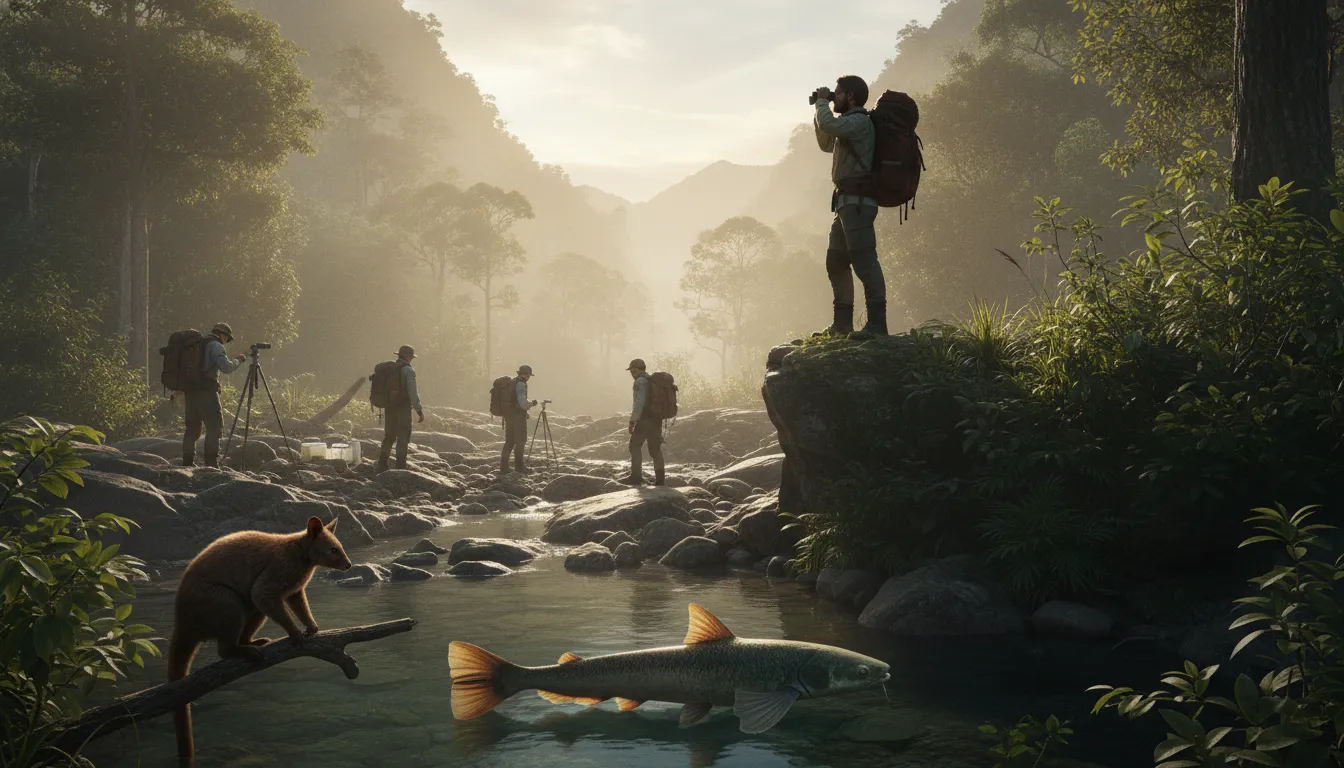
In the remote rainforests of New Guinea's Vogelkop Peninsula, scientists recently photographed two marsupials that the fossil record had marked as extinct for roughly 6,000 to 7,000 years. The pygmy long-fingered possum and the ring-tailed glider — both described in the Records of the Australian Museum in early 2026 — join a growing roster of so-called Lazarus species: organisms that reappear after being assumed gone forever.
"The discovery of two Lazarus species, thought to be extinct for millennia, is unprecedented," said Professor Tim Flannery of the Australian Museum, one of the lead researchers. The find was made possible in part by indigenous Elders from the Tambrauw and Maybrat clans, whose oral knowledge of local wildlife proved indispensable.
What Exactly Is a Lazarus Species?
The term Lazarus taxon — borrowed from the biblical figure raised from the dead — was coined by paleontologists to describe a species that disappears from the fossil or historical record for a significant stretch of time, then is found alive. The gap can range from decades to tens of millions of years.
Two distinct situations produce a Lazarus species:
- Fossil gap: The animal lived on but left no preserved remains during a certain period — bones simply were not deposited, or those that were have not yet been found.
- Presumed extinction: Scientists declared the species extinct based on surveys or historical records, but a surviving population was hiding in an overlooked or inaccessible habitat.
In both cases the creature was never actually gone — only invisible to science.
Famous Examples Through History
The Coelacanth — 66 Million Years of Silence
No Lazarus story is more dramatic than that of the coelacanth, a lobe-finned fish whose fossil record ends roughly 66 million years ago — the same mass extinction that wiped out non-avian dinosaurs. Scientists considered it a textbook example of ancient extinction. Then, in December 1938, a South African museum curator named Marjorie Courtenay-Latimer spotted a strange blue fish in a fisherman's catch off East London. It was a living coelacanth. A second population was later discovered near the Comoro Islands, and another off Sulawesi, Indonesia.
The Wollemi Pine — A Living Fossil
In 1994, a park ranger stumbled across a grove of trees in a remote gorge west of Sydney that turned out to be Wollemia nobilis, a conifer known only from fossils up to 200 million years old. Fewer than 100 adult trees exist in the wild, yet the species had survived ice ages and continental drift, concealed in a narrow sandstone canyon.
The Night Parrot and the Chacoan Peccary
Australia's night parrot (Pezoporus occidentalis) vanished from scientific records for nearly a century before a photographed specimen emerged in Queensland in 2013. Similarly, the Chacoan peccary — a pig-like mammal of South America — was known only from fossils before a living population was discovered in the Gran Chaco region of Paraguay in 1975, surprising zoologists who had placed it firmly in prehistory.
Why Do Species Disappear From the Record?
Preservation is capricious. Fossilization requires very specific conditions — rapid burial in sediment, the right chemistry, no scavengers. Even abundant species can go millions of years without leaving a trace. Rarity, nocturnal habits, dense vegetation, or extreme remoteness can all make an animal effectively invisible to human observers for generations.
Climate change and habitat shifts also play a role: a species retreating to a refugium — a small, stable pocket of suitable habitat — may survive in tiny numbers while disappearing from its former range entirely, erasing itself from the scientific radar.
Why Lazarus Species Matter for Conservation
Every rediscovery carries a double message. On one hand, it is cause for celebration: biodiversity is more resilient than we sometimes assume. On the other, it is a warning. Many Lazarus species cling to survival in single, fragile pockets of habitat. The ring-tailed glider discovered in New Guinea, for instance, raises only one young per year and forms lifelong pair bonds — making its population extremely vulnerable to deforestation.
Rediscoveries also sharpen the tools of conservation biology. They push researchers to invest in surveys of under-explored regions, build better ecological monitoring systems, and reconsider what "extinction" truly means before writing a species off. As Professor Kristofer Helgen of the Bishop Museum put it, the New Guinea find demonstrates that "the forests of New Guinea are among the most biologically rich and poorly known on Earth."
The Lesson: Absence of Evidence Is Not Evidence of Absence
Science's understanding of extinction is necessarily incomplete. Each time a Lazarus species surfaces — whether after 100 years or 66 million — it underscores a fundamental truth: the natural world is vast, complex, and full of secrets that patient, rigorous fieldwork can still uncover. For conservationists, that is both humbling and hopeful.


