What Are Superconductors and How Do They Work?
Superconductors carry electricity with zero resistance, enabling MRI scanners, maglev trains, and particle accelerators. Here is how they work and why a room-temperature version could change the world.
Electricity Without Waste
Every wire you plug into a socket wastes energy. Electrons collide with atoms as they flow, generating heat — that subtle warmth on a phone charger is a reminder of how inefficient ordinary conductors are. Superconductors are materials that eliminate that waste entirely: below a specific critical temperature, their electrical resistance drops to exactly zero. A current set flowing in a superconducting loop will circulate indefinitely, with no power source, losing not a single electron to heat.
This is not a theoretical approximation. It is a measurable physical fact, first observed by Dutch physicist Heike Kamerlingh Onnes in 1911 when he cooled mercury to 4 degrees above absolute zero and watched its resistance vanish. The discovery earned him a Nobel Prize — and opened one of the longest quests in modern physics.
Cooper Pairs: The Secret Behind Zero Resistance
For decades nobody understood why resistance disappeared. The answer came in 1957, when John Bardeen, Leon Cooper, and John Schrieffer published the BCS theory — named after their initials — and won a second Nobel Prize for physics.
In an ordinary metal, electrons travel alone and constantly collide with vibrating atoms in the crystal lattice, scattering energy as heat. In a superconductor, something counterintuitive happens: as one electron passes through the lattice, it slightly attracts the positively charged ions around it, creating a fleeting region of positive charge. That positive region then attracts a second electron. The two electrons become loosely bound into what physicists call a Cooper pair.
Cooper pairs behave very differently from lone electrons. They condense into a collective quantum state — a superfluid — that flows through the lattice as a single coherent wave rather than a chaotic crowd. Because the wave cannot scatter off individual atoms without breaking apart the entire condensate, resistance becomes impossible.
The Meissner Effect: Floating Magnets
Superconductivity has a second, visually striking property. When a superconducting material transitions below its critical temperature, it expels all magnetic fields from its interior — a phenomenon called the Meissner effect. Place a small magnet above a superconducting disc and the disc's perfectly expelled field pushes back, making the magnet hover in mid-air. This magnetic levitation is not a trick; it is a direct consequence of superconducting physics, and it is the principle behind Japan's SC Maglev train, which has hit speeds exceeding 600 km/h.
Where Superconductors Already Work
Despite requiring extreme cold, superconductors are embedded in technologies billions of people rely on daily:
- MRI scanners: More than 35,000 MRI machines worldwide use superconducting magnets — typically niobium-titanium wire bathed in liquid helium — to generate the powerful, stable magnetic fields needed for high-resolution imaging. Without superconductivity, an MRI machine would be neither affordable nor practical.
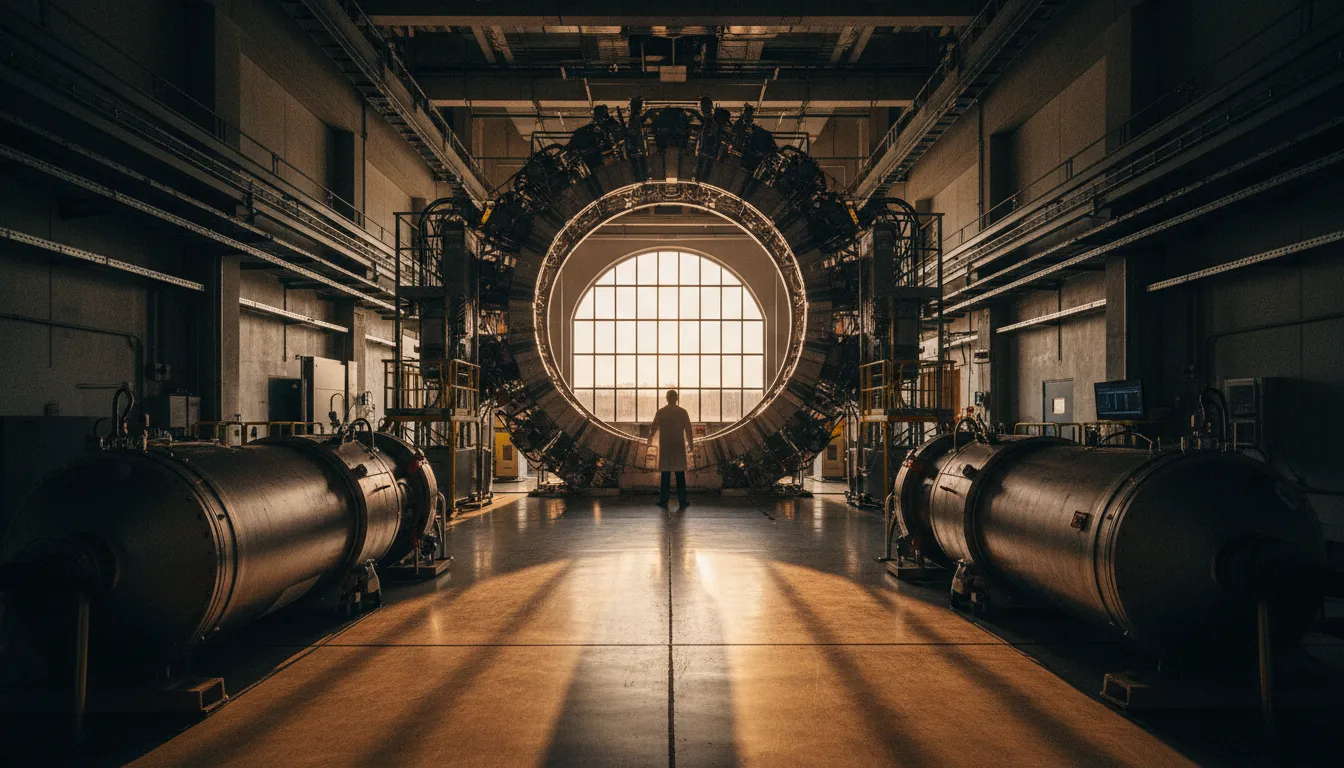
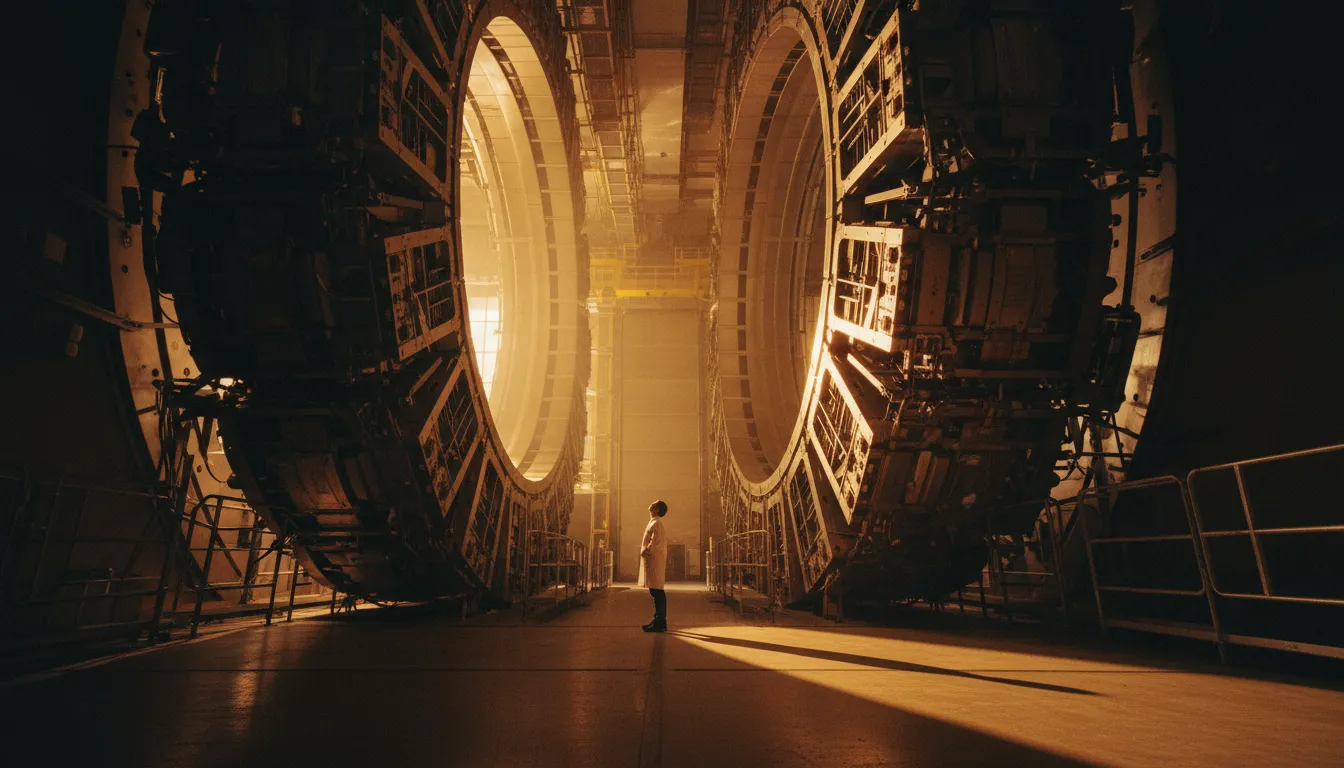
- Particle accelerators: CERN's Large Hadron Collider uses 1,232 superconducting dipole magnets, each generating fields over 100,000 times stronger than Earth's magnetic field. Without them, the LHC's 27-kilometre ring would need to be 120 kilometres long to reach the same particle energies.
- Power cables: Experimental superconducting cables can carry five times more electricity than conventional copper cables of the same diameter, with no transmission losses — a critical advantage for dense urban grids.
The Holy Grail: Superconductivity at Room Temperature
The central challenge is temperature. Conventional superconductors require cooling to within a few degrees of absolute zero (−273 °C), which demands expensive liquid helium infrastructure. Since the 1980s, a class of materials called cuprates — copper-oxide ceramics — have shown superconductivity at far higher temperatures, above 77 K (−196 °C), allowing cheaper liquid nitrogen cooling. But they remain brittle and difficult to manufacture into practical coils.
A true room-temperature superconductor, working at everyday pressures and temperatures, would be transformative: lossless national power grids, magnetically levitating freight, and faster computers drawing a fraction of today's energy. The search has produced dramatic claims — most notably the 2023 Korean material LK-99, which initially generated global excitement before independent labs could not replicate the results.
In early 2026, researchers at the Norwegian University of Science and Technology reported evidence that the alloy NbRe may behave as a triplet superconductor — a rarer type that can carry both electrical and spin currents without resistance, potentially useful for quantum computing. The finding, published in Physical Review Letters, must still be independently verified, but it illustrates how the field continues to advance.
Why It Matters
The U.S. Department of Energy estimates that roughly 10 percent of electricity generated in the United States is lost to resistance during transmission. Globally, that lost energy amounts to hundreds of billions of dollars and millions of tonnes of avoidable CO₂ every year. Superconducting power lines, even operating at cold temperatures, could eliminate much of that waste.
Over a century after Kamerlingh Onnes first cooled mercury in his Leiden laboratory, superconductivity remains one of physics' most productive frontiers — already indispensable in medicine and science, and still full of unrealized potential for the way the world moves and uses power.